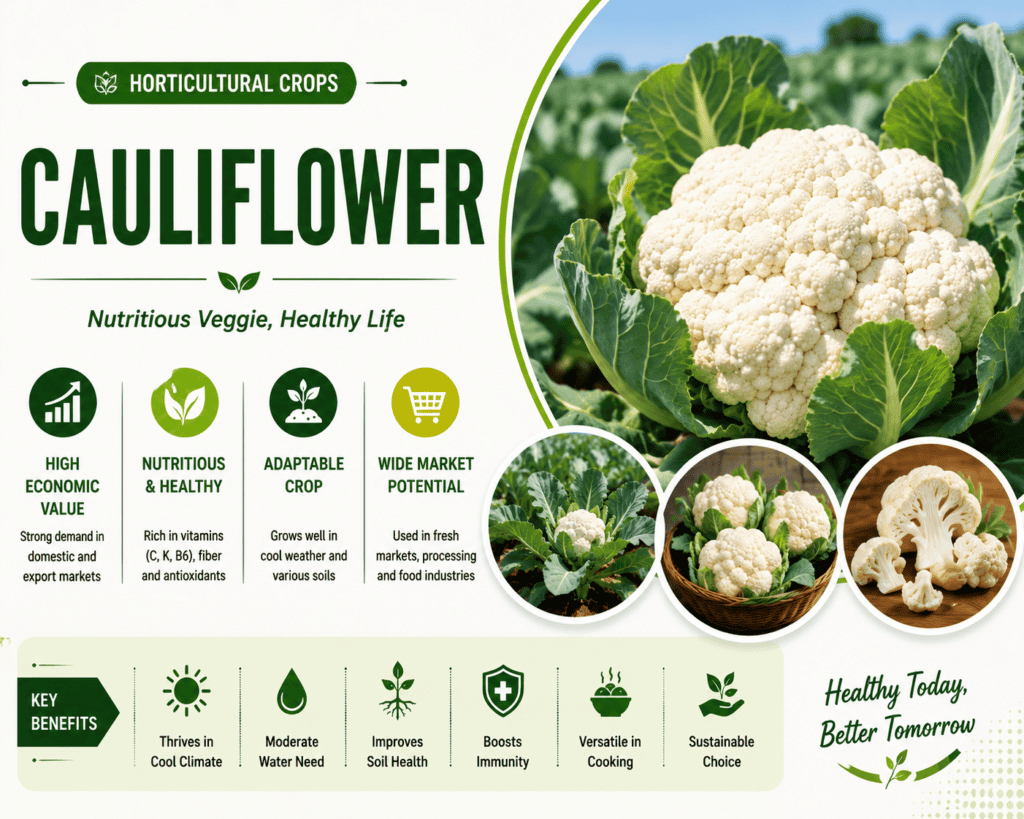
Cauliflower
Cauliflower
Understanding About Cauliflower
Nutritional Value of Cauliflower
- Rich in Vitamin C which helps in boosting immunity.
- Provides Vitamin K that supports bone health.
- High in dietary fiber aiding digestion and gut health.
- Contains powerful antioxidants that combat free radicals.
- Good source of B-vitamins like folate for brain development.
- Low in calories but nutrient-dense, ideal for a balanced diet.
- Helps in weight management as it is filling and light.
Role in Dietary Diversity
- Used in daily meals as a common vegetable.
- Can be cooked in multiple ways (boiling, frying, baking, soups).
- Consumed in both vegetarian and non-vegetarian diets.
- Plays an important role in Indian curries and global cuisines.
- Pickled and preserved in some regions for long-term use.
- Can replace rice or flour (mashed or powdered options).
- Promotes dietary diversity in both rural and urban households.
Economic Importance of Cauliflower
- High market demand in domestic and export markets.
- Provides farmers with good income during the winter season.
- Plays a significant role in vegetable-based industries.
- Acts as a cash crop for small and marginal farmers.
- Processing varieties are used for frozen and canned food products.
- Contributes to local employment in farming and market distribution.
- Encourages diversification beyond cereals like wheat and rice.
Role in Crop Rotation
- Excellent crop for crop rotation with cereals and legumes.
- Helps in breaking pest and disease cycles.
- Improves soil fertility when rotated with pulses.
- Maintains ecological balance in farming systems.
- Farmers can achieve higher overall productivity using rotations.
- Reduces risk of soil exhaustion caused by mono-cropping.
- Supports sustainable farming practices.
Climate Resilience of Cauliflower
- Grows well in cool-season climate.
- Tolerates low temperatures better than many vegetables.
- Resistant varieties available for climate change challenges.
- Can adapt to humid and temperate regions.
- Plays role in food security during winter months.
- Withstands light frost better than crops like tomatoes.
- Provides farmers with crop security even under variable climate.
Health Benefits of Cauliflower
- Supports heart health by lowering cholesterol.
- Improves liver function by detoxifying the body.
- Prevents constipation due to high fiber content.
- May reduce risk of cancer due to glucosinolates.
- Controls blood sugar levels, good for diabetics.
- Helpful in weight management for obese people.
- Boosts immunity and prevents seasonal infections.
Key Features of Cauliflower Cultivation
Climate and Soil Requirements
- Cool-season crop; optimum temperature: 15–20°C.
- High temperatures cause poor curd formation.
- Sensitive to extreme heat and frost damage.
- Best soil type: loamy soil rich in organic matter.
- Soil pH between 6.0 to 7.0 suitable.
- Requires well-drained soil to avoid root rots.
- Excess saline and alkaline soils are not suitable.
- Adequate moisture is essential for good curd growth.
- Early varieties need slightly higher temperatures than late ones.
- Uniform climate helps in compact white curd formation.
Land Preparation
- The field should be ploughed 3–4 times for fine tilth.
- Remove weeds, stones, and stubbles from the field.
- Prepare raised beds or ridges for good drainage.
- Incorporate farmyard manure or compost before sowing.
- Level the land for uniform irrigation.
- Deep ploughing ensures removal of soil pests.
- Add lime or gypsum if soil is too acidic/alkaline.
- Proper leveling prevents waterlogging.
- Prepare a nursery bed for seed raising.
- Mulching helps conserve soil moisture.
High-Yielding and Hybrid Seed Selection
- Choose certified and disease-free seeds.
- Hybrid seeds ensure higher yield and uniform curds.
- Select variety as per season (early, mid, late).
- Improved varieties: Pusa Snowball, Pant Gobhi, Hazipur Local.
- Hybrid types suitable for export purposes.
- Seeds should be selected based on climatic suitability.
- Late varieties have better storage quality.
- Early types mature in 60–80 days.
- Late varieties take 120–150 days.
- Seed cost is higher for hybrids but ensures more profit.
Seed Treatment
- Treat seeds with fungicide (Captan/Thiram @ 2g/kg).
- Bio-fungicides like Trichoderma for eco-safe protection.
- Treat with hot water at 50°C for 30 minutes.
- Seed priming helps in faster germination.
- Prevents seed-borne diseases like damping off.
- Use Rhizobacteria for improved soil health.
- Neem seed extract for bio-protection.
- Seed coating with micronutrients enhances vigor.
- Store treated seeds in cool and dry places.
- Always test germination percentage before sowing.
Sowing and Planting Methods
- Seeds are sown in nursery beds first.
- Transplant seedlings after 3–4 weeks.
- Maintain spacing: 45 x 45 cm for early, 60 x 60 cm for late varieties.
- Line sowing ensures better intercultural operations.
- Planting depth: cover seed lightly with soil.
- Water lightly after sowing.
- Staggered sowing helps in continuous supply.
- Direct sowing is not common, but possible in some regions.
- Avoid overcrowding to reduce disease spread.
- Proper spacing ensures good curd development.
Nutrient and Fertilizer Management
- Requires heavy manuring for healthy growth.
- Apply FYM @ 20–25 tons/ha during land prep.
- Apply N: P: K @ 120:80:60 kg/ha.
- Calcium is important for white curd formation.
- Apply Nitrogen in split doses for best effect.
- Foliar spray of micronutrients improves yield.
- Boron deficiency causes hollow stem; apply accordingly.
- Use bio-fertilizers to maintain soil fertility.
- Avoid excess nitrogen to prevent loose curds.
- Balanced nutrition ensures better quality produce.
Irrigation and Water Management
- Provide light irrigation immediately after sowing.
- Subsequent irrigation every 7–10 days.
- Critical stages: curd initiation and development.
- Avoid flood irrigation to prevent root decay.
- Use drip irrigation for water saving.
- Furrow irrigation is also suitable.
- Excessive moisture spoils crop quality.
- Protect from waterlogging during the rainy season.
- Ensure uniform supply of moisture.
- Mulching reduces evaporation losses.
Intercultural Operations
- Regular weeding and hoeing required.
- Mulching to conserve moisture and suppress weeds.
- Earthing-up around the plant base prevents lodging.
- Gap filling of missing seedlings required.
- Hand weeding at 20–25 days after planting.
- Hoeing improves soil aeration.
- Use pre-emergence herbicides like Pendimethalin for weed control.
- Remove diseased plants immediately.
- Maintain plant spacing.
- Keep nursery weed-free for healthy seedlings.
Pest Management
- Common pests: aphids, diamondback moth, cutworms, cabbage butterfly.
- Spray neem oil for eco-friendly pest control.
- Use pheromone traps for moth insects.
- Release biocontrol agents like Trichogramma.
- Spray insecticides at recommended doses.
- Avoid indiscriminate use of chemicals.
- Intercropping with onion/garlic helps deter pests.
- Handpicking of caterpillars is effective at an early stage.
- Regular field inspection needed.
- Rotation with non-cruciferous crops lowers infestation.
Disease Management
- Common diseases: damping off, black rot, downy mildew, club root.
- Use disease-resistant varieties.
- Apply Trichoderma in the soil for fungal protection.
- Copper oxychloride spray against downy mildew.
- Seed treatment essential to prevent seed-borne pathogens.
- Destroy crop residues to stop re-infection.
- Maintain field sanitation.
- Ensure proper drainage to avoid club root.
- Crop rotation breaks disease cycles.
- Biological fungicides are safer than chemicals.
Harvesting and Post-Harvest Management
- Harvest when curds are compact, white, and firm.
- Early varieties ready in 60–80 days; late ones in 120–150 days.
- Harvest before curds turn yellowish/loose.
- Cut with a sharp knife along with 2–3 leaves for protection.
- Handle carefully to avoid bruising.
- Pack in bamboo baskets or crates.
- Store at 0–4°C with 90–95% humidity for longer shelf life.
- Can be stored for 2–3 weeks in cold storage.
- Sort and grade before marketing.
- Transport carefully to avoid damage.
Do’s
Don'ts
What is the best way to store cauliflower at home?
Cauliflower should be kept in a cool and dry place. Store it in a perforated plastic bag inside the refrigerator. This helps preserve freshness for about a week. Avoid washing before storage to prevent moisture spoilage.
Can cauliflower be eaten raw?
Yes, cauliflower can be eaten raw in salads or as a healthy snack. It is crunchy and rich in vitamins when uncooked. However, people with a sensitive stomach may prefer light cooking for easier digestion.
Is cauliflower good for weight loss?
Cauliflower is very low in calories but high in fiber, making it an excellent food for weight loss. It keeps you full for longer and reduces the need for frequent snacking. Many people even use cauliflower rice as a replacement for regular rice.
Why does cauliflower sometimes turn brown or yellow?
Cauliflower turns brown or yellow mainly due to over-maturity, sun exposure, or improper storage. It is still safe to eat, but the taste and texture may not be as good. Covering curds with leaves can keep cauliflower white and fresh.
Are there any side effects of eating cauliflower?
For most people, cauliflower is very healthy. But in some cases, it may cause gas or bloating because it has complex carbohydrates. People with thyroid issues should eat cauliflower in moderation as it contains goitrogens.
How can cauliflower be used apart from cooking as a vegetable?
Cauliflower is used for making soups, pickles, and snacks. It can also be turned into flour or rice as a healthy alternative for those avoiding grains. In some regions, cauliflower leaves are also cooked and consumed.
Why is cauliflower called a winter crop?
Cauliflower is called a winter crop because it grows best in cool climates. It needs mild temperatures for proper curd development. Hot weather usually reduces its quality and yield.
What makes cauliflower different from cabbage?
Cauliflower grows a large edible white curd, while cabbage forms leafy heads. Both belong to the same family but taste and use are quite different. Cauliflower also has more versatile cooking uses compared to cabbage.
Is cauliflower suitable for people with diabetes?
Yes, cauliflower is highly recommended for diabetics. It has a low glycemic index, which means it does not raise blood sugar quickly. Its high fiber also supports blood sugar management.
Can cauliflower be frozen for later use?
Yes, cauliflower can be frozen to extend its shelf life. Just blanch the florets in hot water for a few minutes, cool them, and then freeze. Frozen cauliflower stays fresh for months.
Does cauliflower have leaves that can be eaten?
Yes, cauliflower leaves are edible and very nutritious. They contain vitamins and minerals similar to spinach. Many farmers and households use them in soups, curries, or as green leafy vegetables.
How does cauliflower help in a healthy diet?
Cauliflower is rich in fiber, vitamins, and antioxidants, making it a powerful addition to a daily diet. It supports digestion, immunity, and overall health. Regular use of cauliflower can help prevent many lifestyle diseases.