Cardamom
Cardamom
Understanding About Cardamom
Nutritional Value
- Cardamom is rich in essential micronutrients like manganese, iron, magnesium, zinc, and vitamins A and C.
- Contains natural oils and antioxidants that support immunity.
- Provides dietary fiber which aids in digestion and reduces constipation.
- Packed with natural phytochemicals that fight inflammation.
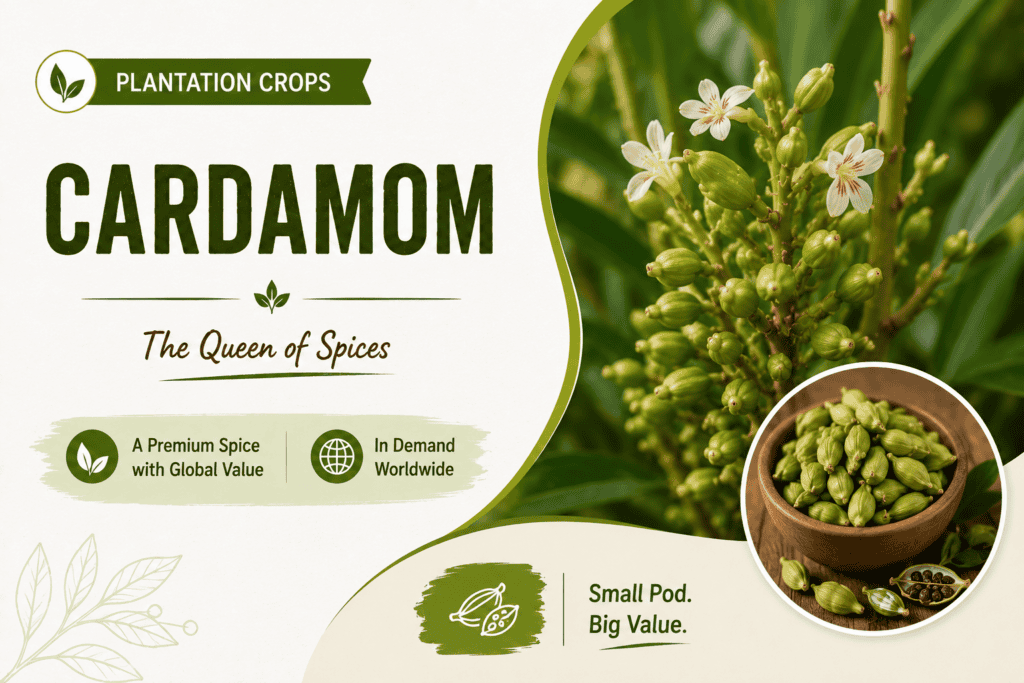
- Known as the “Queen of Spices” due to medicinal richness.
- Small quantity consumption adds major flavor and nutrition to food.
Dietary Diversity
- Cardamom is widely used in curries, rice, tea, sweets, cookies, and traditional medicine.
- Popular in both Indian and Middle Eastern cuisines.
- Used as a mouth freshener and digestive aid.
- Helps in balancing the doshas in Ayurveda (Vata, Pitta, Kapha).
- Adds fragrance and taste, making it versatile in diets.
- Can be consumed raw, powdered, or in essential oil form.
Economic Importance
- Cardamom is a major cash crop that provides income to farmers in Kerala, Karnataka, and Tamil Nadu.
- India, Guatemala, and Sri Lanka are the largest cardamom producers.
- High demand globally in food, beverage, and pharmaceutical industries.
- Brings foreign exchange due to large-scale exports.
- Regularly used in traditional medicines, increasing demand.
- Improves rural economy and provides employment in farm operations.
Crop Rotation
- Cardamom is often intercropped with coffee, pepper, banana, and orange.
- Improves soil fertility when rotated with legumes and shade crops.
- Prevents soil exhaustion and maintains ecological balance.
- Reduces pest and disease infestations compared to monocropping.
- Shade trees play a vital role in sustainable cardamom farming.
- Helps farmers diversify income sources.
Climate Resilience
- Cardamom grows well under humid, tropical conditions.
- Requires 1500–4000 mm rainfall annually, spread throughout the year.
- Shade helps cardamom withstand extreme sunlight and moisture loss.
- Evergreen forests naturally protect the crop from climate variations.
- Performs better in cooler microclimates of Western Ghats.
- Adaptive to mixed-cropping systems, making it climate-resilient.
Health Benefits
- Improves digestion and reduces acidity.
- Natural mouth freshener, reduces bad breath.
- Known to control blood pressure and improve heart health.
- Helps in detoxifying the body and flushing out toxins.
- Used for treating cough, cold, and respiratory problems.
- Helps in weight loss by boosting metabolism.
Key Features of Cardamom Cultivation
Climate and Soil Requirements
- Grows in tropical, humid climates.
- Requires temperature range: 10–35°C.
- Needs 1500–4000 mm annual rainfall.
- Cultivated in evergreen forest regions under shade.
- Altitude: 600–1500 meters above sea level.
- Soil: Well-drained loamy or laterite soils rich in humus.
- Soil pH: 5.5–6.5 (slightly acidic).
- Avoid waterlogging as it damages roots.
- The shade of native forest trees is essential for survival.
- Drought-prone zones not suitable for cardamom.
- High humidity ensures better flowering and fruit set.
- Soil moisture conservation techniques must be applied.
- Organic matter improves yield drastically.
- Cardamom thrives in valleys and gentle slopes.
Land Preparation
- Select shaded lands in hilly areas.
- Clear weeds, shrubs, and bushes.
- Maintain at least 50% shade through forest trees.
- Prepare contour terraces on slopes.
- Provide drainage channels to avoid water stagnation.
- Dig pits of 45×45×30 cm for planting rhizomes.
- Fill pits with compost and topsoil mixture.
- Conservation bunds reduce soil erosion.
- Mulching helps maintain soil moisture and fertility.
- Fencing protects crops from wild animals.
- Maintain biodiversity with mixed plantations.
- Land preparation must be done before monsoon.
- Nurseries to be set up with healthy seedlings.
- Optimum spacing: 1.8 × 1.8 m or as per variety.
- Planting material sourced from high-yielding mother plants.
High-Yielding and Hybrid Seed Selection
- Choose varieties recommended for your region: Malabar, Mysore, Vazhukka types.
- Hybrid types selected based on disease resistance and productivity.
- Seeds collected from 5–6-year-old healthy plants.
- Prefer vegetative propagation (suckers) for true-to-type crops.
- Certified nurseries ensure disease-free seedlings.
- Plant tissue-culture methods are gaining popularity.
- Select bold capsules for seed extraction.
- Hybrid seeds ensure enhanced flavor and oil content.
- High-yielding types give 4–5 times more yield.
- Improved plant types mature early.
- Resistance to thrips and capsule rot must be prioritized.
- Productivity depends on genetic purity.
- Avoid using mixed or poor-quality planting material.
- Cooperative societies provide quality planting stock.
- Proper seed selection determines long-term success.
Seed Treatment
- Treat seeds with Trichoderma or carbendazim against fungal attacks.
- Hot water treatment improves germination.
- Apply bio-fungicides before nursery planting.
- Organic slurry enhances root development.
- Prevents capsule rot at early stages.
- Use Pseudomonas culture for disease management.
- Boosts seedling vigor and early growth.
- Healthy seeds ensure uniform field establishment.
- Protects against rhizome diseases.
- Nursery treated plants survive better when transplanted.
Sowing and Planting Methods
- Planting season: May–June (onset of monsoon).
- Rhizomes or seedlings planted in prepared pits.
- Shade regulation is must during sowing.
- Maintain spacing for aeration and sunlight control.
- Direct sowing avoided; nursery-raised seedlings perform better.
- Contour planting prevents erosion.
- Mulching helps retain soil moisture.
- Gaps filled with new seedlings within the first year.
- Ensure protective irrigation during dry spells.
- Mixed cropping with black pepper or coffee is common.
- A healthy root system ensures faster growth.
- Early weed control is mandatory in plantations.
Nutrient and Fertilizer Management
- Apply compost/FYM @ 5–10 kg per pit.
- NPK ratio generally recommended: 75:75:150 kg/ha.
- Split doses during monsoon are preferred.
- Organic manures enhance soil fertility.
- Farmyard manure reduces dependency on chemicals.
- Neem cake helps control root grubs.
- Apply micronutrients like zinc and boron.
- Mulching conserves nutrients naturally.
- Vermicompost improves sustainability.
- Foliar sprays boost metabolic activity.
- Balanced fertilization = higher yield.
- Green manuring enhances soil health.
- Every year replenish organic matter in soil.
Irrigation and Water Management
- Requires evenly distributed rainfall.
- During dry spells, supplemental irrigation is essential.
- Drip irrigation increases water efficiency.
- Mulching prevents water loss.
- Avoid flood irrigation as it damages roots.
- Construct contour drains for better water management.
- Provide 2–3 irrigations during summer.
- Maintain shade to reduce evaporation.
- Regular moisture supply results in better capsule filling.
- Micro-irrigation systems best suited.
- Rainwater harvesting structures benefit plantations.
Intercultural Operations
- Regular weeding for reducing competition.
- Shade regulation done annually.
- Pruning of shade trees ensures filtered sunlight.
- Mulching controls weeds + conserves moisture.
- Earthing-up supports weak plants.
- Thinning of plants ensures aeration.
- Mixed cropping improves profitability.
- Removal of old stalks keeps plantations healthy.
- Training workers in shade management is necessary.
- Farm sanitation prevents pest buildup.
Pest Management
- Major pests: thrips, root grub, shoot borer, aphids.
- Biological controls: release of predators, bio-pesticides.
- Neem oil spray reduces sucking pests.
- Mechanical removal of infected shoots.
- Regular monitoring of plantations.
- Grow pest-resistant varieties if available.
- Avoid overuse of chemicals.
- Maintain shade regulation to reduce thrips infestation.
- Apply pheromone traps.
- Adopt Integrated Pest Management (IPM) system.
Disease Management
- Major diseases: capsule rot, rhizome rot, leaf spot.
- Fungicidal spray during monsoon reduces spread.
- Trichoderma bio-fungicides encouraged.
- Shade regulation lowers fungal infection.
- Mulching prevents soil-borne pathogens.
- Remove and destroy infected plants.
- Adequate spacing lowers disease incidence.
- Prophylactic copper oxychloride sprays are helpful.
- Good drainage prevents waterborne diseases.
- Rotate crops with non-host species periodically.
Harvesting and Post-Harvest Management
- Harvest season: October–February.
- Harvest mature capsules just before splitting.
- Handpicking is preferred to retain quality.
- Capsules dried in curing ovens or under sunlight.
- Proper curing develops aroma and green color.
- Graded based on size, color, aroma.
- Stored in moisture-free, airtight bags.
- Packed for domestic and export markets.
- Capsules may be processed into oil and oleoresin.
- Timely harvesting ensures maximum flavor retention.
Do’s
Don'ts
What is cardamom mainly used for in daily life?
Cardamom is widely used as a spice in tea, sweets, and curries. It is also used as a mouth freshener and in natural remedies for cough and digestion. Its strong aroma makes it popular in both food and medicine.
How should cardamom be stored at home?
Cardamom should be stored in airtight glass or steel containers. Keep it in a cool, dry place away from direct sunlight. Proper storage helps preserve its green color, aroma, and medicinal properties for months.
Is cardamom safe to eat daily?
Yes, small amounts of cardamom can be safely eaten every day. It refreshes the mouth, supports digestion, and keeps the body energetic. However, eating too much at once may cause stomach irritation in some people.
Why is cardamom called the "Queen of Spices"?
Cardamom is called the “Queen of Spices” because of its rich flavor, fragrance, and health value. It is one of the most expensive spices and adds high quality to food, tea, sweets, and medicines.
Can cardamom help with bad breath?
Yes, chewing raw cardamom seeds naturally removes bad breath. Its essential oils have antibacterial properties that keep the mouth fresh and clean. That’s why it is a common ingredient in natural mouth fresheners.
Does cardamom have any side effects?
Cardamom is generally safe, but excessive use may cause acidity, nausea, or gallbladder issues in rare cases. People with gallstones should consult a doctor before consuming large amounts of cardamom.
Which country produces the most cardamom?
India and Guatemala are the top producers of cardamom. In India, Kerala, Karnataka, and Tamil Nadu are known for high-quality cardamom farming. These regions grow cardamom in shaded forests with humid climates.
How is cardamom used in traditional medicine?
In Ayurveda and Unani medicine, cardamom is used to treat cough, indigestion, and urinary problems. Its essential oils are valued for calming the nerves and improving appetite naturally.
What is the difference between green cardamom and black cardamom?
Green cardamom is smaller, sweet, and used in desserts and tea. Black cardamom is larger, smoky in flavor, and mostly used in curries and meat dishes. Both types of cardamom have their own unique uses.
Is cardamom expensive and why?
Yes, cardamom is one of the costliest spices because it grows only in specific climates and requires heavy care. Harvesting is done by hand, which makes cardamom labor-intensive and costly in the market.
Can cardamom be grown in pots at home?
Yes, cardamom can be grown at home if proper shade, moisture, and rich soil are provided. However, it usually takes 2–3 years to bear pods. Cardamom grows best in natural forest-like conditions.
How is cardamom processed before reaching markets?
Fresh cardamom pods are harvested, cured by drying, and graded by size and color. After proper storage, they are packed for sale in spice markets and exported worldwide. Processing ensures quality and long shelf life.