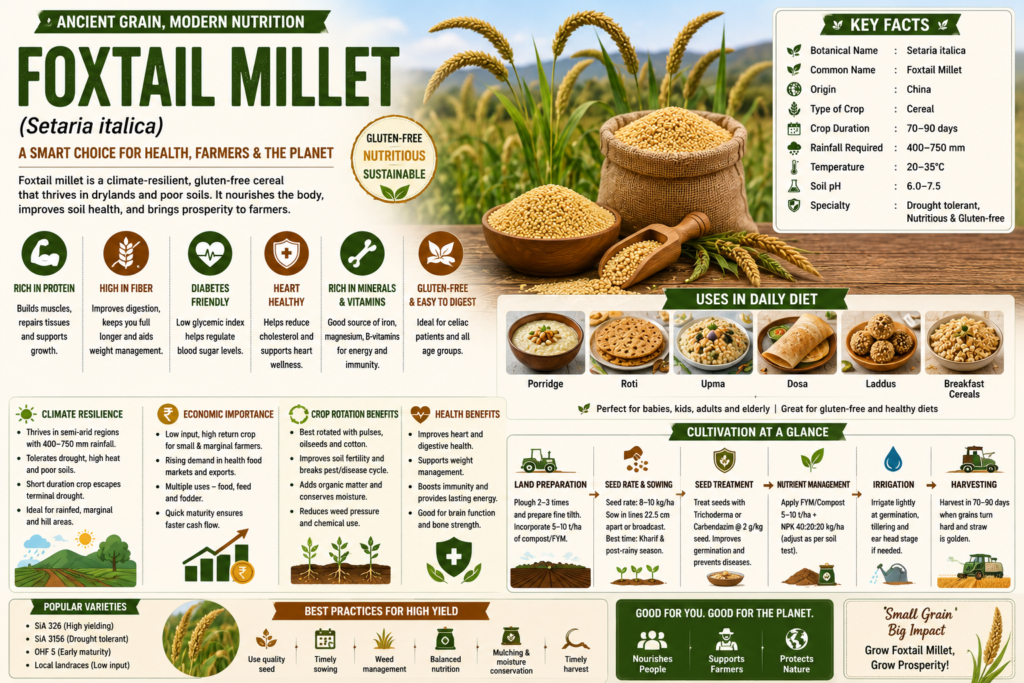
Foxtail Millet
Foxtail Millet

Understanding About Crop
Nutritional Value:
- Foxtail millet is rich in protein, dietary fiber, iron, magnesium, and complex carbohydrates, giving slow-releasing energy and supporting muscle, bone, and heart health.
- It is gluten-free and easily digestible, making it suitable for people with gluten intolerance or celiac disease.
- Contains antioxidants, vitamins B1 and B3, and minerals that boost immunity and metabolic activity.
- The low glycemic index makes it great for diabetes control and balanced diets.
- Improves satiety and weight management due to its high fiber and protein content.
- Regular consumption helps regulate cholesterol and maintain healthy blood sugar.
- Excess intake in rare cases may cause mild bloating or digestive discomfort, so moderate use is best.
Dietary Diversity:
- Used to prepare traditional dishes like rotis, porridge, upma, dosa, and khichdi, or replace rice in daily meals.
- Foxtail millet flour is popular for gluten-free baking and snacks.
- Puffed or popped millet is enjoyed as a healthy snack by kids and adults.
- Ready-to-eat mixes, breakfast cereals, and even millet noodles ar e now available.
- The grain is used in baby foods, laddus, health mixes, and local sweets.
- Straw can be used as animal feed or mulch.
- Its mild flavor pairs well with both sweet and savory dishes for all ages.
Economic Importance:
- A profitable crop for small farmers due to low input needs and high drought tolerance, fitting well in dry regions.
- Provides steady income in areas unsuitable for wheat and paddy, often as a backup or primary cereal.
- All about agriculture offers price updates, value-add tips, and millet market news to growers.
- Processing industries (flour, ready-to-cook) and animal husbandry use millet and its by-products.
- Export demand is rising among health-conscious consumers worldwide for ancient grains.
- Serves as a feed, food, and fodder crop, diversifying farm income.
- Local trade networks in rural areas help faster cash flow for growers.
Crop Rotation:
- Foxtail millet is widely grown after pulses or oilseeds to restore soil fertility and nitrogen balance.
- Diversifies cropping systems in rainfed and drylands, mixed with groundnut, pigeon pea, or cotton.
- Breaks disease and pest cycles, minimizing buildup in continuous mono-cropping.
- Rotation with green manure or legumes adds organic matter, improves moisture conservation and yields.
- Ensures the efficient use of marginal lands and barrens.
- Multicropping supports soil health, farm resilience, and family nutrition.
- Long-term rotations help reduce fertilizer and pesticide needs.
Climate Resilience:
- A very tough crop – grows in semi-arid tropics with just 400–750 mm of rainfall and temperature of 20–35°C.
- Withstands drought, dry spells, and high heat better than many cereals.
- It grows from plains to hills (up to 2,000 meters elevation) as long as drainage is good.
- Improved and local varieties available for different rainfall and soils.
- Mulching and intercropping further improve water use and lower stress during dry years.
- It matures quickly (70–90 days), escaping severe weather when needed.
- Suitable for climate-smart and water-limited farming zones.
Health Benefits:
- Supports heart and digestive health due to fiber, low fat, and cholesterol-lowering effects.
- Minerals and B vitamins boost brain function and strengthen bones.
- Low GI makes it ideal for managing diabetes or aiding weight reduction diets.
- Gluten-free for people with celiac, ideal for daily meals and snacks.
- Antioxidants support immunity, anti-aging, and inflammation reduction.
- Can be eaten daily as a replacement for rice/wheat; safe for kids and elderly.
- Some people may feel mild digestive discomfort if over-eaten for the first time, so introduce gradually.
Key Features
Climate and Soil Requirements
- Foxtail millet grows in tropical and temperate regions with 20–35°C temperature and 400–750 mm annual rainfall.
- Thrives in well-drained sandy loam, loam, or red soils with pH 6.0–7.5; avoids waterlogged, saline, or heavy clay land.
- Tolerates acidic soils, but best results with moderate organic content and good aeration.
- Drought-tolerant; survives with minimum irrigation, making it ideal for dry areas.
- Needs open sun, but can also grow in light partial shade.
- Previous green manure crops help improve soil structure and yield.
- Mulching keeps roots cool, improves moisture, and reduces weeds in hot seasons.
- Land should have gentle slopes for drainage, avoiding flat low-lying areas prone to flooding.
- Soil testing for nutrients before sowing is advised for precise fertilizer planning.
Land Preparation
- Plough 2–3 times, harrow, and make fine tilth for quick root establishment and weed control.
- Remove field stones, old crop stubble, and deep-rooted weeds for smooth growth.
- Incorporate 5–10 tons/ha of compost or well-rotted manure before sowing.
- Beds, flat plots, or broad ridges may be used depending on local rainfall and slope.
- Level land for even sowing and easy irrigation or moisture conservation.
- Create boundary bunds and drainage channels as needed in heavy rainfall zones.
- Pre-irrigate if sowing is planned off-monsoon.
- Keep plots weed-free till crop establishment for best tillering.
- Maintain easy-access paths for operations and monitoring.
High-Yielding and Hybrid Seed Selection
- Use certified, healthy, and pure-stand seeds from improved or recommended varieties like SiA 326, SiA 3156, or local releases.
- Ensure seeds are small, shiny, plump, and free from disease, pests, or dust.
- Hybrid and short-duration types are good for dryland, while traditional varieties suit low-input and hilly areas.
- Avoid using self-saved seed for several years – risk of mixing and disease.
- Buy seed from government outlets or reliable suppliers for genetic quality and traceability.
- Seed rate is generally 8–10 kg/ha for broadcast and 5 kg/ha for line sowing.
- Store seeds in airtight, dry containers till use.
- Always check germination percentage with a simple pre-sowing test.
- Keep a field record for variety, batch, and source for better management.
Seed Treatment
- Treat seeds with fungicides (thiram, bavistin) or biocontrol like Trichoderma to prevent root rot, smut, mildew.
- Optional: soak for 6 hours, sun-dry, and coat with micronutrient (zinc, boron) for poor soils before sowing.
- For organic farming, use cow urine, neem extract, or biofertilizer dips as natural seed protectants.
- Label and separate batches to track treated and untreated seeds.
- Do not store treated seed with food grain for household safety.
- Air-dry briefly after treatment if the seed feels wet.
- Clean and disinfect all sowing and handling tools for disease control.
- Use fresh solutions for every batch to maintain efficacy.
- Dispose leftover treated seed and wrappers safely.
Sowing and Planting Methods
- Broadcast or line-sow at monsoon onset; 22–30 cm row spacing and 5–10 cm between plants ideal for best yield.
- Seeds sown 2–3 cm deep, covered with loose soil; avoid deep sowing or waterlogged beds for uniform germination.
- In heavy soils, sow on ridges or raised beds for better drainage.
- Fill gaps within 10–15 days of emergence to maintain an even stand.
- Direct seeding is common, but transplanting is possible in some irrigated fields for very early crops.
- Mulch lightly after sowing to preserve moisture and control weed flush.
- Intercropping with short pulses, legumes or green manure improves yield and soil nutrition.
- Staggered sowing over two weeks may help spread risk in erratic rains.
- Mark planting date, seed batch, and layout for good management.
Nutrient and Fertilizer Management
- Basic dose: 40–60 kg N, 20–30 kg P2O5, 20–25 kg K2O per hectare, with 8–10 tons/ha compost or FYM at land prep.
- Split N dose: half at sowing, rest at tillering/booting; P and K all basal at sowing.
- Supplement with micronutrients (Zn and Fe) in low-nutrient soils using granules or foliar spray.
- Use biofertilizers and green manure crops to improve soil life and organic content.
- Avoid excess fertilizer, especially N, in rainfed and low-yield potential lands.
- Fertilizer placement: 4–5 cm away from seeds to avoid injury and burning.
- Mulching and cropping residues add natural nutrients back to the soil.
- Keep fertilizer and application records for analysis and improvements.
- Foliar nutrition or micronutrient spray can recover crops at an early deficiency stage.
Irrigation and Water Management
- Needs little irrigation – one or two life-saving irrigations during prolonged dry spells is usually enough.
- First irrigation at tillering, second at panicle initiation improves yields in dryland.
- Avoid frequent, heavy irrigation – can lead to root disease and lodging.
- Check soil moisture by hand or with a probe before watering.
- Use farm ponds or rainwater harvesting for life-saving irrigation in severe droughts.
- Field bunding, mulching, and organic matter conserve soil moisture in rainfed areas.
- Good surface drainage is crucial – remove standing water after heavy rains quickly.
- Avoid overhead irrigation that increases leaf wetness and disease risk.
- Monitor irrigation pipelines for leaks, cleaning them each season before use.
Intercultural Operations
- Keep field weed-free for the first 30–40 days by manual or shallow mechanical weeding.
- Thin seedlings in line-sown plots to 8–10 cm spacing for robust growth.
- Hoe gently to loosen soil surface, enhancing aeration and root development.
- Mulching after weeding deters weed flush and retains moisture.
- Remove and compost dry leaves, stems, and weed trash after each operation.
- Light harrowing or inter-cultivation helps manage difficult weeds in larger fields.
- Intercrop with pulses or greens for diversification and soil improvement.
- Practice clean, safe handling to avoid crop damage during weeding.
- Monitor for pests and early signs of nutrient deficiency during each field round.
Pest Management
- Main pests: stem borer, shoot fly, armyworms, grasshoppers, and aphids.
- Regular scouting and use of pheromone traps, light traps, or hand picking for major pests.
- Neem-based sprays and biopesticides control basic pest infestations organically.
- Avoid indiscriminate chemical sprays to protect beneficial insects and soil health.
- Crop rotation and clean field hygiene disrupt pest cycles.
- Prompt burning or removal of pest-damaged crops/parts prevents spread.
- Pest-resistant varieties are available in some regions.
- Rotate pesticide classes if chemical sprays are needed as a last resort.
- Teach workers about safe pest management and thresholds.
Disease Management
- Key diseases: rust, downy mildew, smut, and blast.
- Certified disease-free seed and crop rotation prevent early disease build up.
- Remove and bury or burn infected patches quickly.
- Early use of bio-fungicides or recommended sprays can limit outbreaks.
- Avoid dense sowing and maintain proper field airflow for leaf drying.
- Good drainage after rain prevents fungal root diseases.
- Record every outbreak, symptoms, and actions taken for next crop improvement.
- Train workers in early detection and hygiene using boots/gloves.
- Rotate or alter chemicals as per advice; never over-spray or over-dose.
Harvesting and Post-Harvest Management
- Harvest when panicles turn golden yellow and seeds are hard – usually 70–90 days after sowing.
- Cut just above the ground and dry panicles in the sun for 3–5 days before threshing gently or beating.
- Clean and winnow grain thoroughly for storage or market.
- Store clean, sun-dried millet in airtight bins in cool, dry, pest-free places.
- Separate straw for animal feed, compost, or field mulch.
- Process surplus into flour, flakes, or ready mixes for higher value.
- Clean tools and areas after every batch to prevent carry-over of pests/diseases.
- Market promptly for best price; avoid long storage in humid conditions.
- Keep records on yield, loss, and price for next year’s decision making.
Other Important Points
- Foxtail millet is ideal for rainfed, dryland, and resource-poor farms seeking strong returns.
- It suits gluten-free, high-protein, and diabetic diets across age groups.
- Gradual dietary introduction ensures good tolerance and maximum health benefit.
- Visit All about agriculture for latest seed releases, market news, and climate-special millet farming updates.
Do’s
Don'ts
Can foxtail millet be grown without chemical fertilizers?
Yes, foxtail millet can be cultivated using organic compost, green manures, and biofertilizers, making it a good choice for natural and organic farming.
What are some easy recipes using foxtail millet?
Foxtail millet can be cooked as porridge, pulao, upma, and even used in baking bread or preparing millet pancakes for healthy meals.
Is foxtail millet suitable for babies and the elderly?
Yes, foxtail millet is soft, easy to digest, and rich in nutrients, making it safe for children and older people when cooked properly.
How should foxtail millet be stored after purchase?
Store dry, clean millet in airtight containers kept in a cool, dry place to protect from pests and keep it fresh for a long time.
Does foxtail millet help with weight management?
Because it’s high in fiber and protein, foxtail millet keeps you fuller for longer, aiding in natural weight control and supporting a healthy diet.
Are there specific weeds that affect foxtail millet fields?
Yes, common weeds like crabgrass and nutgrass can affect fields, so regular weeding is important for maintaining healthy millet crops.
How can farmers add value to their foxtail millet harvests?
Processing millet into flour, flakes, and ready-to-cook mixes helps farmers reach more markets and increase their profits.
What are the export opportunities for foxtail millet?
There is growing international demand for foxtail millet, especially as a gluten-free, healthy grain in Europe, America, and Middle Eastern countries.
Can foxtail millet be grown in kitchen gardens or pots?
Yes, foxtail millet’s hardy nature allows it to grow in small kitchen gardens or even large pots, given sunlight and regular watering.
Does eating foxtail millet have any side effects?
Foxtail millet is safe for most people, but for some, eating too much for the first time may cause mild digestive upset; start with small servings.
Is foxtail millet safe for people with diabetes?
Yes, foxtail millet has a low glycemic index, making it a recommended choice for blood sugar control and diabetic diets.
Where can I find market prices and farming updates for foxtail millet?
You will get the information about this on our website All about agriculture, where you can track prices, seed varieties, and new farming techniques.