Oats
Oats

Understanding About Crop
Nutritional Value:
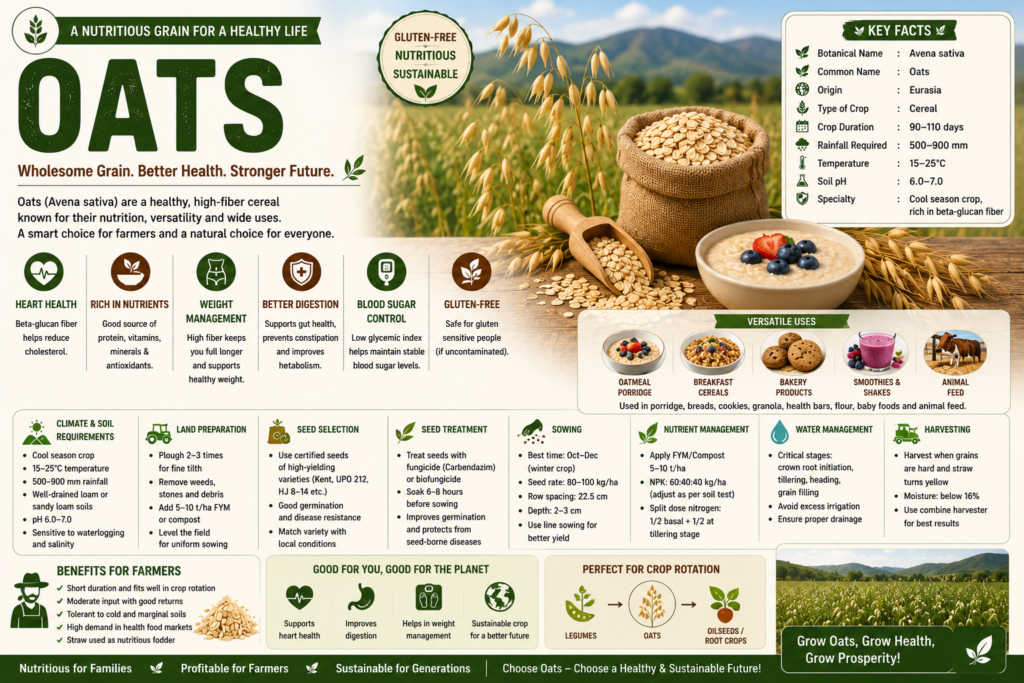
- Oats are rich in soluble fiber beta-glucan, known to lower blood cholesterol.
- Deliver good amounts of protein, vitamins (B1, B5), minerals (iron, magnesium, zinc) for overall health.
- Rich source of energy with complex carbohydrates and low glycemic index aiding blood sugar control.
- Contain antioxidants like avenanthramides that reduce inflammation and protect heart health.
- Gluten-free nature (if contamination-free) makes oats popular among gluten-sensitive people.
- High in manganese and phosphorus supporting bone health and metabolism.
- Helps with digestion, weight management, and immune function.
Dietary Diversity:
- Eaten as oatmeal porridge, breakfast cereals, baked in bread, muffins, cookies, and snack bars.
- Used in granola, energy bars, smoothies, and baby foods.
- Oat flour is increasingly popular as a gluten-free alternative in commercial and home baking.
- Added to soups and smoothies to increase fiber content and texture.
- Oat bran is used as a dietary supplement for heart health.
- Used in skin care products for soothing and moisturizing properties.
- Animal feed uses oat straw and husks as roughage.
Economic Importance:
- Grown widely in cool temperate climates, oats are an important cereal crop globally.
- Supports farmers with moderate input and resistance to colder climates and poor soils.
- All about agriculture provides market trends, yield enhancement practices, and disease control advice for oats.
- Processing industries use oats for health foods and specialty flours fetching premium prices.
- Crop’s short duration allows double cropping in some regions raising land productivity.
- Oat straw contributes to fodder supply increasing livestock productivity.
- Rising global demand for healthy, gluten-free foods increases oat export prospects.
Crop Rotation:
- Oats fit well into crop rotations with legumes, oilseeds, and root crops to maintain soil fertility.
- Rotation reduces pests like armyworms and diseases like rust associated with continuous cereals.
- Improves soil organic matter and microbial activity when followed by deep-rooted crops.
- Breaks weed, disease, and insect cycles supporting disease management naturally.
- Helps in sustainable farming practices lowering chemical dependence.
- Supports diversified cropping systems to maximize land use efficiency.
- Crop residues enhance soil porosity and water retention.
Climate Resilience:
- Oats grow best in mild cool climates with temperatures between 15–25°C.
- Adapted to high altitudes and temperate zones where other cereals struggle.
- Requires 500–900 mm of well-distributed rainfall or supplementary irrigation.
- Tolerates light frost but not extreme heat; hot, dry weather reduces grain quality.
- Oats are drought-tolerant relative to wheat but prefer moist soil during germination and flowering.
- A short growing season (90–110 days) helps escape late-season drought or frost.
- Suitable for marginal soils where other cereals have lower performance.
Health Benefits:
- Regular oat consumption reduces cholesterol, improving cardiovascular health.
- High fiber content aids digestion, prevents constipation, and supports colon health.
- Rich antioxidants combat oxidative stress and reduce inflammation.
- Supports stable blood sugar levels, reducing diabetes complications.
- Nutrients promote skin health and immune response.
- Helps maintain healthy weight by promoting satiety.
- Safe for most, but some people with avenin sensitivity should moderate intake.
Key Features
Climate and Soil Requirements
- Grows best in mild temperate climates with 15–25°C temperature range and 500–900 mm rainfall.
- Requires well-drained loam, sandy loam, or clay loam soils with pH 6.0–7.0 for optimal growth.
- Cannot withstand waterlogged or saline soils; good drainage essential to prevent root issues.
- Succeeds in cooler high-altitude zones where other cereals fail.
- evenly distributed moisture through the season is critical, especially during heading and grain filling.
- Preferably soils rich in organic matter which enhances nutrient availability and moisture retention.
- Avoid heavy clay or compacted soils which limit root spread and reduce yield.
- Use of mulching and soil conservation structures reduce erosion and moisture loss.
- Soil testing before planting helps tailor nutrient application for maximal performance.
Land Preparation
- Prepare seedbed by ploughing 2–3 times and leveling to fine tilth for uniform seed placement.
- Remove stones, clods, debris for uninterrupted seedling establishment.
- Incorporate 5–10 tons per hectare of well-rotted farmyard manure or compost.
- Timely seedbed preparation ensures proper sowing window and moisture retention.
- Ensure the seedbed is firm but loose enough for proper root penetration and moisture holding.
- Control weeds in early preparation stages to reduce competition.
- Use a ridge or flat seedbed approach depending on irrigation and drainage conditions.
- Consider soil solarization if disease incidence or weeds are historically high.
- Maintain clear field boundaries and drainage canals to protect from excess water or erosion.
High-Yielding and Hybrid Seed Selection
- Use certified seeds of high-yielding, disease-resistant varieties such as Kent, UPO 212, and HJ 8–14.
- Hybrid seeds give better yield, grain quality, and tolerance to pests and drought.
- Avoid farmer-saved uncertified seed as it risks low vigor or disease transmission.
- Store seed in cool, dry, and airtight containers to maintain germination viability.
- Verify seed germination percentage before sowing with a simple pre-sowing test.
- Match variety with local agro-climatic conditions for optimal performance.
- Regularly update seed stock to introduce improved genetics.
- Purchase seed from trusted agricultural centers or government suppliers.
- Maintain seed lot identification and storage records.
Seed Treatment
- Treat seeds with fungicides (like Carbendazim or Thiram) to prevent seed and soil-borne diseases.
- Soaking seeds in warm water before treatment can improve germination.
- Use biofungicides (Trichoderma, Pseudomonas) as eco-friendly alternatives.
- Treating seeds prevents damping-off and root rot, vital in cool/moist soils.
- Dry seeds after treatment to ease handling and avoid clumping.
- Avoid mixing treated and untreated seeds in sowing batches for uniformity.
- Clean sowing equipment before use to prevent cross-contamination.
- Label treated seeds for field monitoring.
- Reapply seed treatment if stored for a long duration.
Sowing and Planting Methods
- Sow seeds at 2–3 cm depth using seed drills or by manual broadcast at 20–25 kg/ha rate.
- Use row spacing of 20–25 cm for machine sowing; wider spacing may be used for manual.
- Line sowing helps with weed control and mechanical intercultural operations.
- Sow at the beginning of the rainy season for good moisture; avoid extreme heat or dry spells.
- Lightly cover seeds with loose soil or sand to conserve moisture.
- Irrigate immediately after sowing in dry conditions to improve germination.
- Thin seedlings after 15–20 days to optimal spacing (10–15 cm apart).
- Intercrop foxtail millet in mixed cropping systems to optimize income and soil health.
- Accurate sowing depth and spacing affect uniformity and final yield significantly.
Nutrient and Fertilizer Management
- Apply basic fertilizers: N 30–60 kg/ha, P2O5 20–30 kg/ha, K2O 20–30 kg/ha based on soil test.
- Split nitrogen application: half basal and the rest at tillering stage for best growth.
- Add 5–10 tons per hectare of well-rotted organic manure for soil structure and nutrition.
- Micronutrients like zinc and iron improve plant vigor and resistance, especially in marginal soils.
- Fertilizer placement close to the root zone enhances nutrient uptake.
- Avoid excess nitrogen to prevent excessive tillering and lodging.
- Mulching with crop residues supports nutrient recycling.
- Fertilizer application should be timed with rainfall or irrigation availability.
- Record fertilizer use and adjust over seasons for cost-effective farming.
Irrigation and Water Management
- Foxtail millet is drought tolerant but benefits from well-timed irrigation during germination, tillering, and grain filling.
- Drip or sprinkler irrigation improves water use efficiency compared to flood methods.
- Avoid waterlogging which causes root diseases and stunts growth.
- Use mulch to conserve soil moisture and reduce evaporation losses.
- Supplement rainfall with irrigation during dry spells, especially in late growing stages.
- Use soil moisture checks to avoid over- or under-watering.
- Rainwater harvesting helps ensure supplemental irrigation in arid environments.
- Irrigations early in the day reduce the risk of fungal infections.
- Maintain clean irrigation infrastructure to prevent clogging and runoff.
Intercultural Operations
- Perform first weeding 15 days after sowing, followed by 2–3 weddings during the crop cycle.
- Thin plants after 3–4 weeks to recommend spacing for better grain yield.
- Use light mechanical cultivation or hand hoeing to aerate soil and remove weeds.
- Mulch to suppress weeds and retain soil moisture.
- Remove diseased or stunted plants to prevent pest and disease spread.
- Intercrop with legumes or short-duration crops to diversify income and improve soil fertility.
- Avoid deep cultivation after establishment to protect shallow roots.
- Sanitize tools after each inter-cultivation to avoid disease transmission.
- Provide labor training on proper intercultural techniques for best crop health.
Pest Management
- Watch for pests such as shoot fly, armyworm, stem borer, aphids, and white grubs.
- Use integrated pest management combining biological control, pheromone traps, and cultural practices.
- Spray neem oil or bio-pesticides as the first control step; apply chemical pesticides only if necessary.
- Remove crop residues to eliminate pest habitats and breeding sites.
- Rotate crops to break pest life cycles and reduce infestations.
- Encourage natural enemies like parasitic wasps and entomopathogenic nematodes.
- Avoid broad-spectrum pesticide overuse to protect beneficial organisms.
- Monitor pest population thresholds and act promptly.
- Train farmers and workers in pest identification and safe handling.
Disease Management
- Major diseases include blast, smut, rust, and downy mildew.
- Use disease-resistant seeds and certified planting material.
- Remove and destroy infected plants and debris to reduce disease spread.
- Apply fungicides early as preventive or curative measures based on disease scouting.
- Maintain proper field sanitation, spacing, and drainage to minimize humidity.
- Avoid overhead irrigation during disease-prone periods.
- Rotate pathogens with non-host crops to prevent buildup.
- Keep detailed records of disease outbreaks and control measures.
- Educate farmworkers on disease symptoms and hygiene practices.
Harvesting and Post-Harvest Management
- Harvest foxtail millet when seeds are hard, golden, and moisture is about 14%.
- Cut panicles carefully, dry in sun for 3–5 days before threshing.
- Store grain in moisture-proof bags or containers to prevent mold.
- Clean and grade grains before sale to meet market needs.
- Use crop residues for fodder or composting to improve sustainability.
- Avoid delays in harvest to prevent seed shattering and quality loss.
- Proper post-harvest handling maintains nutrient and seed viability.
- Document yields and post-harvest losses for farm improvement.
- Package grains safely for transport to reduce contamination.
Other Important Points
- Foxtail millet’s low-water needs make it vital for dryland and rainfed farming.
- It supports gluten-free diets and diabetic healthy eating.
- Progressive farmers can use precision farming for higher productivity.
- Visit the All about agriculture website for latest millet seed news, farming tips, and market rates.
Do’s
Don'ts
What are the best organic practices for growing oats?
Organic oat farming involves using natural compost, crop rotation, biological pest control, and avoiding synthetic chemicals to maintain soil health and yield.
How can oats improve soil fertility in crop rotations?
Oats add organic matter to soil, break pest cycles, and improve soil structure, making them an excellent rotational crop with legumes and vegetables.
What are the health benefits of consuming oat bran?
Oat bran is rich in soluble fiber, which lowers cholesterol, improves digestion, and helps control blood sugar levels effectively.
How is oat hay used in livestock feeding?
Oat hay is a nutritious, high-fiber feed that supports dairy and beef cattle health, improving milk production and weight gain.
What factors influence the quality of oat grain?
Grain quality depends on variety, weather during growing season, harvesting time, and proper drying and storage methods.
Can oats be grown in saline or marginal soils?
Oats tolerate mild salinity better than many cereals but need well-drained soils; poor drainage and high salt levels reduce yield and quality.
What is the ideal harvesting time for oats?
Oats are harvested when grains reach physiological maturity, usually indicated by a change in grain color and moisture content around 14%.
How does cover cropping with oats benefit farmers?
As a cover crop, oats prevent soil erosion, suppress weeds, and add organic matter, improving soil health and water retention.
What are the common pests that affect oat crops?
Common pests include aphids, armyworms, and oat midge; integrated pest management with monitoring and biological controls is recommended.
How can oats be processed for human consumption?
Oats are cleaned, hulled, and steamed to produce rolled oats, oat flour, and instant oats used in breakfast cereals and baking.
What storage conditions are best for maintaining oat grain quality?
Store oats in a cool, dry, and pest-free environment with good ventilation to prevent mold growth and insect damage.
Where can growers find updated market prices and cultivation tips for oats?
Our website All about agriculture offers reliable information on oat market trends, new technologies, and best cultivation practices for farmers.