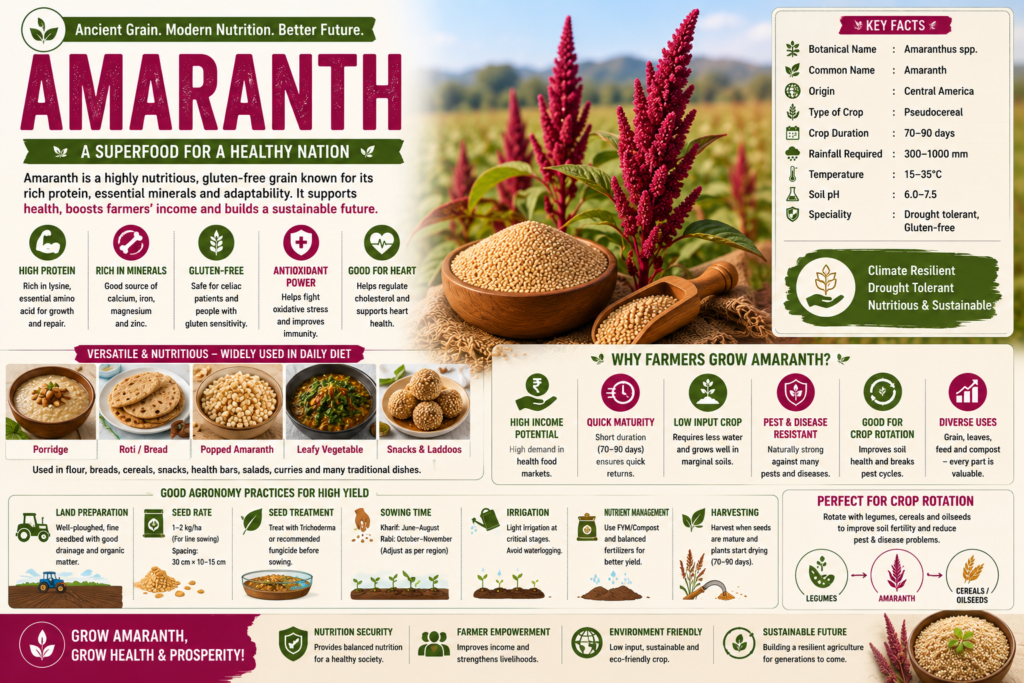
Amaranth
Amaranth

Understanding About Crop
Nutritional Value:
- Amaranth is high in protein, especially lysine, an essential amino acid rare in cereals.
- Rich in dietary fiber, calcium, iron, magnesium, and antioxidants beneficial for overall health.
- Gluten-free, suitable for celiac patients and those with gluten sensitivity.
- Contains vitamins A, C, and folate supporting immunity and metabolic processes.
- High energy content helps in growth and repair of body tissues.
- Leaves also contain essential nutrients and are eaten as green vegetables.
- Safe and nutritious for all age groups, promoting digestive and bone health.
Dietary Diversity:
- Consumed as flour in breads, porridge, pancakes, cookies, and traditional dishes.
- Popped amaranth is used as snack food, health bars, and breakfast cereals.
- Leaves are used in salads, curries, and stir-fries for fresh vegetable intake.
- Flour and grains are popular in vegan and gluten-free diets.
- Used in infant weaning foods and healthy diet plans globally.
- Animal feed and compost also use residual biomass.
- Versatile grain supporting traditional and modern nutrition needs.
Economic Importance:
- Amaranth is a drought-tolerant crop important for marginal farmers’ income security.
- Increasing demand in health food markets due to nutritional benefits.
- All about agriculture provides market information, seed availability, and cultivation advice.
- Cultivation in diverse agro-climatic zones supports rural livelihoods.
- Quick maturity and multiple harvests per year enhance income flow.
- By-products generate additional farm value through feed and composting.
- Crop diversification opportunity increasing agro-business scope.
Crop Rotation:
- Fits well in rotation with legumes, cereals, and root crops for sustainable farming.
- Rotation breaks pest, weed, and disease cycles common in continuous mono-cropping.
- Enhances soil nitrogen levels and organic matter through intercropping with nitrogen-fixing plants.
- Supports better moisture retention and soil structure over cycles.
- Improves pest management reducing chemical use and costs.
- Integrates easily into mixed cropping systems for farmer resilience.
- Promotes biodiversity and environmental sustainability on farms.
Climate Resilience:
- Performs well in tropical, subtropical, and temperate climates with 15–35°C temperature range.
- Adapted to low rainfall (300–1000 mm) and tolerates drought conditions.
- Grows in well-drained soils; sensitive to waterlogging and salinity.
- Short lifecycle (70–90 days) helps avoid climate extremes.
- Mulching and organic matter significantly improve drought resistance.
- Resistant to common cereal pests and diseases reducing crop losses.
- Valuable crop for climate-smart agriculture and dryland farming zones.
Health Benefits:
- Promotes muscle and bone strength due to high protein and calcium levels.
- Antioxidant-rich aiding in disease prevention and cellular repair.
- Supports digestive and metabolic health with fiber and iron content.
- Suitable for gluten-free, diabetic, and heart-friendly diets.
- Helps regulate blood sugar and reduce cholesterol levels naturally.
- Provides vital nutrients for pregnancy, lactation, and child development.
- Overconsumption rarely causes mild digestive discomfort; best taken moderately.
Key Features
Climate and Soil Requirements
- It thrives in a broad temperature range of 15–35°C and rainfall between 300–1000 mm annually.
- Prefers well-drained sandy loam to loam soils with neutral to slightly acidic pH 6.0–7.5.
- Sensitive to waterlogged, saline, or heavy clay soils that reduce root respiration and growth.
- Grows well in dry and rainfed areas, tolerant of drought and moderate heat.
- Light shade can be tolerated but better yields with full sunlight exposure.
- Soil rich in organic matter improves yield and resistance to drought stress.
- Avoid frost-prone areas as seedlings and young plants are vulnerable to cold damage.
- Mulch application helps maintain soil moisture and temperature.
- Soil testing prior to planting helps optimize nutrient management.
Land Preparation
- Clear weeds, crop residues, and debris before preparing seedbed.
- Deep plough and harrow for a fine seedbed ensuring uniform moisture.
- Incorporate 5–10 tons/ha of well-decomposed organic manure or compost.
- Avoid overly compacted soils by breaking clods and lumps.
- Level the land for even moisture distribution and ease of sowing or irrigation.
- Maintain good drainage to prevent water stagnation around roots.
- Use contour bunds or terraces on slopes to prevent erosion.
- Implement soil solarization if needed to reduce soil pathogens.
- Remove stones and roots thoroughly for smooth field operations.
High-Yielding and Hybrid Seed Selection
- Use certified seeds from recommended varieties with high germination and disease resistance.
- Popular varieties for high yield include ‘Pant Suvarna’, ‘Shweta’, and local adapted cultivars.
- Store seeds in dry, cool, and airtight containers to maintain viability.
- Avoid using mixed or old seed lots to minimize uneven germination and diseases.
- Test seed germination before sowing through a small sample batch.
- Purchase seed from public seed agencies or trusted local suppliers.
- Use hybrids or improved open-pollinated varieties as per farmer preference and region.
- Update seed lots regularly to incorporate advancements and improve productivity.
- Keep seed source and batch records for traceability and quality control.
Seed Treatment
- Treat seeds with recommended fungicides to control seed-borne and soil fungi infections.
- Biofungicides like Trichoderma can be used in organic or eco-friendly farming systems.
- Soak seeds for 6–8 hours in water before treatment to improve germination.
- Dry treated seeds partially under shade to avoid moisture retention.
- Maintain separate storage for treated and untreated seeds with clear labels.
- Use fresh treatment solutions for each lot to ensure effectiveness.
- Disinfect sowing equipment after every batch to avoid spread of pathogens.
- Avoid treating seeds too close to sowing time to prevent seed damage.
- Train farmworkers in proper seed treatment procedures and safety.
Sowing and Planting Methods
- Sow at the beginning of the rainy season or when soil moisture is adequate.
- Sow seeds using a line method with 20–25 cm spacing between rows and 8–10 cm between plants.
- Seed depth of 2–3 cm ensures good emergence and protects seeds from birds.
- For broadcast sowing, thin seedlings after 15–20 days to avoid overcrowding.
- Use seed drills for uniform sowing in large fields for better crop management.
- Apply light mulch after sowing to conserve moisture and control weeds.
- Inter-crop with pulses or short-duration vegetables for income and soil benefits.
- Fill gaps by reseeding within 10–15 days to maintain crop uniformity.
- Keep complete records on sowing dates, seed type, and field layout.
Nutrient and Fertilizer Management
- Apply 5–10 tons/ha farmyard manure or compost before sowing to improve soil fertility.
- Fertilizer recommendations typically include 40–60 kg N, 20–30 kg P2O5, and 20–25 kg K2O per hectare.
- Split nitrogen application: half at sowing, remainder at tillering and panicle initiation.
- Micronutrients such as zinc and iron may be needed depending on soil tests.
- Mulch and green manure crops increase soil organic matter and nutrient availability.
- Avoid excessive nitrogen fertilization to prevent excessive vegetative growth.
- Soil testing aids in customizing fertilization according to local nutrient status.
- Foliar feeding supplements micronutrient deficiencies during key growth stages.
- Maintain detailed records for nutrient inputs and crop response.
Irrigation and Water Management
- Foxtail millet is drought tolerant but benefits from 1–2 supplemental irrigations during dry periods.
- Timely watering at sowing, tillering, and flowering improves yields significantly.
- Avoid waterlogging and over-irrigation which encourage root and fungal diseases.
- Use mulching to conserve soil moisture and reduce irrigation frequency.
- Adopt drip or sprinkle irrigation systems where water conservation is critical.
- Maintain clean and functional irrigation channels for uniform water distribution.
- Rainwater harvesting can supplement irrigation in dry zones.
- Irrigate early morning or late evening to reduce water loss.
- Monitor soil moisture regularly to optimize watering schedules.
Intercultural Operations
- Perform early and regular weeding, starting 15 days after sowing and repeating 2–3 times.
- Thin plants recommended spacing to reduce competition and increase yield.
- Light hoeing maintains soil aeration and helps root health without uprooting plants.
- Mulching after weeding controls weed regrowth and conserves moisture.
- Remove diseased or stunted plants to prevent spread.
- Practice crop diversification and intercropping with legumes and vegetables.
- Sanitize tools and equipment to reduce disease transmission.
- Provide training to farm laborers on proper intercultural techniques.
- Keep the field clean from crop residues to discourage pests.
Pest Management
- Common pests include armyworms, shoot flies, aphids, and stem borers.
- Use integrated pest management combining biological controls, pheromone traps, and selective insecticides.
- Monitor pest populations regularly for timely interventions.
- Remove and destroy affected plants or residues to limit pest spread.
- Encourage natural predators such as ladybugs and parasitic wasps.
- Avoid indiscriminate pesticide use to protect beneficial organisms.
- Rotate pesticides to avoid resistance buildup.
- Educate farmers and workers on pest recognition and safe chemical use.
- Maintain clean field conditions to suppress pest habitats.
Disease Management
- Key diseases include leaf spots, blast, smut, rust, and downy mildew.
- Use disease-free certified seed and practice early field sanitation.
- Remove and burn infected plants to control disease spread.
- Apply fungicides or biocontrol agents at recommended stages to manage infections.
- Maintain good spacing and air circulation to reduce humidity-related diseases.
- Avoid overhead irrigation to decrease leaf wetness.
- Rotate crops or alter planting dates to interrupt disease cycles.
- Record disease outbreaks and treatments for future reference.
- Provide training on disease management and implement hygiene protocols.
Harvesting and Post-Harvest Management
- Harvest when grain moisture is about 12–14% and panicles are fully mature and golden brown.
- Cut panicles carefully and dry in shade or sun for 3–5 days before threshing.
- Clean grain, remove chaff, and store in moisture-proof containers to avoid pest infestation and spoilage.
- Use graded grains for seed or market; ungraded grains for local consumption.
- Store crop residues as fodder or convert to compost to enrich the next crop’s soil.
- Avoid harvest delays to minimize seed losses and preserve quality.
- Maintain hygiene in drying, threshing, and storage to retain food safety.
- Keep post-harvest records to learn and improve handling efficiency.
- Process grains into flour or ready-to-cook mixes for added value.
Other Important Points
- It is a strategic crop for dryland and low-input farming systems.
- Its health benefits and flexibility make it a favorite in gluten-free and diabetic diets.
- Introducing millet gradually into diets improves acceptance and digestion.
- For variety updates, pest alerts, and market prices, visit All about agriculture website.
Do’s
Don'ts
How can farmers store amaranth seeds to maintain their quality?
Store amaranth seeds in cool, dry, airtight containers away from direct sunlight to prevent moisture absorption and pest damage, ensuring longer seed viability.
What are the common uses of amaranth leaves in cooking?
Amaranth leaves are used as leafy vegetables in soups, stir-fries, salads, and traditional dishes providing essential nutrients like vitamins and minerals.
Is amaranth suitable for organic farming, and why?
Yes, amaranth suits organic farming due to its natural resistance to pests and diseases and low input requirements, making it ideal for sustainable agriculture.
How does amaranth help improve soil health?
Amaranth contributes organic matter through its residues, supports beneficial soil microbes, and fits well in crop rotations that enrich soil fertility.
What is the recommended seed rate for amaranth cultivation?
Typically, 4–6 kilograms of seed per hectare is sufficient for direct sowing, but seed rate may vary based on sowing method and plant spacing.
How fast does amaranth mature from sowing to harvest?
Amaranth generally matures within 90 to 110 days, depending on variety and climatic conditions, making it suitable for short-duration cropping systems.
Can amaranth be used as animal fodder?
Yes, amaranth leaves and stems serve as nutritious fodder for livestock, providing high protein and minerals, especially during dry seasons.
What are some natural ways to control pests in amaranth?
Use neem-based sprays, introduce beneficial insects, and practice crop rotation and field sanitation to minimize pest infestations organically.
How does amaranth contribute to food security in dry regions?
Due to its drought tolerance and adaptability to poor soils, amaranth is vital for food security in semi-arid and marginal lands.
Can amaranth flour be used in gluten-free baking?
Yes, amaranth flour is a popular gluten-free alternative that provides rich nutrition and unique flavor in breads, cakes, and other baked goods.
Are there any side effects of consuming amaranth?
Amaranth is generally safe, but excessive consumption may cause mild allergies or digestive discomfort in some individuals sensitive to high-fiber foods.
Where can growers find updated information on amaranth cultivation and markets?
You will get the latest insights and expert advice on our website All about agriculture, helping you improve yields and market returns effectively.