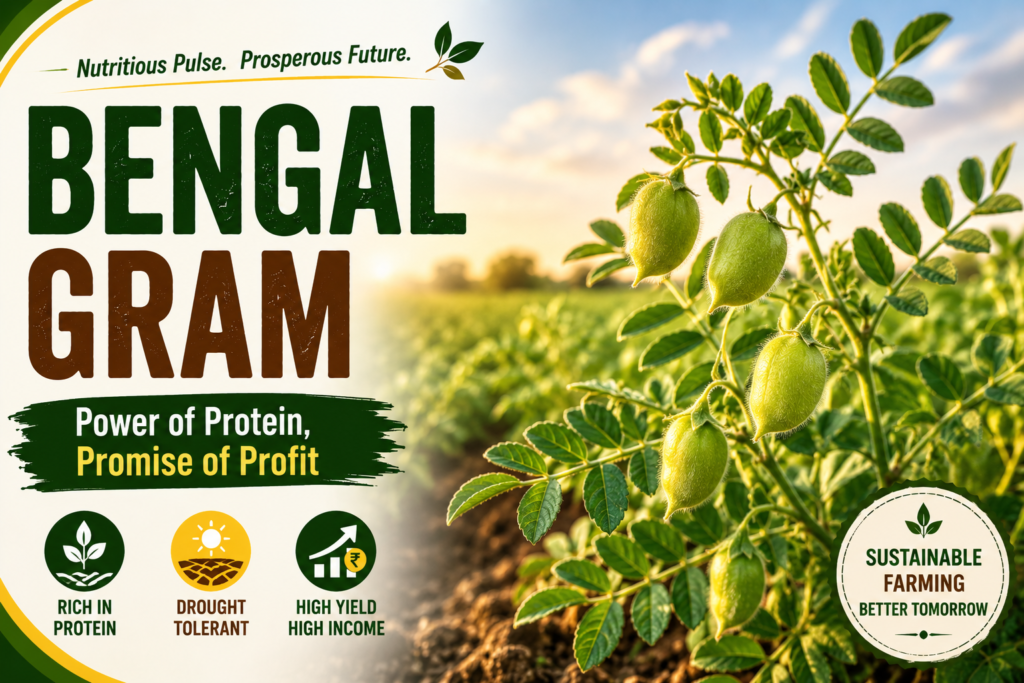
Bengal Gram
Bengal Gram
Understanding about Crop
Nutritional Value:
- Bengal Gram (Kala Chana) is rich in protein (around 22%), fiber, carbs, vitamins B and minerals like iron, potassium, and zinc. It supports muscle growth, digestion, and immunity. Low in fat and cholesterol, Kala Chana is heart-friendly and helps control blood sugar.
Dietary Diversity:
- Used widely in Indian cuisine, Bengal Gram (Kala Chana) is consumed boiled, roasted as snacks, or ground into flour for making bread and sweets. Its versatility adds valuable protein and nutrition to vegetarian diets everywhere.
Economic Importance:
- Bengal Gram (Kala Chana) is a major pulse crop offering good income for farmers across India. It fetches steady market demand and price, with government schemes supporting cultivation. Its hardy nature ensures reliable yield even in semi-arid zones.
Crop Rotation:
- Rotating Bengal Gram (Kala Chana) with cereals like wheat and maize improves soil nitrogen and manages pest and disease cycles efficiently. Crop rotation enhances overall land productivity and sustainability.
Climate Resilience:
- Thrives in moderate temperatures (20–30°C) with 500–1000 mm rainfall. It tolerates drought but is sensitive to waterlogging. Best grown in well-drained soils with balanced sunlight.
Health Benefits and Side Effects:
- Bengal Gram (Kala Chana) promotes digestion, heart health, and weight control due to fiber and antioxidants. Overconsumption may lead to gas or bloating; soaking and proper cooking reduce this effect.
Other Important Points:
- Residue and husk of Bengal Gram improve soil organic matter and can be used as fodder. Find more tips and market updates on All about agriculture for better management.
Key Features of Bengal Gram
Climate and Soil Requirements
- Performs best in temperatures 20–30°C with moderate rainfall of 500–1000 mm.
- Prefers well-drained sandy loam to clay loam soils with pH between 6 and 8.
- Avoid waterlogging and very acidic soils which damage the crop.
- Deep, loose soils promote strong root growth and better yields.
- Good aeration and moisture retention in soil essential for seedling health.
- Raised beds help drainage in heavy rain areas.
- Conduct soil testing to optimize fertilizer application.
- Thrives better in frost-free climates.
- Crop duration varies between 90–120 days depending on variety.
Land Preparation
- Plough land 2-3 times followed by harrowing to prepare seedbed.
- Remove weeds and previous crop residues to reduce pest risks.
- Level the field for uniform sowing and irrigation.
- Incorporate well-rotted manure or compost to improve fertility.
- Avoid compacted, hard soils for better germination.
- Raised beds help manage moisture and reduce fungal diseases.
- Maintain good soil moisture during planting for seed germination.
- Avoid late tillage that can dry out the soil surface.
- Prepare the field 2 weeks before sowing so moisture settles properly.
High-Yielding and Hybrid Seed Selection
- Use certified seeds from trusted sources with high germination rates.
- Popular varieties include JG 6, JAKI 9218, Pusa 372, and Vijay.
- Hybrid varieties provide better yields, disease resistance, and early maturity.
- Select seeds that are uniform, healthy, and free of pests.
- Avoid old or damaged seeds that affect germination.
- Store seeds in cool, dry places to maintain viability.
- Test seed samples for adaptability before large scale planting.
- Use seeds suited to your region’s climate and soil type.
- Purchase seeds annually to ensure freshness and purity.
Seed Treatment
- Treat seeds with fungicides like Carbendazim to prevent seedling diseases.
- Apply Rhizobium inoculants to improve nitrogen fixation and yield.
- Avoid soaking seeds for long to prevent seed rot.
- Dry treated seeds under shade to prevent heat damage.
- Use bio-fertilizers as part of seed treatment for soil health.
- Treat seeds close to sowing for best disease protection.
- Follow safety protocols during chemical handling.
- Use natural treatments like neem extracts where applicable.
- Monitor seed quality post-treatment before sowing.
Sowing and Planting Methods
- The best sowing time is October-November for Rabi season crops.
- Use seed rate of 75–100 kg/ha depending on seed size and variety.
- Sow seeds 8–10 cm deep with 30–40 cm row spacing and 10 cm plant spacing.
- Line sowing is preferred for easy intercultural operations.
- Cover seeds gently with soil and irrigate immediately.
- Use seed drills or manual sowing methods suited to field size.
- Ensure even planting depth to avoid patchy emergence.
- Thin seedlings if overcrowded for uniform growth.
- Opt for timely sowing to avoid late heat stress.
Nutrient and Fertilizer Management
- Bengal Gram (Kala Chana) fixes atmospheric nitrogen reducing fertilizer needs.
- Apply phosphorus (40–60 kg P2O5/ha) and potassium (20–30 kg K2O/ha) as basal doses.
- Nitrogen applied only if soil deficient, typically 10–20 kg N/ha.
- Use organic manures or compost to enhance soil organic content.
- Avoid excess nitrogen; it favors foliage over pods.
- Foliar sprays of micronutrients may be needed if deficiency symptoms appear.
- Conduct soil tests annually for precise nutrient application.
- Balanced fertilization improves yield and seed quality.
- Incorporate crop residues to maintain soil fertility.
Irrigation and Water Management
- Bengal Gram requires moderate water, especially during flowering and podding.
- Avoid waterlogging; drainage must be ensured.
- Irrigate based on soil moisture; avoid over-irrigation.
- Drip or furrow irrigation systems improve water use efficiency.
- Mulching helps retain soil moisture and reduces weeds.
- Stop irrigation 15 days before harvest to allow pod drying.
- Make irrigation schedules based on crop growth stages and climatic conditions.
- Harvest soon after maturity to avoid yield loss.
- Utilize rainwater harvesting for sustainable irrigation.
Intercultural Operations
- Regular weeding until the crop canopy closes is essential.
- Earthing-up supports lodging and improves nutrient uptake.
- Remove diseased plants promptly to curb infections.
- Mulching conserves moisture and suppresses weed growth.
- Fill gaps by replanting during early crop stages.
- Control weeds manually or use selective herbicides carefully.
- Rotate crops to reduce pest and disease build-up.
- Avoid deep tillage that harms roots during growth.
- Inspect fields regularly for timely intervention.
Pest Management
- Common pests include pod borers, aphids, and thrips.
- Employ integrated pest management: biological controls, resistant varieties.
- Use neem-based pesticides and biopesticides to reduce chemical use.
- Timely pest monitoring and field sanitation prevent outbreaks.
- Physically remove infested pods to minimize damage.
- Avoid indiscriminate insecticide spraying to protect beneficial insects.
- Rotate crops for natural pest suppression.
- Use traps and pheromone lures when available.
- Store harvested grain properly to avoid stored grain pests.
Disease Management
- Major diseases: wilt, blight, root rot, and Ascochyta blight.
- Use disease-resistant varieties and treated seeds.
- Ensure proper spacing for airflow to reduce fungal diseases.
- Remove and destroy infected plants promptly.
- Rotate with non-host crops to break disease cycles.
- Fungicide sprays applied as per expert advice during epidemics.
- Avoid overhead irrigation to lower leaf wetness.
- Clean tools and equipment to reduce spread.
- Monitor fields regularly for early disease signs.
Harvesting and Post-Harvest Management
- Harvest Bengal Gram when pods are brown and dry, 90–120 days after sowing.
- Cut plants at ground level and dry sun for 5–7 days before threshing.
- Use clean threshing methods to preserve seed quality.
- Store seeds in cool, dry, airtight containers to prevent spoilage.
- Regularly inspect stored grain for insects and mold.
- Avoid mixing new and old seeds during storage.
- Proper drying enhances shelf life and market value.
- Use appropriate packaging and fumigation when necessary.
- Post-harvest management reduces loss and maintains grain quality.
Other Important Points
- Residues improve soil organic matter and serve as fodder.
- Bengal Gram supports sustainable farming through nitrogen fixation.
- It plays a vital role in food and nutrition security in semi-arid areas.
- Soaking and cooking reduce anti-nutritional factors for better digestibility.
- Bengal Gram flour is increasingly used in gluten-free products.
- Visit All about agriculture for latest cultivation tips and market updates.
Do’s
Don'ts
Frequently Asked Questions
What are some common culinary uses of Bengal Gram (Kala Chana) in Indian households?
Bengal Gram (Kala Chana) is used in dishes like chana masala, snacks, soups, and salads, offering high protein and rich taste that enriches vegetarian meals.
How does Bengal Gram (Kala Chana) aid in improving soil fertility naturally?
Through nitrogen fixation and organic matter from crop residues, Bengal Gram (Kala Chana) enriches soil nutrients, reducing fertilizer dependency.
Can Bengal Gram (Kala Chana) be used for animal feed?
Yes, its residues and straw serve as nutritious livestock fodder, especially during dry seasons when forage is scarce.
What natural pest control methods are effective for Bengal Gram (Kala Chana)?
Botanical insecticides, crop rotation, and encouraging natural predators help manage pests on Bengal Gram (Kala Chana) crops sustainably.
Is Bengal Gram (Kala Chana) suitable for organic farming practices?
Bengal Gram (Kala Chana) adapts well to organic farming with the use of biofertilizers, organic manures, and minimal chemical inputs.
How does Bengal Gram (Kala Chana) contribute to climate resilience in agriculture?
Its drought tolerance and short growing cycle enable stable crop production under erratic rainfall and dry conditions.
What are the post-harvest challenges faced in Bengal Gram (Kala Chana) storage?
Moisture, pests, and improper handling affect Bengal Gram (Kala Chana) quality; storing in dry, sealed containers mitigates these risks.
Can Bengal Gram (Kala Chana) be grown as an intercrop?
Yes, it pairs well with crops like wheat and mustard, optimizing land use and improving overall farm income.
What role does Bengal Gram (Kala Chana) play in protein security?
As a pulse rich in protein, Bengal Gram (Kala Chana) supports nutritional security, especially in vegetarian diets across India.
Are there medicinal uses of Bengal Gram (Kala Chana)?
Traditionally, Bengal Gram (Kala Chana) is used in remedies for digestion issues, blood sugar control, and boosting immunity.
How can farmers access quality Bengal Gram (Kala Chana) seeds?
Certified seeds for Bengal Gram (Kala Chana) are available at agricultural centers and trusted suppliers, ensuring high germination and yields.
Where can updated market prices and government schemes for Bengal Gram (Kala Chana) be found?
Farmers can get latest prices, schemes, and advising tips about Bengal Gram (Kala Chana) from trusted agricultural websites like All about agriculture.