Corn Germ
Corn Germ
Understanding about Crop
Nutritional Value:
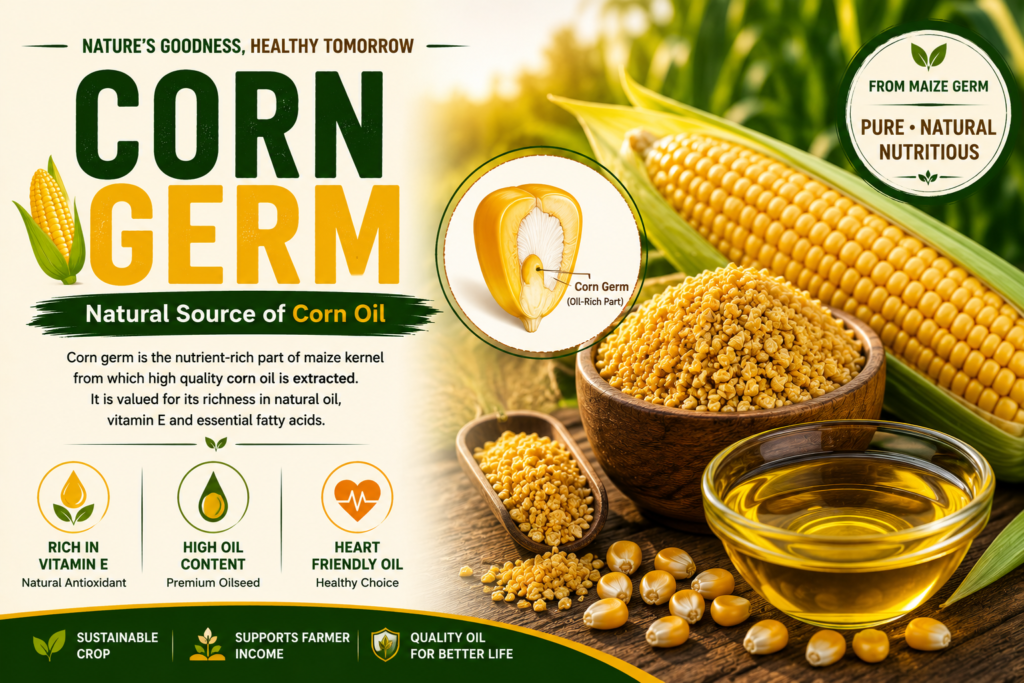
- Corn/Maize Germ (for corn oil) is rich in essential fatty acids, particularly linoleic acid, and vitamins like vitamin E, providing antioxidants.
- Corn oil derived from the germ is low in saturated fats, beneficial for heart health and cholesterol control.
- The germ contains proteins and minerals such as magnesium and phosphorus, supporting energy metabolism.
- High vitamin E content supports skin health and protects cells from oxidative damage.
- Corn germ oil has about 80% unsaturated fats, making it a preferred cooking oil.
- The germ also provides dietary fiber when consumed in whole corn forms.
- Nutrients in corn germ contribute both to human health and animal nutrition when processed.
Dietary Diversity:
- Corn oil from maize germ is used widely in cooking for frying and salad dressings due to its mild taste.
- It is blended with other oils to improve nutritional profile and shelf life.
- Corn germ is also used in processed foods and snack industries.
- Byproducts are utilized in animal feeds, boosting livestock growth.
- This versatility enhances food product variety and farmer income.
- Corn oil is a popular ingredient in margarine and bakery products.
- The crop indirectly supports diverse agricultural and food processing sectors.
Economic Importance:
- Corn/Maize Germ (for corn oil) cultivation supports oil industries and seed markets, contributing to farmer livelihoods globally.
- High demand for corn oil in food and industrial sectors ensures a consistent market.
- Processing maize germ for oil adds value to maize production.
- Byproducts support animal feed industries enhancing farm income.
- Government and private sector investments promote maize germ oil processing infrastructure.
- Improved varieties help farmers increase oil yields and profitability.
- Access to market pricing information guides better cultivation planning.
Crop Rotation:
- Corn fits well in rotation with legumes and cereals, improving soil nitrogen and breaking pest cycles.
- Rotation reduces pest buildup and enhances soil structure for successive crops.
- Corn residues contribute to soil organic content.
- Crop diversification prevents soil fatigue and supports sustainable farming.
- Including maize germ in rotations produces multiple income streams.
- Rotation optimizes nutrient utilization and water efficiency.
- Strategic crop sequencing benefits crop health and farm ecology.
Climate Resilience:
- Corn/Maize Germ (for corn oil) grows best between 18°C and 27°C with 600–1000 mm rainfall.
- It prefers warm and moderately humid conditions but can tolerate short dry periods.
- Sensitive to frost and prolonged drought especially after germination.
- Well-timed irrigation helps overcome moisture stress during flowering and grain fill.
- Soil temperature affects seed germination and seedling vigor.
- Adaptive varieties increase resilience to climatic variability.
- Climate management improves crop stability and oil yield quality.
Health Benefits:
- Corn oil helps reduce bad cholesterol and increases good cholesterol when consumed moderately.
- High in antioxidants, corn oil protects against oxidative stress.
- It supports skin hydration and elasticity when used externally.
- Contains vitamin E, which boosts immune function.
- Corn oil is a rich energy source suitable for all age groups.
- Balanced intake supports metabolic and cardiovascular health.
- Excessive cooking with corn oil should be avoided to preserve nutrients.
Other Important Points:
- Processing corn germ efficiently enhances both oil yield and quality.
- Maize germ oil is increasingly favored due to its health benefits and cooking properties.
- Residues from maize processing are valuable for animal feed industries.
- All about agriculture provides in-depth guidance on cultivation, processing, and marketing of corn germ and oil.
Key Features of Corn/Maize Germ
Climate and Soil Requirements
- Corn/Maize Germ thrives best in warm climates with temperatures ranging from 18°C to 27°C.
- Requires annual rainfall between 600 mm to 1000 mm for optimal growth.
- Prefers well-drained loamy soils rich in organic matter with neutral pH 6 to 7.
- Sensitive to water stagnation; good drainage is essential to avoid root diseases.
- Grows well in soils with good moisture retention but poor in excessive water-holding capacity.
- Adapts to varied topographies, though flat to gently sloping lands are preferred.
- Soil fertility must be regularly assessed through testing to maintain crop health.
- Tolerant maize varieties enhance adaptability to soil and climatic variability.
- Sunlight plays a critical role in grain filling and oil content.
- Proper soil and climate conditions lead to improved seed oil proportion and quality.
Land Preparation
- Deep ploughing ensures better soil aeration and root penetration for maize plants.
- The field is cleaned from previous crop residues and weeds to reduce pest build-up.
- Levelled land eases irrigation and promotes uniform plant emergence.
- Incorporate 10-15 tons per hectare of farmyard manure or compost to enrich soil.
- Ridges or beds may be prepared for better drainage in heavy soils.
- Avoid soil compaction by minimizing heavy machinery on wet soil.
- Scheduled land preparation ensures timely sowing leading to better crop growth.
- Maintain soil moisture at planting for efficient seed germination.
- Good land preparation directly influences plant population uniformity.
- Field sanitation lowers chances of seed and soil-borne diseases.
High-Yielding and Hybrid Seed Selection
- Use certified high-yielding hybrid seeds for better oil and grain yield.
- Select seeds with good germination percentage and vigor.
- Disease-resistant varieties reduce crop losses and input costs.
- Seed quality affects uniformity and harvest timing.
- Seeds are chosen based on soil and climate adaptability for the area.
- Store seeds in optimal conditions to retain viability till sowing.
- Periodic evaluation of seed lots maintains genetic purity.
- Source seeds from reputed dealers or government seed banks.
- Adoption of improved technology contributes to yield sustainability.
- Seed treatment prior to sowing boosts germination and seedling health.
Seed Treatment
- Use fungicides like Captan or Thiram for seed treatment against soil fungi.
- Seed priming techniques improve moisture absorption and germination uniformity.
- Bio-inoculants like Azospirillum enhance nitrogen fixation and plant growth.
- Dry seeds post-treatment under shade to avoid heat damage.
- Treat seeds close to the sowing date for maximum effectiveness.
- Proper seed treatment reduces early seedling disease and fungal infections.
- Follow chemical handling and safety guidelines meticulously.
- Treat seeds depending on local disease prevalence and soil conditions.
- Improved seed health leads to stronger, more uniform seedlings.
- Seed treatment helps in maximizing field establishment rates.
Sowing and Planting Methods
- Sow seeds 3-5 cm deep, with row spacing of 60-75 cm and plant spacing 20-30 cm.
- Ideal sowing time varies with climate but commonly late spring to early summer.
- Seed rate generally ranges from 15 to 20 kg per hectare for hybrids.
- Use seed drills or manual sowing depending on land size and resources.
- Maintain proper depth and spacing to avoid poor germination and overcrowding.
- Irrigate immediately after sowing to promote seed-soil contact and moisture.
- Maintain weed control during early crop stages to reduce competition.
- Timely planting reduces pest and disease pressure on the crop.
- Gap filling recommended within 15 days for uniform population.
- Mulching aids moisture conservation and weed suppression.
Nutrient and Fertilizer Management
- Apply nitrogen at 100-120 kg/ha during growth stages, split applications recommended.
- Basal application of phosphorus 40-60 kg/ha is essential for root development.
- Potassium fertilization (40-60 kg/ha) supports overall plant health and stress resistance.
- Incorporate organic manures for improved nutrient availability and microbial activity.
- Micronutrients such as zinc may be foliar applied if deficiencies are detected.
- Soil testing prior to fertilization optimizes nutrient application and avoids wastage.
- Balanced nutrition fosters better ball setting and kernel filling.
- Excess nitrogen should be avoided to prevent excessive vegetative growth.
- Integrated nutrient management enhances productivity and environmental sustainability.
- Proper nutrient management impacts both yield and oil composition in kernels.
Irrigation and Water Management
- Corn/Maize Germ cultivation requires moderate water; water stress during flowering and grain filling stages affects yield significantly.
- Use drip or furrow irrigation for water-efficient agriculture.
- Avoid waterlogging, as it can induce root diseases and limit nutrient uptake.
- Mulching aids in conserving soil moisture and reducing evaporation losses.
- Monitor soil moisture regularly using tensiometers or manual checks.
- Schedule irrigation to coincide with critical crop stages for maximum efficiency.
- Rain-fed regions require supplemental irrigation in prolonged dry spells.
- Efficient water use reduces input costs and improves environmental sustainability.
- Water management affects seed quality and oil content.
- Adopt water-saving technologies to enhance productivity under scarce water conditions.
Intercultural Operations
- Early and regular weeding is necessary to minimize competition and enhance nutrient availability.
- Mechanical cultivation and earthing-up improve root aeration and nutrient access.
- Remove diseased plants promptly to avoid spread.
- Mulching suppresses weed growth and conserves soil moisture.
- Crop rotation used to manage pest cycles and improve soil health.
- Maintain field sanitation to prevent pest establishment.
- Timely intercultural activities improve crop health and yields.
- Monitor crops for stress signs to enable early interventions.
- Fertilize and irrigate appropriately to sustain multiple intercultural stages.
- Adopting precision agriculture technologies enhances intercultural efficiency.
Pest Management
- Major pests include bollworm, thrips, leafminer, and aphids that affect both yield and quality.
- Integrated Pest Management (IPM) combines chemical, biological, and cultural controls.
- Natural predators and biopesticides reduce reliance on harmful chemicals.
- Use pheromone traps for bollworm monitoring and management.
- Crop rotation and virus-resistant varieties mitigate pest damage.
- Timely pest surveillance prevents wide outbreaks.
- Store harvested kernels properly to avoid post-harvest pest damage.
- Avoid pesticide overuse to prevent resistance and ecological imbalance.
- Maintain biodiversity for natural pest control.
- Combine pest management with overall crop health scheduling.
Disease Management
- Common diseases include bacterial blight, leaf curl virus, and root rot.
- Use disease-free seeds and resistant hybrids to minimize infections.
- Monitor fields regularly and remove infected plants to contain outbreaks.
- Fungicides and antibacterial sprays used judiciously during outbreaks.
- Maintain proper plant spacing to enhance airflow and reduce humidity.
- Crop rotation helps manage soil-borne diseases.
- Avoid excess irrigation that favors fungal disease development.
- Sanitize tools and equipment to prevent pathogen spread.
- Implement disease forecasting and advisory services.
- Early disease identification and prompt mitigation improve crop outcomes.
Harvesting and Post-Harvest Management
- Cottonseed (Kapasiya) is harvested when bolls are fully mature and dry, usually 150-180 days post-sowing.
- Use mechanical or manual methods for boll picking with minimal seed damage.
- Dry harvested bolls adequately under the sun before ginning.
- Separate seeds carefully, then clean and grade to remove impurities.
- Store seeds in airtight, moisture-free containers to maintain quality.
- Regularly inspect storage areas for pest infestations to prevent losses.
- Proper post-harvest handling ensures high-quality oil extraction yield.
- Process cottonseed promptly for oil and meal production.
- Use residual material for organic compost or biofuel production.
Other Important Points
- Cottonseed (Kapasiya) plays a crucial role in sustainable farming through nitrogen fixation and soil health improvement.
- Cottonseed oil and meal contribute significantly to food and feed industries.
- Advances in hybrid seed technology improve cottonseed productivity and fiber quality.
- Visit All about agriculture for detailed cultivation knowledge and up-to-date market information.
- Proper management and best practices enhance profitability and environmental sustainability.
- Integration with other crops and modern technologies increases farm resilience to climate and market changes.
Do’s
Don'ts
What is the significance of Corn/ Maize Germ in oil production?
Corn/ Maize Germ (for corn oil) is the embryo of the maize kernel and contains most of the oil content, making it the primary raw material for corn oil extraction.
How is Corn/ Maize Germ separated from the maize kernel?
It is separated either through dry, wet, or semi-wet milling methods, each having different efficiencies and energy consumptions.
What are the common processes used to extract oil from Corn/ Maize Germ?
Oil is extracted via mechanical pressing or solvent extraction, with recent advancements including enzymatic and supercritical fluid extraction methods for higher yields.
Why is the moisture content of Corn/ Maize Germ important in oil extraction?
Ideal moisture levels ensure better oil yield; too much moisture hampers pressing efficiency, while too little affects oil quality.
What are the nutritional components of Corn/ Maize Germ oil?
This oil is rich in unsaturated fats, especially linoleic acid, and contains beneficial antioxidants like vitamin E.
Can Corn/ Maize Germ oil be used for cooking?
Yes, it has a high smoke point and a mild flavor, making it suitable for frying and salad dressings.
What happens to the residual cake after Corn/ Maize Germ oil extraction?
The residual cake is protein-rich and widely used as animal feed or fertilizer, contributing to sustainable farming.
How can farmers enhance Corn/ Maize Germ quality?
By adopting suitable harvesting and processing techniques, along with optimized post-harvest handling, farmers can improve germ quality for oil extraction.
Are there environmental concerns in Corn/ Maize Germ oil production?
Processing methods increasingly focus on reducing solvent use and energy consumption to minimize environmental impact.
What new technologies are improving Corn/ Maize Germ oil extraction?
Technologies like steam explosion pretreatment and enzymatic extraction improve yield and oil quality, making production more efficient.
How does Corn/ Maize Germ contribute to the economy?
It supports the edible oil market, provides livelihoods for growers, and fuels industries from food to biofuels.
Where can farmers find up-to-date info on Corn/ Maize Germ cultivation and market trends?
Reliable cultivation guides, processing innovations, and price updates are available on platforms like All about agriculture.