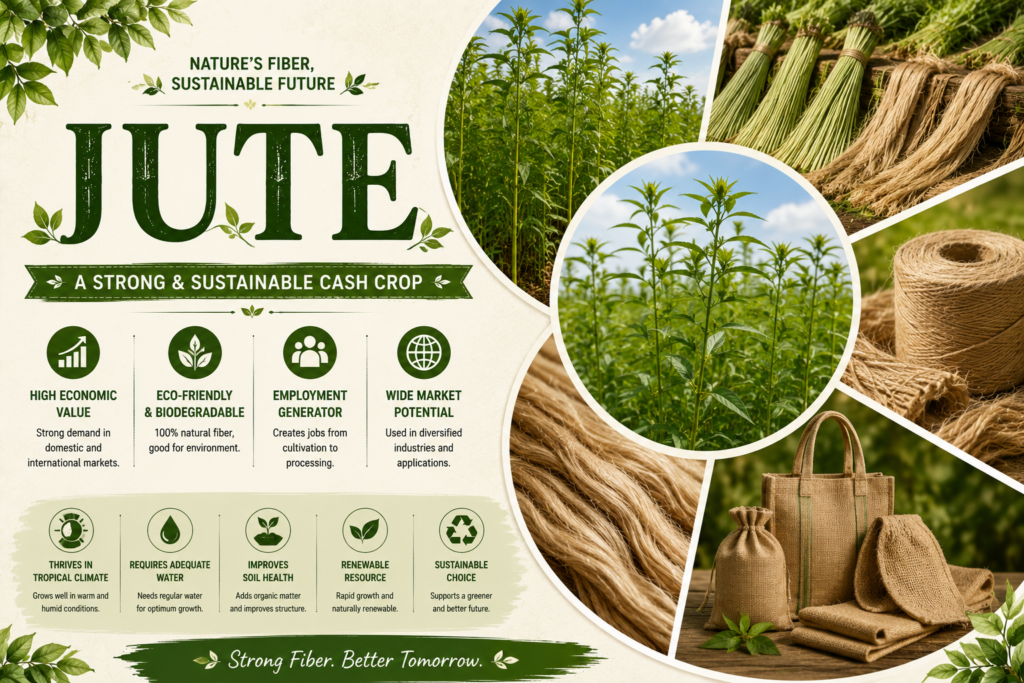
Jute
Jute
Understanding about Crop (Jute)
Nutritional Value:
- Jute plants indirectly support nutrition by contributing to sustainable agriculture, and their residues enrich soil fertility.
- Jute seeds provide oil rich in unsaturated fats suitable for industrial use but are non-edible.
- The fiber of jute is biodegradable and eco-friendly, replacing synthetic textiles.
- Jute products contribute to food storage and transportation sustainability.
- The crop enhances soil organic matter improving nutrient cycling beneficial to subsequent crops.
- Jute plants harbor beneficial microorganisms aiding soil health.
- Jute cultivation practices reduce environmental pollution compared to synthetic alternatives.
Dietary Diversity:
- Though primarily a fiber crop, jute leaves are consumed as vegetables in certain regions, adding to dietary diversity.
- The crop’s residues serve as animal fodder, supporting rural food chains.
- Jute oil is used in medicines and other non-food applications.
- Crop rotation with jute fosters crop diversity enhancing overall farm income.
- Traditional uses include culinary herbs from jute leaves in local cuisines.
- Jute by-products help sustain diversified rural livelihoods.
- The crop supports cultural practices involving plant-based foods.
Economic Importance:
- Jute is a major cash crop vital to fiber industries, especially in South Asia, contributing significantly to farmer incomes.
- It supports industries including textiles, packaging, handicrafts, and paper manufacturing.
- The crop is a major export commodity generating foreign exchange.
- Jute cultivation provides employment in rural areas with industrial supply chains.
- Government programs promote jute research, quality improvement, and market access.
- By-products such as seeds and oil diversify revenue streams.
- Its economic impact extends to allied sectors like transportation and trade.
Crop Rotation:
- Growing jute after rice or in rotation with pulses improves soil fertility and breaks pest cycles.
- Jute’s rapid biomass decomposes quickly, enriching soils naturally.
- Rotational cropping with jute improves water use efficiency and nutrient cycling.
- Crop rotations reduce reliance on chemical fertilizers and pesticides.
- Strategic rotation fosters biodiversity supporting agro-ecosystem health.
- Improved soil structure from jute rotations benefits succeeding crops.
- Crop rotation mitigates disease build-up common in monocultures.
Climate Resilience:
- Jute thrives in warm, humid climates between 24-37°C with relative humidity 65-90%.
- Requires 1500-2500 mm annual rainfall, optimally distributed during growth phases.
- Sensitive to waterlogging, necessitating well-drained, fertile alluvial soils.
- Prolonged drought reduces fiber quality but plants show moderate resilience.
- Can tolerate moderate flooding during early growth stages.
- Grows well in frost-free, tropical deltaic regions.
- Climate variations impact flowering and fiber quality.
- Proper timing of sowing and harvesting adapts to climatic shifts.
Health Benefits:
- Jute fiber is natural and hypoallergenic, making it environmentally and health-friendly.
- Jute leaves consumed in some cultures provide dietary fiber and antioxidants.
- The crop contributes indirectly to cleaner air through carbon sequestration.
- Jute-based products reduce plastic exposure, safeguarding health.
- Some traditional medicines use jute seed oil, but it is non-edible.
- Using biodegradable jute products reduces infection risks associated with plastics.
- Fiber promotes sustainable fashion with less toxic processing chemicals.
Other Important Points:
- Jute growing practices promote sustainable rural development, balancing ecology and economy.
- Jute fibers are recyclable, supporting circular economy goals.
- Research focuses on enhancing fiber quality and disease resistance.
- Policy interventions improve farmer livelihoods through better marketing and support.
- More cultivation information is accessible on All about agriculture for interested growers.
- Proper cultivation benefits soil restoration and poverty alleviation.
Key Features of Jute
Climate and Soil Requirements
- Requires tropical climate with 24°C to 37°C temperature range maintained during growth.
- High humidity above 65% and annual rainfall of 1500-2500 mm is essential for optimal fiber yield.
- Ideal soils are alluvial with good fertility, balanced texture, and adequate drainage.
- Sensitive to waterlogging; excess moisture during maturity affects fiber quality.
- Soil pH optimum between 6.0 and 7.5; liming may be needed for acidic soils.
- Loamy and sandy loam soils with organic matter favor root penetration and nutrient uptake.
- Heavy clay soils with poor drainage are unsuitable for jute cultivation.
- Proper drainage infrastructure is vital in flood-prone regions.
- Soil texture influences fiber strength and productivity.
- Soil moisture content management is critical during seedling and flowering stages.
Land Preparation
- Remove weeds and previous crop residues thoroughly to reduce pest and disease incidence.
- Plough and harrow soil multiple times to ensure fine tilth for seedbed preparation.
- Level field to facilitate irrigation and uniform seed germination.
- Incorporate organic matter like compost or farmyard manure to enhance fertility.
- Construct raised beds in areas prone to waterlogging.
- Maintain soil moisture balance, avoiding excessive wetness.
- Prepare seedbeds well in advance of sowing for better stand establishment.
- Avoid soil compaction for proper root growth.
- Use mechanical or manual land preparation methods suited to farm size.
High-Yielding and Hybrid Seed Selection
- Select certified seeds with high germination rates and vigor for high yield.
- Use varieties like JRO 3811, JRO 524, and JRC 321 known for fiber quality and resistance.
- Opt for disease-resistant cultivars based on regional adaptability.
- Store seeds properly in cool, dry environments before sowing.
- Avoid old or damaged seeds to maintain crop uniformity.
- Use seeds from reputed sources for traceability and quality assurance.
- Conduct seed testing for purity and viability.
- Replace seed stock periodically to maintain genetic integrity.
- Consider high-yielding hybrids for greater productivity.
Seed Treatment
- Treat seeds with fungicides to prevent damping-off and seed-borne diseases.
- Apply bio-inoculants to enhance nutrient uptake and root development.
- Dry seeds properly after treatment to maintain viability.
- Use seed treatments as recommended by agricultural extension services.
- Store treated seeds in sealed containers away from moisture and pests.
- Seed treatment aids early germination and seedling vigor.
- Avoid excessive chemical use that may damage seeds.
- Follow safety protocols during treatment application.
- Timely treated sowing reduces field losses.
Sowing and Planting Methods
- Sow seeds during pre-monsoon or early monsoon season to ensure adequate moisture.
- Use line sowing or broadcasting based on farm resources, with line sowing preferred for uniformity.
- Maintain spacing of 25-30 cm between rows and 5-7 cm between plants.
- Seed rate varies between 2-4 kg per acre depending on the sowing method.
- Cover seeds lightly with soil and press gently for seed-soil contact.
- Irrigate after sowing if rainfall is insufficient to aid germination.
- Thin seedlings as necessary to avoid overcrowding and ensure air circulation.
- Use pest-resistant seed varieties in high pest pressure zones.
- Follow the recommended sowing calendar to avoid climatic adversities.
Nutrient and Fertilizer Management
- Apply nitrogen at 25-35 kg/acre to boost vegetative growth and fiber production.
- Phosphorus (10-20 kg/acre) applied as basal fertilizer to improve root development.
- Potassium (15-25 kg/acre) enhances stem strength and disease resistance.
- Use organic manures to improve soil organic carbon and microbial activity.
- Micronutrient application based on soil testing improves overall crop health.
- Balanced fertilization improves fiber yield and quality.
- Nitrogen split application optimizes nutrient use efficiency.
- Avoid fertilizer overdosing to prevent negative environmental impact.
- Employ soil testing regularly to refine fertilization strategy.
Irrigation and Water Management
- Jute cultivation largely depends on rain; supplemental irrigation needed during dry spells.
- Use light surface or furrow irrigation for better moisture distribution.
- Avoid overwatering to prevent root diseases and lodging.
- Mulching conserves soil moisture reducing irrigation frequency.
- Water stress during early seedling growth can adversely affect establishment.
- Schedule irrigation considering soil texture and climatic conditions.
- Rainfall frequency is critical during the rapid growth phase.
- Efficient water management improves fiber strength and uniformity.
- Use conservation practices to optimize water use in dry areas.
Intercultural Operations
- Maintain weed-free fields through manual or mechanical weeding regularly.
- Earthing up promotes aeration and nutrient absorption.
- Remove diseased or dead plants to control infections.
- Mulching suppresses weeds and retains soil moisture.
- Practice crop rotation to break pest and disease cycles.
- Monitor intercultural activities to improve plant vigor.
- Field hygiene reduces pest populations.
- Fill gaps early to maintain stand density.
- Regular scouting optimizes intercultural timings.
Pest Management
- Important pests include jute semilooper, aphids, and whiteflies.
- Adopt IPM using predators, biopesticides, and selective insecticides.
- Early detection and control prevent severe damage.
- Use neem-based organic pesticides to reduce chemical load.
- Monitor pest populations regularly for informed decisions.
- Destroy crop residues harboring pests.
- Rotate crops to prevent pest buildup.
- Encourage biodiversity for natural pest control.
- Store fibers and seeds clean to prevent storage pests.
Disease Management
- Common diseases are stem rot, leaf spot, and anthracnose.
- Use resistant varieties and apply fungicides during outbreaks.
- Maintain ideal plant spacing to prevent humidity build-up.
- Remove and destroy infected plant parts promptly.
- Rotate with non-host crops to reduce soil-borne pathogens.
- Avoid excessive irrigation that fosters fungi.
- Disinfect tools to prevent disease spread.
- Use disease forecasting for early management.
- Monitor fields frequently for proactive control.
Harvesting and Post-Harvest Management
- Harvest jute when plants turn yellowish green, about 120-150 days after sowing.
- Cut stems close to ground level using sharp tools.
- Bundles are submerged in water (retting) for fiber separation.
- Maintain retting duration carefully for best fiber quality.
- After retting, fibers are stripped, washed, and dried thoroughly.
- Store fibers in dry, ventilated places to preserve quality.
- Proper handling reduces mechanical damage and fiber loss.
- Post-harvest by-products can be used as animal feed or organic manure.
- Market readiness increases with proper fiber grading and packaging.
Other Important Points
- Jute production supports sustainable livelihoods for millions in South Asia.
- Biodegradable jute fibers offer eco-friendly alternatives to synthetic materials.
- Innovations in seed technology and processing enhance productivity and quality.
- Detailed cultivation advice and market support are provided on All about agriculture.
- Sustainable jute farming integrates environmental conservation and economic development.
- Educational resources empower farmers for improved management and profitability.
Do’s
Don'ts
What is the environmental benefit of cultivating Jute?
Jute is a highly sustainable crop that reduces pollution by being biodegradable and helping absorb carbon dioxide, thus mitigating climate change impacts.
How does Jute cultivation affect soil health?
Jute improves soil fertility through its deep rooting system, reduces erosion, and adds organic matter when plant residues decompose, enriching the soil naturally.
Can Jute be used in products other than textiles?
Yes, Jute fibers are used in geo-textiles, paper, composites, and even as eco-friendly packaging materials, reducing reliance on plastics.
Is Jute cultivation suitable for all climates?
Jute grows best in warm, humid climates with good rainfall; it is sensitive to frost and requires well-drained fertile soils for optimal growth.
What economic opportunities does Jute farming provide?
Jute supports millions of rural livelihoods, generating income through cultivation, processing, and related industries, contributing to regional development.
How does Jute help in reducing the use of plastics?
Jute’s biodegradability and durability make it an excellent alternative to synthetic plastics for bags and packaging, reducing plastic pollution.
Are there health benefits associated with Jute?
While Jute itself isn’t consumed widely, its cultivation promotes cleaner air and a healthier environment due to its capacity to sequester carbon.
What are the ideal planting practices for Jute to maximize yield?
Proper spacing, timely sowing, and consistent weed and pest management are essential to ensure healthy Jute plants and quality fiber.
How is Jute harvested and processed?
Jute is typically harvested when plants turn yellow, followed by retting in water to separate fibers, then drying and processing into various products.
Can Jute cultivation aid in climate change adaptation?
Yes, Jute’s carbon sequestration ability and suitability for marginal lands help communities adapt by providing sustainable income sources.
What role do government policies play in promoting Jute?
Governments offer support through subsidies, research, and market development initiatives to enhance Jute farming and industry growth.
Where can farmers find more detailed guidance on Jute cultivation?
Farmers can access comprehensive cultivation advice, market information, and government schemes on agriculture portals like All about agriculture.