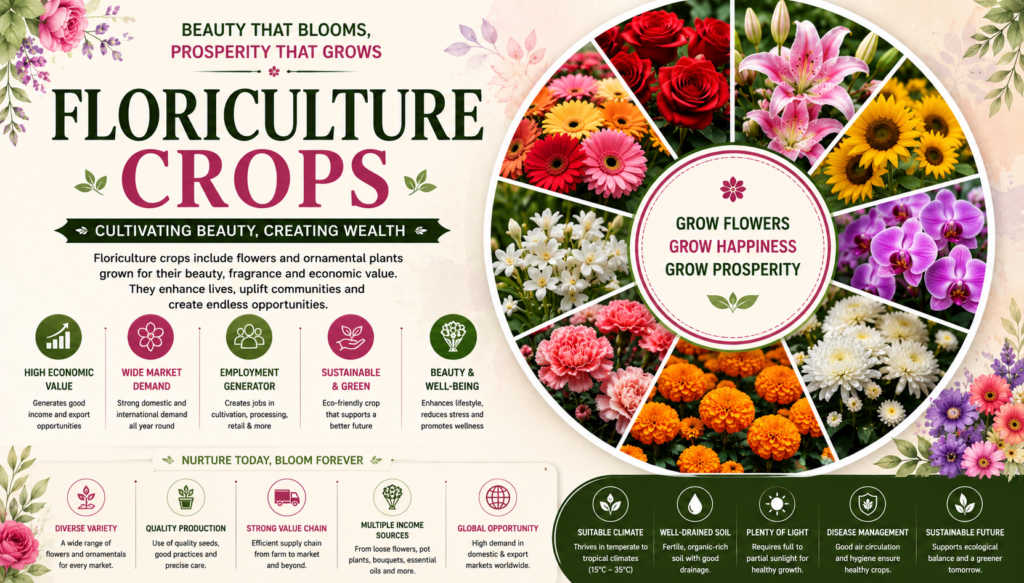
Floriculture Crops
Floriculture Crops
Understanding About Crop
Nutritional Value:
- Though floriculture crops are mostly cultivated for ornamental and commercial purposes, some also possess nutritional benefits in terms of edible flowers and medicinal properties.
- Certain flowers like marigold and chrysanthemum offer antioxidants and vitamins helpful for health.
- Nutritional content varies widely between species, with some used in traditional diets.
- Edible flowers contribute to dietary diversity by adding micronutrients and phytonutrients.
- Flowers can have essential oils and compounds used in health supplements.
- Consumption benefits skin health, digestion, and immune support.
- Always ensure flowers are grown organically for safe edible use.
Dietary Diversity:
- Edible floriculture crops expand food choices, adding color, flavor, and nutrients to meals.
- Flowers like hibiscus, rose, and nasturtium are used in teas, salads, and desserts.
- Flour from certain flowers serves as a gluten-free alternative in baking.
- Some floriculture crops provide medicinal teas promoting health and wellness.
- They diversify community diets especially during seasonal scarcities.
- Nutritionally rich flowers can be easily integrated into vegan and health-conscious diets.
- Floriculture crops broadly support food culture alongside ornamental value.
Economic Importance:
- Floriculture crops are among the most profitable cash crops due to high demand in domestic and export markets.
- They provide significant employment in production, processing, transportation, and retail sectors.
- Rising urbanization and lifestyle changes drive increasing consumption globally.
- All about agriculture offers valuable insights on market trends, seed selection, and cultivation methods to maximize income.
- Multiple harvesting cycles increase income opportunities year-round.
- Value addition through floral arrangements, pot plants, and essential oils generates diversified revenue.
- Floriculture crops support rural economies and export earnings robustly.
Crop Rotation:
- Rotating floriculture crops with vegetables or cereals helps enhance soil health and pest management.
- Crop rotation prevents depletion of soil nutrients and buildup of diseases or pests.
- Incorporating leguminous crops in rotation fixes nitrogen and improves soil fertility.
- Proper rotation aids sustainable farming by maintaining ecological balance.
- Employing green manures alongside rotation improves organic matter content.
- Supports integrated pest and weed management reducing chemical reliance.
- Crop rotation schemes are adaptable to different floriculture species requirements.
Climate Resilience:
- Floriculture crops vary widely, but many thrive in tropical to subtropical climates between 15–35°C.
- Require moderate humidity and well-distributed rainfall or irrigation for optimum flowering.
- Many flower crops tolerate drought stress with irrigation adjustments.
- Wind protection and shade provision improve resilience against climatic extremes.
- Greenhouse and shade-net technology enhance climate adaptability for sensitive species.
- Disease management improves under stable climate conditions supported by crop choice.
- Flowering and seed setting depend heavily on temperature and daylight length.
Health Benefits:
- Floriculture crops provide essential oils and bioactive compounds beneficial for skin, respiratory, and mental health.
- Aromatic flowers promote relaxation and stress relief in aromatherapy.
- Leaf and flower extracts are used in traditional medicine and cosmetics.
- Edible flowers supply antioxidants that help prevent oxidative stress and inflammation.
- Certain crops like lavender and chamomile support better sleep and digestion.
- Growing and enjoying floriculture crops enhances community well-being and cultural practices.
- Safe handling and organic cultivation are essential for health benefits to consumers.
Key Features
Climate and Soil Requirements
- Floriculture crops typically require temperate to tropical climates with temperatures ranging between 15–35°C.
- Soil should be well-drained, fertile with good organic matter content; pH varies between species, often 6.0–7.5.
- Avoid waterlogged or overly saline soils to prevent root diseases and poor growth.
- Most floriculture crops thrive under full to partial sunlight; some require shade conditions.
- Adequate air circulation reduces humidity-related fungal diseases.
- Protection from strong winds and frost improves flower quality and yield.
- Mulching conserves moisture and stabilizes root-zone temperature.
- Regular soil testing helps maintain nutrient balance and prevents deficiencies.
- Adapt soil and climate choice to specific crop requirements for success.
Land Preparation
- Clear all weeds, debris, and previous crop residues before cultivation begins.
- Plough and harrow soil thoroughly to produce a fine, level seedbed suitable for flower planting.
- Incorporate 10–15 tons/ha organic manure or compost for improved soil fertility and structure.
- Prepare raised beds, ridges, or flat beds depending on crop species and water availability.
- Level soil carefully to avoid water stagnation and ensure uniform moisture.
- Create drainage channels on sloped land to prevent erosion and waterlogging.
- Maintain field borders and roadways for easy access and clean operations.
- Avoid soil compaction to ensure good root penetration and aeration.
- Sanitize tools and avoid cross-contamination between fields.
High-Yielding and Hybrid Seed Selection
- Choose high-yielding varieties or hybrids with disease resistance and desired flower traits.
- Use certified seeds or quality planting materials from reliable suppliers and nurseries.
- Buy seeds appropriate to local agro-climatic conditions for best flowering.
- Maintain genetic purity by avoiding mixture of varieties.
- Store seed in cool, dry conditions in airtight containers.
- Test seed germination before planting to ensure high sprouting rates.
- Regularly update planting stock with improved varieties for continual yield enhancement.
- Utilize tissue-cultured plants for uniform growth and disease-free start.
- Maintain documentation on seed source and variety details.
Seed Treatment
- Treat seeds or planting materials with recommended fungicides or biocontrol agents to prevent fungal infections.
- Use natural seed treatment methods like neem or biofungicides in organic systems.
- Soak seeds in water for 12-24 hours where applicable to improve germination.
- Dry the seed or planting material adequately after treatments to prevent damage.
- Keep treated seed separately well labeled to avoid misuse.
- Sterilize seed handling tools to prevent disease spread.
- Apply treatment shortly before planting for maximum effect.
- Train workers on safety and proper treatment procedures.
- Use only registered chemicals with recommended doses.
Sowing and Planting Methods
- Sow seeds in well-prepared seedbeds, following species-specific spacing recommendations.
- Transplant healthy seedlings grown in nurseries into main fields when 4–6 weeks old.
- Use raised beds or row planting for better drainage and easier field operations.
- Maintain appropriate plant spacing to ensure good air circulation and light exposure.
- Use mulching post-planting to retain soil moisture and reduce weed pressure.
- Ensure timely planting to match optimal climatic windows for flowering and yield.
- Fill gaps within 10-15 days after planting to maintain uniform stands.
- Employ drip irrigation and fertigation during critical growth stages.
- Record planting dates and varieties for field management.
Nutrient and Fertilizer Management
- Apply 10–15 tons/ha organic compost or manure pre-planting to enrich soil.
- Use balanced NPK fertilizers adapted to flower species and soil fertility (typical rates: 100–120 kg N, 80–100 kg P2O5, 100–120 kg K2O per hectare).
- Split fertilizer doses at key crop stages: planting, vegetative, and flowering.
- Provide micronutrients like magnesium, zinc, and iron as needed for optimal flower development.
- Avoid excessive nitrogen which may promote leaf growth over flowering.
- Use foliar sprays to quickly correct mineral deficiencies.
- Incorporate biofertilizers to improve nutrient uptake and soil health.
- Maintain fertilizer application records for future efficiency improvements.
- Tailor fertilization plans according to soil test results for sustainability.
Irrigation and Water Management
- Floriculture crops require consistent moisture but avoid waterlogging.
- Drip irrigation is preferred for water efficiency and uniform supply.
- Irrigate early morning or late evening to minimize evaporation losses.
- Mulching conserves soil moisture, reducing irrigation frequency.
- Adjust water according to phenological stages – early growth and flowering need the most moisture.
- Avoid wetting flowers during irrigation to prevent disease and decay.
- Ensure proper drainage to prevent root diseases from excess water.
- Promote rainwater harvesting for supplemental irrigation in dry seasons.
- Establish a water monitoring routine for timely irrigation.
Intercultural Operations
- Weed regularly to minimize competition for water and nutrients.
- Mulch with organic materials to control weeds and maintain soil moisture.
- Thin overcrowded plants to improve light penetration and airflow.
- Remove dead or diseased leaves or flowers promptly to avoid infection spread.
- Use crop rotation and intercropping to boost soil health and biodiversity.
- Avoid deep tillage that damages root systems of sensitive floriculture crops.
- Clean tools thoroughly before and after use to prevent disease transmission.
- Educate laborers on proper handling and intercultural care.
- Maintain orderly field layout for efficient operations.
Pest Management
- Monitor and control pests like aphids, thrips, mites, and caterpillars common in floriculture crops.
- Use biological controls, neem-based products, and insecticidal soaps to minimize chemical use.
- Employ trap crops and reflective mulches to deter pests.
- Remove infested and damaged plant parts immediately.
- Rotate crops to disrupt pest life cycles.
- Avoid blanket pesticide applications; spray only at threshold levels.
- Promote habitat for natural pest predators like lady beetles.
- Regularly inspect plants especially during flowering to prevent damage.
- Train farm workers on safe and effective pest control measures.
Disease Management
- Common diseases include powdery mildew, botrytis blight, rusts, and leaf spots.
- Use resistant varieties and disease-free planting materials.
- Maintain field sanitation and remove infected plant parts on time.
- Apply fungicides or biopesticides preventively during high-risk periods.
- Ensure good plant spacing and airflow to reduce humidity and disease incidence.
- Avoid overhead irrigation, which increases leaf wetness and fungal growth.
- Rotate with non-host crops to lower soil-borne disease pressure.
- Keep records of outbreaks and treatment outcomes for future reference.
- Educate staff on disease identification and safe chemical use.
Harvesting and Post-Harvest Management
- Harvest flowers or floral parts fresh at peak bloom for highest market quality.
- Use clean, sharp tools and handle with care to avoid bruising.
- Dry flowers intended for medicinal or dried floral markets in shade with good airflow.
- Store harvested flowers in cool, humidified conditions to maintain freshness.
- Clean, grade, and pack flowers carefully for transport to reduce loss.
- Residual plant matter can be composted or used as livestock feed for resource efficiency.
- Avoid delays in post-harvest processing to minimize quality degradation.
- Keep records of yield, quality, and market preferences for improvement.
- Explore value-added products like essential oils, dried bouquets, and floral extracts.
Other Important Points
- Floriculture crops play a significant role in rural livelihoods and export economies.
- Many flower types have multiple uses beyond ornamentation, including health and culinary benefits.
- Climate-smart production and modern technologies enhance quality and yield.
- For comprehensive updates and expert advice on floriculture crops, visit All about agriculture website.
Do’s
Don'ts
What are the common methods used for propagation in floriculture crops?
Floriculture crops are typically propagated through seeds, cuttings, grafting, or tissue culture depending on the plant species and desired quality.
How do floriculture crops benefit local economies and employment?
Floriculture crops create income opportunities in farming, processing, and trade, supporting millions of jobs in rural and urban areas.
What types of soils are best suited for growing floriculture crops?
Well-drained, fertile soils rich in organic matter with neutral to slightly acidic pH levels favor the healthy growth of floriculture crops.
What are the water requirements for floriculture crops?
Floriculture crops usually require moderate, consistent irrigation with good drainage to avoid root diseases and ensure optimal flowering.
How important is climate control in the cultivation of floriculture crops?
Climate control, including temperature, humidity, and light management, is crucial for high-quality flower production in floriculture crops.
What are effective pest management strategies for floriculture crops?
Integrated pest management involving biological agents, cultural practices, and selective chemical use helps keep floriculture crops healthy and pest-free.
Which floriculture crops are best suited for commercial export?
High-demand floriculture crops for export include roses, orchids, chrysanthemums, and gerberas grown under quality standards and proper post-harvest handling.
What post-harvest care should floriculture crops receive to maintain freshness?
Proper cooling, handling, and packaging immediately after harvest help preserve the beauty and shelf life of floriculture crops.
How can floriculture crops contribute to environmental sustainability?
Floriculture crops can support biodiversity, improve air quality, and promote sustainable land use when grown with eco-friendly methods.
What are the typical spacing and planting densities for floriculture crops?
Spacing varies by flower type but maintaining adequate distance improves airflow, reduces disease, and encourages uniform blooms in floriculture crops.
Can floriculture crops be grown organically?
Yes, many floriculture crops can be cultivated organically using natural fertilizers, pest control, and sustainable practices to produce chemical-free flowers.
Where can growers find updated market prices and cultivation tips for floriculture crops?
All reliable and current information about floriculture crops, market trends, and sustainable farming techniques are available on our website All about agriculture.