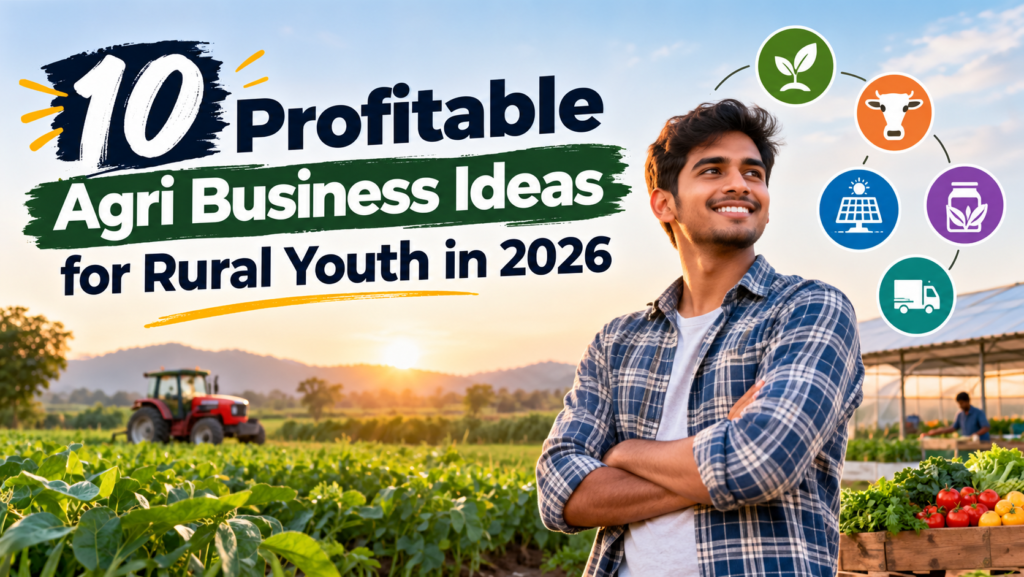
10 Profitable Agri Business Ideas for Rural Youth in 2026
Agriculture is no longer limited to traditional crop cultivation. In 2026, rural youth can explore several agri business ideas that combine farming with food processing, technology, livestock, logistics, and value-added services. With growing interest in sustainable agriculture, direct-to-consumer food products, agri-tech, and farm mechanization, rural areas are creating new opportunities for entrepreneurship.
For young people looking to build a rural business, agriculture can offer multiple income streams beyond simply selling raw produce. Here are 10 promising agriculture business ideas to consider in 2026.
- Organic and Natural Farming
The demand for chemical-free and sustainably produced food continues to create opportunities for farmers and rural entrepreneurs. Organic farming can focus on vegetables, fruits, pulses, spices, and other high-value crops.
Rural youth can increase profitability by selling directly to consumers, local retailers, restaurants, or through online platforms instead of depending entirely on traditional wholesale markets.
- Dairy Farming and Value-Added Dairy Products
Dairy farming remains a practical rural business because milk has consistent demand. Instead of selling only raw milk, entrepreneurs can explore value-added products such as paneer, curd, ghee, butter, and flavored dairy products.
Small-scale processing can help rural businesses improve margins while creating employment opportunities within the local community.
- Food Processing Business
Food processing is one of the most attractive agri business ideas for rural youth because it adds value to agricultural produce. Entrepreneurs can process tomatoes into sauces, fruits into jams, grains into flour, or spices into packaged products.
Local processing also helps reduce post-harvest losses and allows agricultural products to reach consumers in a more market-ready form.
- Mushroom Farming
Mushroom cultivation can be started on a relatively small scale and does not necessarily require large agricultural landholdings. Oyster and other commercially cultivated mushrooms can be sold to restaurants, retailers, wholesalers, and consumers.
With proper training, climate management, hygiene, and marketing, mushroom farming can become a supplementary income source for rural families.
- Beekeeping and Honey Production
Beekeeping is another promising rural business that can complement crop farming. Bees support pollination while producing honey and other marketable products such as beeswax.
Entrepreneurs can develop a local honey brand and sell products through farmers’ markets, retail stores, social media, and e-commerce channels.
- Agri-Tech and Digital Farming Services
Technology is changing the way farmers monitor crops and manage resources. Rural youth with digital skills can create businesses around agri-tech, including farm data services, crop monitoring, digital marketing for farmers, weather-based advisory services, and online agricultural marketplaces.
Even without developing sophisticated technology, young entrepreneurs can act as local digital service providers who help farmers adopt useful agricultural tools.
- Custom Hiring and Farm Machinery Services
Modern farm machinery can improve efficiency, but purchasing expensive equipment may not be practical for every farmer. This creates an opportunity for a farm machinery rental or custom hiring business.
Young entrepreneurs can provide tractors, rotavators, seed drills, reapers, harvesters, and other implements on a rental or service basis. This model can generate recurring revenue while helping small and marginal farmers access mechanization.
- Poultry Farming
Poultry farming can provide regular income through the production of eggs or meat. Rural youth can begin with a small operation and expand gradually based on local demand.
Profitability depends on factors such as breed selection, feed costs, disease prevention, housing, and market prices. Good farm management and reliable local buyers are essential.
- Nursery and High-Value Plant Business
A plant nursery can be a profitable rural business serving farmers, gardeners, landscapers, and homeowners. Entrepreneurs can grow fruit saplings, vegetable seedlings, ornamental plants, medicinal plants, and forestry species.
Demand for quality planting material makes nurseries particularly interesting for young entrepreneurs who have access to water, suitable land, and basic horticultural knowledge.
- Agricultural Logistics and Direct Farm Marketing
Getting farm produce from the field to consumers is an important part of the agricultural value chain. Rural youth can build businesses around collection, grading, packaging, transportation, storage, and direct marketing.
Selling produce through farmer groups, local retailers, restaurants, subscription models, or digital channels can potentially reduce dependence on multiple intermediaries.
Why Agri Business Can Be a Good Opportunity for Rural Youth in 2026
The future of rural entrepreneurship is increasingly connected to value addition, agricultural technology, food processing, farm mechanization, and direct market access. Instead of depending on one agricultural activity, rural entrepreneurs can develop integrated businesses—for example, combining crop cultivation with processing, packaging, or direct sales.
Government schemes, agricultural training programs, digital platforms, and improved access to farm machinery can also help entrepreneurs explore new opportunities. However, profitability varies according to location, investment, market demand, input costs, and business execution.
Conclusion
These 10 Profitable Agri Business Ideas for Rural Youth in 2026 demonstrate that agriculture can offer opportunities across the entire value chain. Organic farming, dairy, food processing, mushroom cultivation, beekeeping, agri-tech, machinery services, poultry, nurseries, and agricultural logistics can all be explored according to local resources and market demand.
For rural youth, the key is not simply choosing a business idea but identifying a genuine local demand, starting at a manageable scale, controlling costs, and gradually adding value to agricultural products and services.