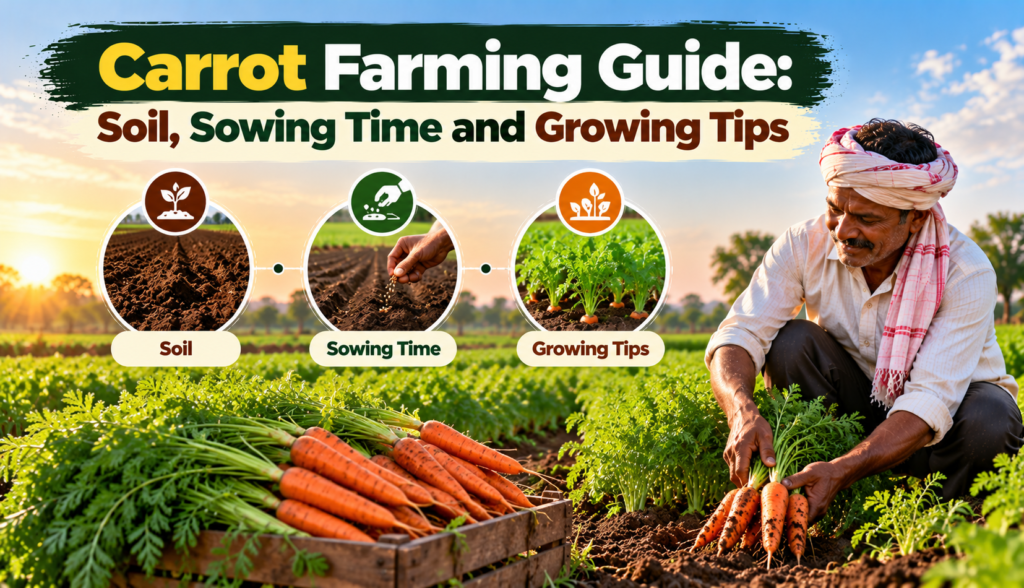
Carrot Farming Guide: Soil, Sowing Time and Growing Tips
Carrot farming is an important part of vegetable cultivation in India, particularly during the winter season in many northern plains. Growing healthy carrots requires suitable soil, the right sowing time, quality seeds, balanced nutrient management, and consistent irrigation. By following proper carrot cultivation practices, farmers can improve root quality, reduce crop losses, and produce marketable carrots for fresh consumption and processing.
Carrot (Daucus carota L.) is a cool-season root vegetable valued for its beta-carotene content, crisp texture, and versatility in Indian cooking. Selecting a suitable variety and preparing the field properly are essential steps for successful carrot production.
- Best Soil and Climate for Carrot Farming
Carrots grow best in deep, loose, well-drained sandy loam or loamy soil rich in organic matter. A fine soil structure allows the roots to develop evenly and helps produce straight, smooth carrots.
For better carrot root development, farmers should consider these conditions:
- Soil type: Deep, loose, stone-free sandy loam or loam.
- Soil pH: Approximately 6.0–7.0 is generally suitable, although recommendations vary by region and soil conditions.
- Climate: Cool weather supports good root development and colour formation.
- Drainage: Avoid waterlogged fields because excess moisture can damage roots and encourage disease.
Hard soil, stones, compacted layers, and fresh manure can cause forked, twisted, or split roots. Conducting a soil test before cultivation helps farmers determine the appropriate nutrient and soil-management requirements.
- Best Time for Carrot Sowing in India
The best carrot sowing time in India depends on the variety, climate, altitude, and local growing conditions. In many northern plains, carrot cultivation is concentrated in the autumn and winter seasons, while suitable varieties can be grown during different periods in other regions.
Before sowing, farmers should check local agricultural university or Krishi Vigyan Kendra recommendations for their area. Choosing the correct sowing window helps the crop establish under favourable temperatures and improves root quality.
Farmers should also select varieties suited to their region. Pusa Kesar, Pusa Meghali, and other locally recommended varieties may be considered according to climate, root colour, maturity, and market demand. Seed selection should be based on reliable varietal recommendations rather than yield claims alone.
- Land Preparation for Better Root Growth
Proper land preparation is one of the most important steps in carrot cultivation. The field should be ploughed and levelled to create a fine, friable seedbed without large soil clods or stones.
Follow these field-preparation practices:
- Remove weeds, crop residues, stones, and other obstructions.
- Loosen the soil sufficiently to support downward root growth.
- Incorporate well-decomposed farmyard manure according to soil-test results and local recommendations.
- Prepare raised beds or suitable ridges where drainage or field conditions require them.
- Ensure the seedbed has enough moisture before sowing.
Avoid applying fresh or incompletely decomposed manure immediately before planting. Properly decomposed organic matter improves soil structure and supports healthy crop establishment.
- Carrot Seed Rate, Spacing and Sowing Method
Carrots are generally grown by direct sowing because transplanting can damage their developing taproots. Uniform sowing and appropriate spacing help produce straight roots and simplify intercultural operations.
A seed rate of approximately 4–6 kg per hectare is used in some cultivation recommendations, but the actual requirement depends on the variety, seed quality, germination rate, and sowing method.
For effective carrot seed sowing:
- Sow seeds in rows at locally recommended spacing, commonly around 25–30 cm apart.
- Cover seeds lightly with fine soil; avoid sowing too deeply.
- Maintain even moisture during germination.
- Thin crowded seedlings after establishment to provide sufficient space for root development.
- Use quality seeds from a reliable supplier.
Seed germination can be slow or uneven if the soil dries out or forms a hard crust. Gentle irrigation and careful seedbed management help improve crop establishment.
- Irrigation and Nutrient Management
Carrot farming requires consistent soil moisture, especially during germination and root development. Water stress can restrict growth, while irregular watering after dry periods may contribute to root cracking.
Give light irrigation after sowing and adjust subsequent irrigation according to soil moisture, rainfall, temperature, and crop stage. Avoid excessive watering and standing water. Drip irrigation may be useful where farmers need better control over water application, depending on field layout and investment capacity.
Nutrient management should be based on soil testing and regional recommendations. Well-decomposed farmyard manure can improve soil structure and organic matter, while balanced fertilizer application supports crop growth. Excess nitrogen may encourage excessive foliage at the expense of desirable root development, so fertilizer doses should not be applied indiscriminately.
- Weed Control and Crop Protection
Early weed control is essential because carrot seedlings grow slowly and compete poorly with weeds during establishment. Remove weeds carefully without damaging developing roots.
Monitor the crop regularly for leaf diseases, soil-borne problems, and root-knot nematodes. Use crop rotation, clean field practices, suitable drainage, and healthy seeds as part of an integrated crop-management approach.
If pests or diseases appear, identify the problem before selecting a treatment. Use only locally approved crop-protection products at label-recommended doses and follow the prescribed safety precautions and waiting period before harvest.
- Carrot Harvesting and Post-Harvest Handling
Carrots may become ready for harvesting in approximately 90–120 days, depending on the variety, season, and growing conditions. Farmers should follow the variety’s maturity guidance and check root size, colour, and firmness before harvesting.
Harvesting too early may reduce marketable root size, while delayed harvesting can affect tenderness and quality. Loosen the soil carefully before pulling carrots to minimise breakage and mechanical damage.
After harvesting, remove excess soil gently, separate damaged roots, and sort produce according to size and quality. Keep harvested carrots away from direct sunlight and transport them in clean containers to reduce moisture loss and physical damage.
- Tips to Improve Carrot Quality and Farm Returns
Successful carrot cultivation depends on managing soil, moisture, crop nutrition, and market requirements together. Farmers can improve production decisions by following these practices:
- Choose varieties suitable for local climate and buyer preferences.
- Maintain a fine, loose seedbed for straight root development.
- Use soil testing to guide fertilizer and organic-manure application.
- Maintain consistent moisture and ensure good drainage.
- Thin seedlings and control weeds at the appropriate stage.
- Harvest at the recommended maturity and handle roots carefully.
- Check local mandi prices, market demand, and transport costs before planning commercial production.
Carrot farming can provide an opportunity for vegetable growers when crop management is matched to local conditions and market demand. Careful planning from seed selection to post-harvest handling helps improve root quality, reduce avoidable losses, and support more informed cultivation decisions.
Conclusion
For successful carrot farming in India, prioritise suitable sowing time, loose and well-drained soil, quality seeds, uniform moisture, and balanced nutrition. Following region-specific agricultural recommendations can help farmers grow healthier carrots and improve their chances of producing marketable roots.