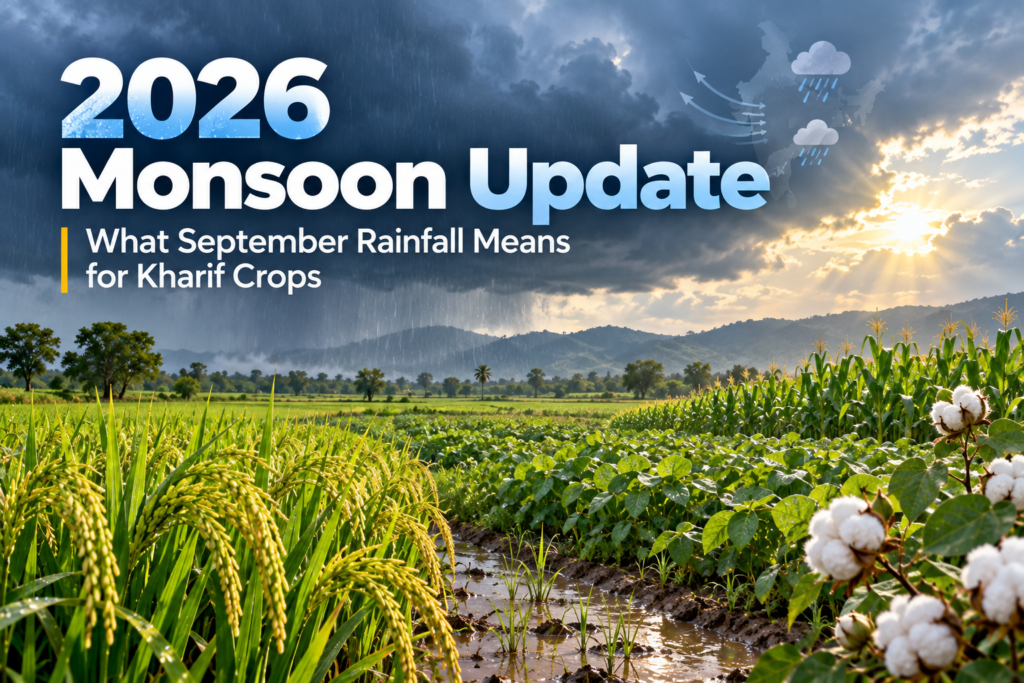
2026 Monsoon Update: What September Rainfall Means for Kharif Crops
The 2026 monsoon update is becoming increasingly important for Indian farmers as the southwest monsoon enters its final phase. September rainfall is particularly significant because several Kharif crops are now in critical growth and maturity stages. Uneven rainfall, dry spells and sudden heavy showers can directly affect crop development, soil moisture and final farm yields.
According to the latest India Meteorological Department (IMD) information, rainfall conditions remain uneven across India, while the southwest monsoon is approaching its withdrawal phase. IMD rainfall data provides daily, weekly, monthly and cumulative rainfall information through September 16, 2026.
For farmers, the key question is no longer simply whether it will rain, but where, when and how much rain will occur during the remaining Kharif season.
2026 Monsoon Update: Current Rainfall Situation
The 2026 monsoon update points to a season marked by significant regional variation. Rainfall has not been evenly distributed across the country, creating different conditions for farmers in different states.
Recent reports based on IMD data indicated that cumulative southwest monsoon rainfall remained below normal in early September, while the Southern Peninsula recorded a particularly large deficit. At the same time, some regions continued to receive useful rainfall, highlighting the uneven nature of the 2026 monsoon.
The monsoon is also expected to begin withdrawing from northwest India around September 19, slightly later than the normal withdrawal date of September 17. However, rainfall activity can continue in several regions even as withdrawal begins.
Therefore, farmers should rely on district-level weather forecasts and local advisories, rather than assuming that national rainfall trends will reflect conditions in their own fields.
Why September Rainfall Matters for Kharif Crops
September is an important month for Kharif farming because crops such as soybean, paddy, maize, cotton, pulses and oilseeds may be approaching important reproductive, grain-filling or maturity stages.
Adequate soil moisture during these stages can support crop development. However, prolonged dry conditions may increase moisture stress, particularly in rainfed farming areas.
On the other hand, excessive rainfall in a short period can create waterlogging, soil erosion and disease pressure. Heavy showers close to harvest can also create difficulties for farmers trying to dry or harvest mature crops.
Recent agricultural reports have highlighted concerns about the effect of erratic monsoon conditions on standing Kharif crops and agricultural productivity.
Impact of September Rainfall on Major Kharif Crops
Paddy
Rice requires adequate water availability during several stages of crop development. Farmers should monitor standing water, drainage and local rainfall forecasts. In areas receiving excessive rain, proper field drainage becomes especially important.
Soybean
Soybean can be affected by both moisture stress and excessive moisture. Farmers should monitor fields for waterlogging and disease symptoms, particularly after repeated rainfall.
Maize
For maize, moisture availability during reproductive stages can influence grain development. Farmers should monitor crop conditions closely if September rainfall remains irregular.
Cotton
Cotton farmers should pay attention to rainfall intensity, humidity and pest activity. Excess moisture combined with humid conditions can increase disease and pest-related concerns.
Pulses and Oilseeds
Tur, groundnut and other pulses and oilseeds can be sensitive to prolonged moisture stress as well as waterlogging. Field drainage and timely crop monitoring can therefore become important during the final monsoon weeks.
How Farmers Can Manage Uneven Rainfall…h3
The latest September rainfall 2026 situation makes field-level planning particularly important. Farmers can take several practical steps:
- Check local IMD and agricultural weather advisories regularly.
- Avoid unnecessary irrigation when rainfall is expected.
- Maintain drainage channels in fields vulnerable to waterlogging.
- Monitor crops after heavy rainfall for disease and pest symptoms.
- Check soil moisture before irrigation decisions.
- Harvest mature crops when weather conditions and crop maturity allow.
- Keep harvested produce protected from unexpected rain.
- Record field conditions to support better planning for the upcoming Rabi season.
Farmers should also avoid making major crop-management decisions based only on national rainfall headlines because rainfall can vary significantly between districts.
What Farmers Should Watch in Late September
As the 2026 monsoon update develops, farmers should focus on four major indicators: rainfall distribution, soil moisture, crop maturity and the timing of monsoon withdrawal.
The remaining rainfall can still provide useful moisture in some agricultural regions. However, the benefit depends on crop stage and local conditions. A moderate, well-distributed rainfall event may be more useful to a standing crop than a short period of extremely heavy rain.
The rainfall outlook is also important for the transition from Kharif to Rabi farming. Lower soil moisture at the end of the monsoon could affect land preparation and water availability for early Rabi operations. Current agricultural assessments have also raised concerns about how deficient monsoon rainfall could affect the upcoming Rabi season.
Key Takeaway for Farmers
The biggest message from the 2026 monsoon update is that rainfall distribution matters as much as total rainfall. While some parts of India have experienced useful showers, other regions continue to face rainfall deficits.
Farmers should therefore follow local weather forecasts, IMD advisories and crop-specific recommendations before making irrigation, harvesting or crop-protection decisions. With the monsoon nearing withdrawal, protecting existing Kharif crops and preparing fields for the next season should remain key priorities.