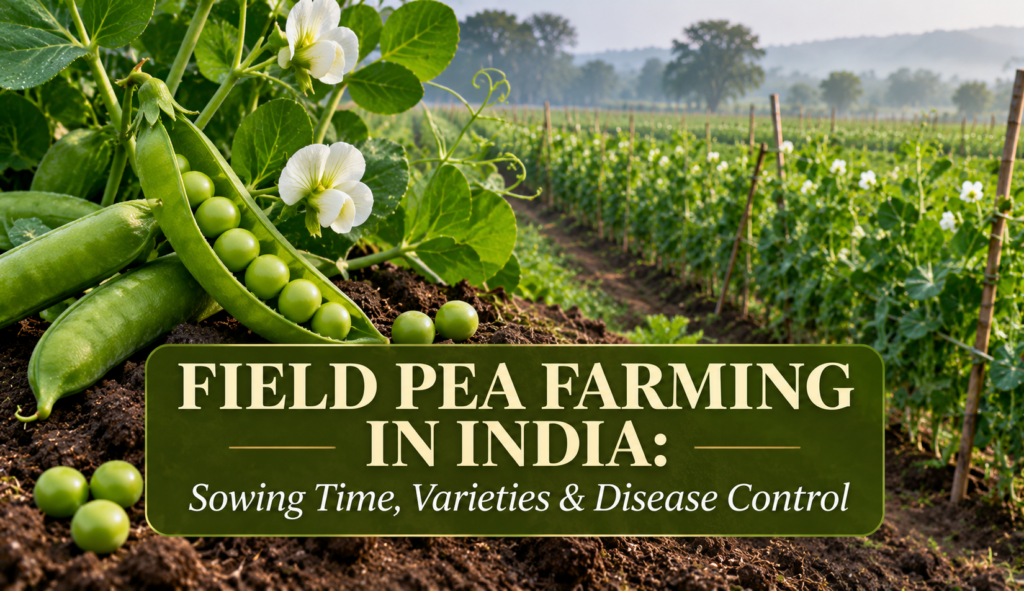
Field Pea Farming in India: Sowing Time, Varieties & Disease Control
Field pea (Matar), scientifically known as Pisum sativum, is an important rabi pulse crop cultivated across several parts of India. It is valued for its protein-rich seeds, soil fertility benefits and demand in food processing and agricultural markets. Successful field pea cultivation depends on selecting suitable varieties, maintaining the correct sowing time, using quality seeds and managing crop diseases effectively.
With increasing interest in pulse production, improved field pea varieties and scientific crop management practices can help farmers achieve better productivity and crop quality.
- Climate and Soil Requirements for Field Pea Cultivation
Field pea is a cool-season crop that grows best under moderate winter temperatures. It performs well in regions with cool weather during vegetative growth and relatively dry conditions during maturity.
Suitable soil conditions:
- Soil type: Well-drained loamy or sandy loam soil.
- Ideal soil pH: Approximately 6.5–7.5.
- Temperature: Cool conditions are suitable for healthy crop development.
- Drainage: Avoid waterlogged fields because excess moisture can damage roots and encourage fungal diseases.
Farmers should select fields with good drainage and adequate soil moisture. Conducting a soil test before cultivation helps determine the appropriate fertilizer and soil amendment requirements.
- Best Sowing Time for Field Pea in India
The ideal field pea sowing time generally falls between mid-October and mid-November, depending on the region, variety and local climatic conditions. Timely sowing helps the crop establish properly and complete its growth cycle under favourable winter conditions.
Recommended sowing period:
- Northern India: October to mid-November.
- Central India: Mid-October to mid-November.
- Eastern India: October to November, depending on local recommendations.
Late sowing can expose the crop to higher temperatures during flowering and pod formation, potentially reducing productivity.
Before sowing, farmers should prepare a fine, level seedbed through ploughing and harrowing. Line sowing using a seed drill helps maintain uniform plant spacing and makes intercultural operations easier.
- Improved Field Pea Varieties for Higher Production
Selecting the right field pea variety is essential for achieving good yield, disease resistance and market quality. Farmers should choose certified seeds recommended for their agricultural zone.
Some field pea varieties developed or documented by Indian agricultural research institutions include:
Variety | Important characteristics |
IPF 99-25 (Adarsh) | Tall variety with powdery mildew resistance |
IPFD 99-13 (Vikas) | Dwarf variety with powdery mildew resistance |
IPFD 01-10 (Prakash) | Large seeds and powdery mildew resistance |
IPF 05-19 (Aman) | Powdery mildew resistance and rust tolerance |
IPFD 10-12 | Green-seeded dwarf variety with powdery mildew resistance |
IPFD 11-5 | Powdery mildew resistance and moderate pod borer tolerance |
IPFD 12-2 | Resistance to powdery mildew and pod borer |
Variety selection should consider local soil conditions, irrigation availability, crop duration, seed demand and disease prevalence. Always check the latest regional recommendations before purchasing seeds.
- Seed Rate, Spacing and Seed Treatment
Using the recommended seed rate and spacing ensures uniform crop establishment and reduces excessive competition between plants.
For many field pea production systems, approximately 75–100 kg of seed per hectare is used, depending on seed size, variety and sowing method.
Important sowing practices:
- Maintain approximately 30 cm row spacing for suitable varieties, adjusting according to local recommendations.
- Place seeds around 4–6 cm deep in properly prepared soil.
- Use healthy, certified and disease-free seeds.
- Treat seeds with an approved seed-treatment product or recommended biological treatment according to agricultural university guidance.
- Rhizobium inoculation, where recommended, can support biological nitrogen fixation.
Avoid using damaged, shrivelled or infected seeds because they can result in poor germination and uneven crop growth.
- Irrigation and Fertilizer Management
Field pea requires balanced nutrition and careful irrigation for healthy vegetative growth, flowering and pod development. Excessive irrigation should be avoided because waterlogging increases the risk of root diseases.
In rainfed conditions, the crop can often utilise residual soil moisture. Under irrigated conditions, one irrigation around 45 days after sowing and another during pod development may be required, depending on soil moisture and weather conditions.
Fertilizer management:
- Apply well-decomposed farmyard manure before sowing.
- Use nitrogen, phosphorus and potassium according to soil-test results.
- Provide phosphorus as recommended because it supports root development and reproductive growth.
- Avoid excessive nitrogen application, as it can encourage unnecessary vegetative growth.
Farmers should follow local agricultural university fertilizer recommendations rather than applying the same fertilizer dose to every field.
- Major Field Pea Diseases and Their Management
Disease management is important for protecting field pea production, particularly during humid weather and periods of excessive soil moisture.
Powdery Mildew: This fungal disease produces white powder-like growth on leaves and stems. Severe infection can affect photosynthesis and reduce seed development.
Management:
- Grow resistant or tolerant varieties.
- Maintain appropriate plant spacing.
- Monitor crops regularly, especially during humid conditions.
- Use locally recommended fungicides when necessary.
Fusarium Wilt: Infected plants may show yellowing of lower leaves, stunted growth and gradual wilting. The disease affects water movement through the plant.
Management:
- Use certified, disease-free seeds.
- Grow locally recommended wilt-resistant varieties.
- Follow crop rotation with non-host crops.
- Remove and destroy infected plants.
- Use approved seed treatments as recommended by agricultural experts.
Rust Disease: Rust infection appears as reddish-brown or brown pustules on leaves and stems. Severe infection can weaken plants and affect crop development.
Management:
- Select tolerant varieties where available.
- Remove infected crop residues.
- Maintain field sanitation.
- Monitor the crop and use recommended fungicides when required.
Integrated disease management, including resistant varieties, clean seeds, crop rotation and regular monitoring, is more sustainable than relying only on chemical treatments.
- Weed Management and Harvesting
Weeds compete with field pea plants for sunlight, nutrients, water and growing space. Early weed management is particularly important because competition during initial crop growth can affect productivity.
Farmers can use timely intercultural operations and manual weeding to control unwanted vegetation. Where herbicides are required, use only products registered for field pea and follow the recommended application stage and label instructions.
Field pea harvesting generally begins when the pods turn yellowish-brown and the seeds become sufficiently mature. Harvesting should be completed at the appropriate stage to minimise shattering and post-harvest losses.
After harvesting, dry the produce properly before threshing and storage. Store clean, dry seeds in moisture-protected conditions to maintain quality.
Conclusion
Field pea cultivation can provide farmers with an additional rabi-season income opportunity while supporting India’s pulse production. Timely sowing, suitable varieties, certified seeds, balanced fertilizer application and integrated disease management are essential for successful production.
Farmers should follow region-specific recommendations from ICAR institutes, Krishi Vigyan Kendras and state agricultural universities to improve field pea productivity and maintain crop quality.