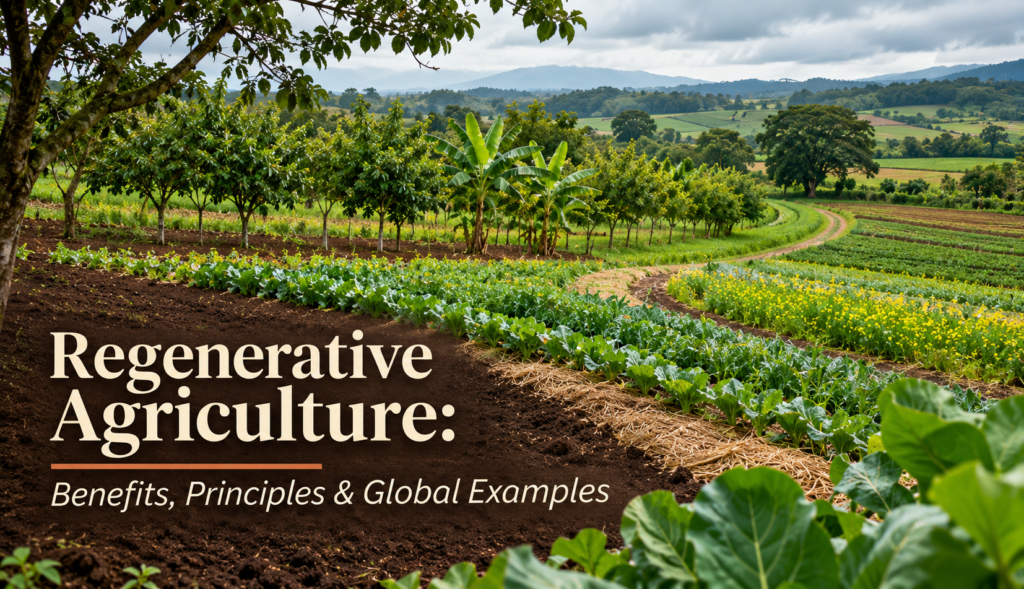
Regenerative Agriculture: Benefits, Principles & Global Examples
Agriculture is facing growing challenges from declining soil fertility, water shortages, unpredictable rainfall and climate change. Regenerative agriculture is emerging as an important approach to address these problems by improving soil health, restoring biodiversity and building more resilient farming systems. Unlike conventional farming approaches that primarily focus on maintaining agricultural productivity, regenerative agriculture aims to improve the natural resources that support food production.
Across India and other agricultural economies, farmers, researchers and agricultural organisations are exploring regenerative farming practices such as crop rotation, cover cropping, minimum tillage, agroforestry and integrated farming. These techniques can help create healthier soils while supporting long-term agricultural productivity.
What Is Regenerative Agriculture?
Regenerative agriculture is a farming approach that focuses on restoring soil health, protecting biodiversity, improving water management and strengthening the natural ecosystem. It uses agricultural practices that work with natural processes rather than depending entirely on external chemical inputs and intensive soil cultivation.
The primary objective is to improve the long-term condition of farmland while maintaining productive and economically viable farming systems.
According to the Food and Agriculture Organization (FAO), regenerative agriculture is a holistic approach to managing agricultural ecosystems that supports the restoration of land, soil and biodiversity.
Unlike a single farming technique, regenerative agriculture combines several methods according to local soil conditions, climate, crop requirements and farmers’ needs.
Key Principles of Regenerative Agriculture
Regenerative agriculture follows interconnected principles that help improve soil productivity and environmental sustainability.
- Minimum Soil Disturbance
Reducing excessive ploughing and tillage helps protect soil structure and the organisms living beneath the surface. Minimum tillage and zero-tillage practices can reduce erosion, preserve soil moisture and support soil biological activity.
- Maintaining Soil Cover
Keeping agricultural land covered with crop residues, mulch or cover crops protects the soil against wind and water erosion. Soil cover also helps conserve moisture, regulate soil temperature and gradually add organic matter.
- Crop Rotation and Diversification
Growing different crops in rotation instead of repeatedly cultivating the same crop can improve nutrient cycling and reduce the pressure from crop-specific pests and diseases. Including pulses and leguminous crops can also contribute to soil fertility through biological nitrogen fixation.
- Increasing Biodiversity
Growing different crops, planting trees and maintaining natural vegetation around agricultural fields can support beneficial insects, pollinators and soil microorganisms. Greater biodiversity helps create more balanced agricultural ecosystems.
- Integrating Livestock and Farming
Combining livestock with crop production allows farmers to use farm resources more efficiently. Properly managed animal manure can contribute organic matter and nutrients to the soil, while crop residues can provide livestock feed.
- Efficient Water and Nutrient Management
Drip irrigation, rainwater harvesting, composting and balanced nutrient management can improve resource efficiency. These practices help farmers reduce unnecessary input use while supporting crop growth.
Major Benefits of Regenerative Agriculture
Adopting regenerative agriculture can provide environmental, agricultural and economic benefits. However, the actual results depend on local conditions, implementation and long-term management.
Improved Soil Health: Practices such as cover cropping, crop rotation and organic matter application can improve soil structure, microbial activity and nutrient cycling. Healthy soil supports better root development and sustainable crop production.
Better Water Retention: Organic matter and improved soil structure can increase water infiltration and help retain moisture. This can make agricultural fields more resilient during dry periods.
Reduced Soil Erosion: Crop residues, cover crops and reduced tillage protect exposed soil from heavy rainfall and wind. This helps preserve valuable topsoil.
Climate Change Mitigation: Increasing soil organic carbon and maintaining tree cover can contribute to carbon storage. However, the amount of carbon stored varies by soil type, climate and farming practices.
Greater Biodiversity: Crop diversification, agroforestry and reduced disturbance can create better habitats for pollinators, beneficial insects and soil organisms.
Long-Term Farm Resilience: Diversified farming systems can reduce dependence on a single crop and improve the ability to manage weather-related risks. Reduced input requirements may also improve profitability when implemented successfully.
Global Examples of Regenerative Agriculture
Regenerative agriculture is gaining attention across different countries, with farmers adapting its principles to local agricultural conditions.
India: Regenerative Cotton Farming in Maharashtra
Maharashtra has become an important example of regenerative cotton production. Under the Regenerative Cotton Standard initiative, approximately 5,000 farmers across more than 70 villages adopted regenerative practices.
The initial results reported by the programme included around 4,400 tonnes of ginned cotton, a 2% increase in yield compared with the previous harvest and a 7% reduction in production costs. These figures demonstrate the potential of regenerative approaches, although outcomes can differ between farming regions and seasons.
Nicaragua: Regenerative Coffee Farming
La Cumplida, a coffee farm in Nicaragua, became the first Rainforest Alliance Certified Regenerative farm. Its farming approach focuses on improving soil conditions, supporting biodiversity and strengthening the natural environment.
The initiative has reported the return of beneficial species, including bees, spiders and birds, which can contribute to natural pest management and ecosystem balance.
Brazil: Regenerative Farming in the Cerrado
Brazil is also exploring regenerative agriculture through large-scale farming initiatives. In 2026, the Regenerative Incentive System pilot project was implemented across five farms in the Brazilian Cerrado, covering approximately 15,000 hectares.
The project focuses on testing regenerative farming practices under commercial agricultural conditions and understanding how these approaches can be adapted to different production systems.
Challenges in Adopting Regenerative Agriculture
Despite its potential, regenerative agriculture faces several adoption challenges.
- Initial investment: Farmers may need new equipment, seeds, training and infrastructure to change existing practices.
- Knowledge gaps: Understanding cover crops, soil management, crop diversification and biological inputs requires technical guidance.
- Transition period: Soil improvements and economic benefits may take several growing seasons to become visible.
- Regional differences: A farming practice that works in one climate or soil type may not produce similar results elsewhere.
- Market access: Farmers may need reliable buyers, transparent certification systems and better market opportunities for regeneratively produced crops.
Agricultural extension services, farmer producer organisations (FPOs), research institutions and government programmes can help address these challenges through training, demonstrations and technical support.
The Future of Regenerative Agriculture in India
Regenerative agriculture can play an important role in India’s transition towards resource-efficient and climate-resilient farming. Natural farming, agroforestry, conservation agriculture, micro-irrigation and integrated farming systems offer practical opportunities to improve agricultural sustainability.
For Indian farmers, the best starting point is to assess soil conditions, retain suitable crop residues, introduce crop rotation, improve water management and gradually adopt practices that match local requirements.
Regenerative agriculture is not a quick solution or a replacement for every existing farming method. It is a long-term approach that connects soil health, biodiversity, water conservation and farm profitability.
As awareness, research and market support continue to develop, regenerative agriculture could become an important part of building productive, resilient and environmentally responsible farming systems.