Farmer Producer Organizations: 7 Benefits for Small Farmers
Farmer Producer Organizations (FPOs) help small and marginal farmers improve their bargaining power, access agricultural inputs, connect with larger markets and explore value-added farming businesses. By working collectively, farmers can combine their produce, reduce certain operational costs and strengthen their position in agricultural supply chains.
In India, FPOs are becoming an important part of agricultural development, rural entrepreneurship and collective marketing. The Government of India’s Central Sector Scheme for the Formation and Promotion of 10,000 FPOs supports farmer collectives through eligible financial assistance, professional guidance and market linkages. The government reported that the target of 10,000 FPOs had been achieved under the scheme in August 2026.
What Is a Farmer Producer Organization (FPO)?
A Farmer Producer Organization is a formal organization formed by farmers to carry out agricultural and related business activities collectively. Depending on its legal structure, an FPO may operate as a producer company, cooperative or another eligible legal entity.
The primary objective of an FPO is to help farmer-members improve their access to agricultural inputs, markets, finance, technology and business opportunities. Instead of purchasing supplies and selling produce individually, members can coordinate activities through their organization.
For example, farmers growing wheat, pulses, mustard, vegetables or fruits can aggregate their produce and approach buyers with larger quantities. This collective approach can improve market access and help farmers negotiate more effectively, although actual results depend on demand, quality, costs and the FPO’s management.
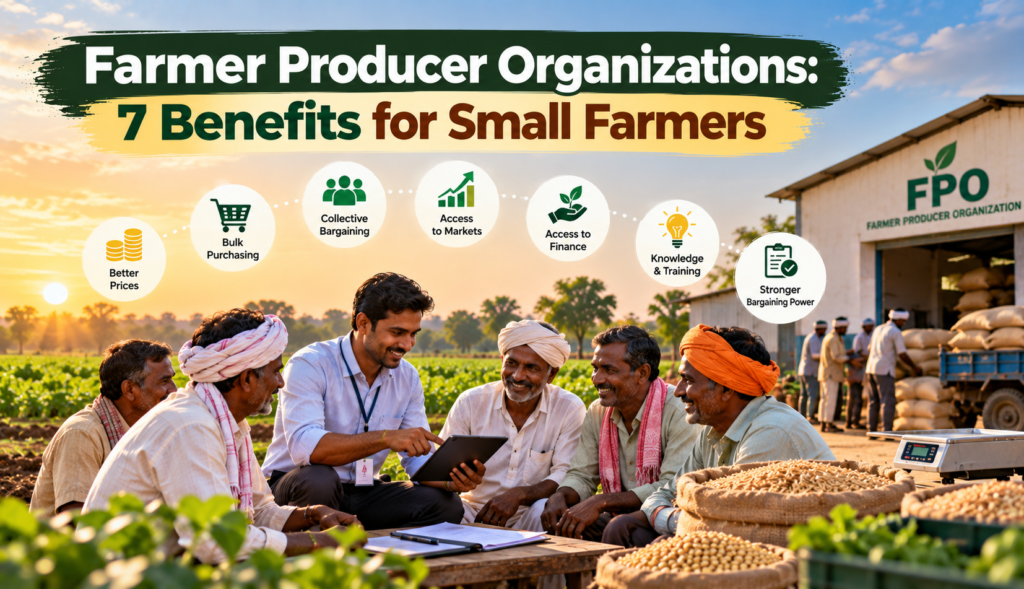
7 Major Benefits of FPOs for Small and Marginal Farmers
- Better Bargaining Power and Market Access
One of the biggest benefits of FPOs is the ability to negotiate as a group rather than as individual producers. Aggregating agricultural produce can help members approach wholesalers, processors, retailers and institutional buyers who require consistent quantities and quality.
FPOs can also explore electronic agricultural trading platforms such as the National Agriculture Market (e-NAM), subject to registration and applicable requirements. Better access to buyers can create additional marketing opportunities, but farmers should compare prices, quality requirements, transport costs and payment terms before finalising sales.
- Lower Input Costs Through Collective Purchasing
FPOs can purchase seeds, fertilizers, pesticides and other agricultural inputs in bulk for their members. Collective procurement may help reduce per-unit costs, improve access to genuine products and simplify the distribution of essential farming supplies.
For small and marginal farmers, who often purchase limited quantities, this can be particularly useful. However, savings depend on supplier quotations, transport expenses, storage arrangements and the FPO’s ability to negotiate favourable terms.
- Access to Credit and Financial Support
Farmer Producer Organizations can help members explore institutional finance and eligible government support for agricultural business activities. A professionally managed FPO may also develop business plans for aggregation, storage, processing and marketing.
Under the central government’s 10,000 FPO scheme, eligible organizations can receive management assistance, matching equity grants and credit guarantee support, subject to scheme guidelines and approval requirements. These benefits are intended to strengthen FPO operations and improve access to institutional credit.
Financial support is not automatic for every organization or member. Farmers should verify current eligibility criteria, documentation requirements and application procedures through the designated implementing agency or the Small Farmers’ Agribusiness Consortium (SFAC).
- Improved Storage, Grading and Processing Facilities
FPOs can coordinate post-harvest activities such as sorting, grading, cleaning, packaging and storage. These services help prepare agricultural produce according to buyer requirements and can reduce losses caused by poor handling.
For example, an FPO working with onion or tomato growers may arrange grading and storage, while a pulse-producing FPO may explore cleaning, sorting and packaging facilities. Depending on its capacity and market opportunities, an organization can also consider processing activities to sell products with greater value addition.
Such facilities require investment, reliable management and sufficient market demand. Farmers should evaluate operating costs and expected returns before establishing new infrastructure.
- Access to Agricultural Technology and Expert Guidance
FPOs can connect members with agricultural universities, Krishi Vigyan Kendras (KVKs), extension officers and technology providers. These connections can support training in improved cultivation practices, soil testing, integrated pest management, precision farming and post-harvest handling.
Digital agriculture platforms can also help FPOs access market information, weather advisories and agricultural business resources. By organizing training and sharing information, FPOs can make technical guidance more accessible to members who may otherwise have limited resources.
- Opportunities for Rural Entrepreneurship and Employment
FPOs can create business opportunities beyond crop production. Their activities may include input supply, custom hiring of farm machinery, aggregation, transport, storage, food processing and direct marketing.
These activities can generate work in rural communities and create opportunities for farmers to participate in agricultural value chains. Young people may contribute through bookkeeping, digital marketing, logistics, quality control and business management.
The scale of these opportunities depends on the organization’s financial strength, professional capabilities and ability to build sustainable customer relationships.
- Stronger Collective Risk Management
Collective organization can help farmers coordinate production, improve access to market information and explore different buyers. An FPO may also help members plan production according to demand and maintain quality standards.
However, an FPO cannot eliminate agricultural risks such as drought, floods, pests, price fluctuations or crop failure. Farmers should continue using suitable crop insurance, diversified cropping, scientific farm management and prudent financial planning.
Government Support for Farmer Producer Organizations in India
The Central Sector Scheme for the Formation and Promotion of 10,000 FPOs was launched to strengthen farmer collectives and help them develop sustainable agricultural businesses.
According to the Ministry of Agriculture and Farmers Welfare, the scheme provides eligible FPOs with professional handholding and financial support under specified conditions. Assistance includes management costs, matching equity grants and credit guarantee facilities for eligible project loans. Source: Government of India’s FPO scheme update, February 2026.
Farmers interested in joining an existing FPO or forming a new organization can contact their district agriculture department, SFAC, the relevant state-level agency or a designated Cluster-Based Business Organization (CBBO).
Before joining, farmers should check the FPO’s registration, membership conditions, financial transparency, management practices, business activities and payment policies. They should also understand any membership fees or share contributions and review how the organization distributes earnings and communicates decisions.
How Small Farmers Can Benefit from an FPO
Farmers should begin by identifying a suitable FPO operating in their district or crop cluster. They can ask about membership eligibility, available services, input prices, marketing arrangements and the organization’s past performance.
It is also important to participate in meetings, maintain records of transactions and understand the organization’s business plan. Strong governance, transparent accounting, professional management and active member participation are essential for long-term success.
Conclusion
Farmer Producer Organizations can help small and marginal farmers strengthen market access, purchase agricultural inputs collectively, explore financial assistance and participate in value-added agricultural businesses. By combining their resources and coordinating business activities, farmers can improve their ability to compete in modern agricultural markets.
The success of an FPO depends on sound management, transparent operations, reliable buyers and active participation from its members. Farmers should evaluate the services and performance of an organization before joining and use available government guidance to make informed decisions.