AI in Agriculture: 5 Ways Farmers Can Use Weather Data
AI in agriculture is helping farmers make more informed decisions by analysing weather forecasts, crop conditions, soil information and pest activity. In India, artificial intelligence (AI), machine learning, satellite imagery and digital farming platforms are increasingly being used to support crop planning, irrigation management, pest detection and climate risk assessment.
For farmers dealing with unpredictable rainfall, rising input costs and changing growing conditions, AI-powered farming tools can provide useful, data-driven insights. When combined with local agricultural knowledge and expert advice, these technologies can support more efficient and sustainable farming.
What Is AI in Agriculture?
AI in agriculture refers to the use of artificial intelligence and machine learning to analyse agricultural data and generate insights that support farming decisions. These systems can process information from weather stations, satellites, field photographs, soil sensors and crop records to identify patterns that may be difficult to detect manually.
For example, an AI-based advisory system may combine rainfall forecasts with crop growth stages to help farmers plan irrigation or field operations. Similarly, image recognition technology can assist with identifying visible pest damage or crop health problems.
The Government of India’s Digital Agriculture Mission promotes the use of modern technologies, including AI, machine learning and remote sensing, to strengthen agricultural services and improve decision-making.
5 Ways Farmers Can Use AI and Weather Data
- Plan Sowing According to Weather Forecasts
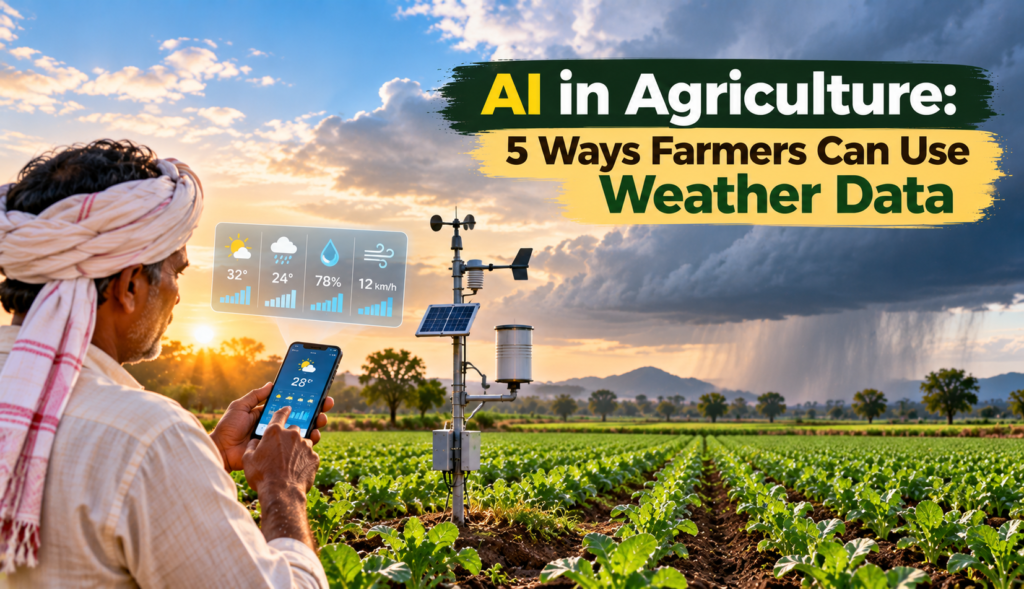
Weather-based crop planning is one of the most practical applications of AI in agriculture. Forecasts of rainfall, temperature and monsoon onset can help farmers decide when to prepare land, sow seeds and schedule early crop operations.
For example, farmers can use location-specific rainfall forecasts to assess whether field conditions are suitable for sowing. In rain-fed areas, this information may help reduce the risk of sowing immediately before an unfavourable dry spell.
In March 2026, the Government of India reported an AI-based local monsoon forecasting pilot that supported Kharif sowing decisions across parts of 13 states. The forecasts were shared with farmers through SMS, demonstrating how digital weather advisories can support agricultural planning.
Farmers should still check updated forecasts and local conditions because weather predictions are not guarantees of future rainfall.
- Improve Irrigation and Water Management
AI-powered irrigation management uses weather forecasts, soil moisture readings, crop growth stages and field conditions to help estimate when irrigation may be required.
When connected to suitable soil moisture sensors or farm monitoring systems, these tools can help farmers avoid unnecessary watering and make better use of available water resources.
For instance, a farmer growing vegetables may combine soil moisture readings with expected rainfall to decide whether irrigation can be postponed. Similarly, wheat growers can use crop-stage information and local weather forecasts to plan irrigation more effectively.
The benefits depend on the quality of the data, the accuracy of the recommendations and the type of irrigation system available. Farmers should follow crop-specific irrigation guidance rather than relying on automated suggestions alone.
- Detect Crop Pests and Diseases Earlier
AI-based crop monitoring can analyse photographs of leaves, stems and other plant parts to identify signs associated with pests or diseases. Some systems also combine field observations, weather conditions and historical pest patterns to support early warnings.
Early identification can help farmers investigate crop problems before damage becomes widespread. It may also support integrated pest management by helping farmers decide when further inspection or appropriate control measures are needed.
India’s National Pest Surveillance System uses AI and machine learning to support pest identification and agricultural advisories. According to the Ministry of Agriculture and Farmers Welfare, the system enables users to capture pest images and obtain guidance for timely intervention.
However, an AI-generated identification should not automatically be treated as a confirmed diagnosis. Farmers should verify serious or unfamiliar crop problems with agricultural experts before applying pesticides.
- Monitor Crop Health Using Satellite and Field Data
AI-enabled crop monitoring uses satellite imagery, remote sensing, drones and field observations to assess changes in vegetation and crop development. These technologies can help identify areas that may require closer inspection because of moisture stress, uneven growth or other field conditions.
For example, a farmer or agricultural adviser may use crop-monitoring maps to identify a section of a field where plants appear less vigorous than surrounding areas. A field visit can then help determine whether the cause is poor irrigation, nutrient deficiency, pest damage or another problem.
The Government of India uses technologies such as satellite imagery, geographic information systems and AI for crop monitoring and agricultural assessments.
These tools are especially useful for monitoring large fields and identifying potential problems, but satellite data alone may not explain the exact cause of crop stress. Field verification remains essential.
- Use Crop Data for Better Farm Decisions
AI-powered agricultural platforms can combine crop information, weather forecasts, soil health data, government scheme details and market information to support farm planning.
Farmers may use these insights to compare suitable crops, estimate operational requirements, monitor field conditions and understand available agricultural services. Data-driven planning can also help farmers consider input costs, expected production risks and market opportunities before making decisions.
India’s Bharat-VISTAAR initiative is designed to provide AI-powered, multilingual agricultural information and advisories. Such platforms aim to make relevant farming knowledge more accessible to users who prefer local-language assistance.
Farmers should check the source, date and location of any recommendation and compare market information with current mandi prices before making financial decisions.
How Farmers Can Start Using AI Farming Tools
Farmers do not necessarily need expensive machinery to begin using digital agriculture services. A practical starting point is to access reliable weather forecasts, local agricultural advisories and crop information through a mobile phone.
Useful steps include:
- Check location-specific weather forecasts before sowing, spraying or irrigation.
- Use soil testing and crop history to understand field conditions.
- Take clear photographs when seeking digital help with crop pests or diseases.
- Consult Krishi Vigyan Kendras (KVKs), agricultural universities or local extension officers for verification.
- Compare the cost of digital tools with their practical benefits before investing in sensors, drones or automated equipment.
- Protect personal and farm data by using trusted platforms and checking their privacy practices.
Combining AI tools with traditional farming experience can help farmers make better-informed decisions without treating technology as a replacement for agricultural expertise.
Challenges of AI Adoption in Indian Agriculture
Despite its potential, AI adoption faces challenges, including limited internet connectivity in some rural areas, language barriers, the cost of digital equipment and gaps in accurate local data.
Recommendations can also be less useful when field conditions differ from the information used by a model. Small and marginal farmers may need affordable services, local-language support and assistance from agricultural extension workers to use these technologies effectively.
AI should therefore complement, rather than replace, soil testing, field inspection, scientific crop recommendations and local agricultural knowledge.
Conclusion
AI in agriculture is creating new opportunities for Indian farmers to use weather forecasts, crop monitoring, pest alerts and agricultural data for more informed farm management. These tools can support sowing decisions, irrigation planning, crop health assessment and access to relevant farming advice.
The most effective approach is to combine reliable digital information with local weather conditions, soil test results and expert guidance. As precision farming and climate-smart agriculture continue to develop, accessible and practical AI tools may become an increasingly useful part of sustainable farm management.