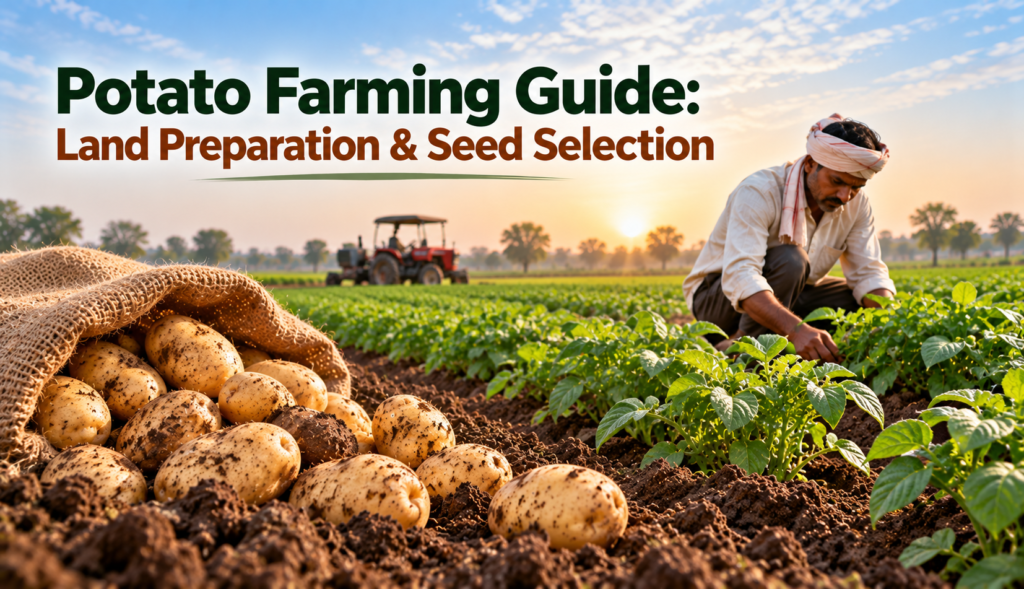
Potato Farming Guide: Land Preparation & Seed Selection
Potato farming starts with two critical decisions: preparing a well-drained, friable seedbed and selecting healthy, quality planting material. Proper land preparation improves soil aeration and tuber development, while disease-free seed potatoes can support better crop establishment and productivity.
With potato cultivation increasingly adopting improved varieties, quality seed production technologies and farm mechanization, farmers can improve the efficiency of planting and early crop management. ICAR-CPRI has also highlighted the importance of healthy seed because potato is vegetatively propagated and can be affected by seed-borne diseases.
Why Land Preparation Matters in Potato Farming
Potato develops underground tubers, making soil condition particularly important. The field should have good tilth, adequate aeration and effective drainage so that developing tubers have sufficient space and are not exposed to prolonged waterlogging.
ICAR research on potato mechanization recommends preparing a loose and friable soil structure with good drainage and aeration. Deep tillage can also help address hard layers and improve water movement through the soil profile.
Farmers should preferably select a field where excess water can drain quickly. Heavy or poorly drained soils can create unfavourable conditions for tuber development and increase the risk of crop problems.
Step-by-Step Land Preparation for Potato Cultivation
- Select a Suitable Field
Choose a level or gently sloping field with good drainage and access to irrigation. Avoid locations where water remains stagnant after irrigation or rainfall.
A well-drained field is particularly important because potato tubers develop below the soil surface. Maintaining suitable soil moisture without prolonged waterlogging supports healthier crop establishment.
- Perform Primary Tillage
Start with ploughing to loosen the soil and incorporate crop residues or organic matter. Depending on soil conditions, a mouldboard plough, disc plough or suitable tillage implement can be used.
Where a hard pan is present, deeper tillage or subsoiling can help break compacted layers. ICAR notes that a subsoiler can improve the soil environment by breaking hard pans and supporting better drainage.
- Improve Soil Tilth
After primary tillage, use suitable secondary tillage equipment to break large clods and create a fine, friable seedbed. A rotavator or disc harrow may be used according to soil condition and local recommendations.
The objective is not simply to make the soil fine but to achieve a balanced structure that provides adequate aeration while retaining sufficient moisture.
- Incorporate Organic Matter
Well-decomposed farmyard manure or other locally recommended organic material can be incorporated during field preparation. Organic matter can help improve soil structure and support better moisture management.
Nutrient application, however, should preferably be based on soil testing and crop requirements rather than applying fertilizers at a uniform rate everywhere.
- Prepare Ridges or Furrows
Potatoes are commonly planted on ridges or raised beds, depending on the production system and local conditions. Proper ridge formation provides space for tuber development and helps manage excess water.
ICAR advisories also recommend ridge planting for potato under suitable conditions.
Choosing Quality Potato Seeds
Seed selection is one of the most important factors in successful potato cultivation. Farmers should prefer healthy, properly graded and disease-free seed tubers from reliable sources instead of using poor-quality or visibly diseased planting material.
ICAR-CPRI states that the availability of healthy planting material is essential because seed-borne diseases can contribute to yield degeneration. Its quality seed production system includes health testing and multiplication of virus-free mother tubers.
What to Check Before Buying Potato Seed
Farmers should consider the following factors:
- Certified or quality-assured seed: Purchase planting material from reliable and recognized sources.
- Healthy tubers: Avoid seed tubers showing rot, severe damage, disease symptoms or abnormal discoloration.
- Uniform size: Proper grading helps achieve more uniform crop establishment.
- Good sprouting condition: Seed should have healthy sprouts appropriate for planting.
- Variety suitability: Select a variety according to climate, soil, market demand and intended use.
- Seed source: Maintain information about the variety and source for better crop traceability.
Seed quality is becoming an increasingly important part of modern potato production. ICAR-CPRI has developed high-tech approaches including tissue culture, micropropagation and aeroponic systems to strengthen the supply of quality potato planting material.
Improved Potato Varieties and New Seed Options
Farmers should select potato varieties according to their region and end-use requirement rather than choosing a variety solely because of its popularity.
ICAR-CPRI has recently reported the notification of four new potato varieties—Kufri Ratan, Kufri Chipbharat-1, Kufri Chipbharat-2 and Kufri Tejas—for seed production and multiplication across the country. The varieties are intended to provide additional options for table consumption and processing requirements.
This development reflects the growing focus on improved potato varieties and specialized production requirements in India’s potato sector.
Seed Rate and Planting Considerations
Seed requirements vary according to variety, seed tuber size, planting geometry, region and production system. Therefore, farmers should follow recommendations applicable to their location rather than relying on a single national seed-rate figure.
For example, an ICAR advisory for potato cultivation in hills recommends 1.5–2.5 tonnes of seed per hectare and a crop geometry of 50 cm × 20 cm for the specified conditions and varieties.
Another ICAR advisory has recommended planting improved varieties at approximately 40–50 cm between rows and 15 cm between tubers under the specified regional conditions.
These figures demonstrate why planting recommendations should be adapted to the variety, seed size, soil, climate and local agricultural advisory.
Modern Potato Farming: Mechanization and Better Inputs
Potato cultivation involves several operations, including seedbed preparation, planting, fertilizer application, earthing up, harvesting, grading and sorting. Mechanization can help farmers complete these operations on time and improve input-use efficiency.
ICAR has highlighted the availability of specialized machinery such as potato planters, fertilizer applicators, weeders, potato diggers and graders. Custom hiring or farmer groups can make such equipment more accessible to smaller farms.
Modern potato farming is also increasingly connected with quality seed production, precision input management, integrated pest management, mechanized planting and improved post-harvest handling. These practices can help farmers improve operational efficiency while reducing avoidable losses.
Key Takeaway
Successful potato cultivation begins before planting. A well-prepared, well-drained field combined with healthy and suitable seed potatoes creates a strong foundation for crop establishment and tuber development.
Farmers should focus on soil testing, proper land preparation, suitable ridge or bed formation, quality seed selection and region-specific variety recommendations. As India’s potato sector adopts improved varieties and advanced seed production technologies, using reliable planting material and following scientific crop-management practices can become increasingly important for productive and sustainable potato farming.