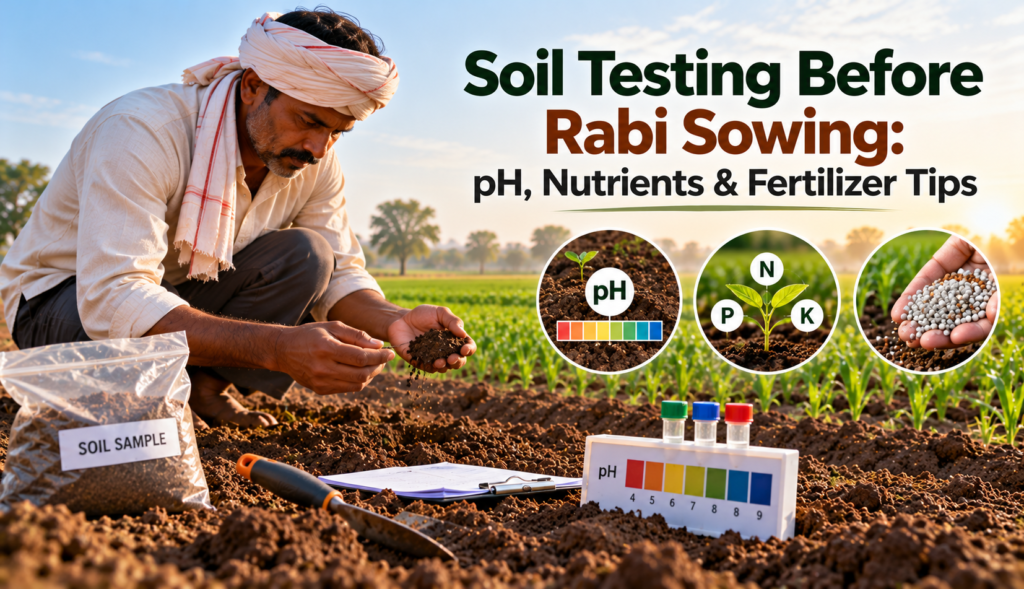
Soil Testing Before Rabi Sowing: pH, Nutrients & Fertilizer Tips
Soil testing before Rabi sowing helps farmers identify nutrient deficiencies, measure soil pH and choose the right fertilizer plan for winter crops. For crops such as wheat, mustard, gram and barley, soil test-based nutrient management can improve fertilizer efficiency, reduce unnecessary input costs and support long-term soil fertility.
As farmers prepare their fields for the Rabi season 2026–27, checking soil health is an important step towards sustainable and productive farming. The Government of India’s Soil Health Card Scheme also promotes scientific soil assessment and balanced fertilizer application through field-specific recommendations. Source: Press Information Bureau, Government of India.
Why Is Soil Testing Important Before Rabi Sowing?
Soil testing provides information about the nutrient status and chemical properties of agricultural land. Instead of applying the same fertilizer quantities every season, farmers can use test results to understand what their soil actually needs.
The major benefits of soil testing before Rabi sowing include:
- Lower fertilizer expenses: Avoid unnecessary applications of nutrients already present in sufficient quantities.
- Better nutrient management: Identify deficiencies in nitrogen, phosphorus, potassium, sulphur and essential micronutrients.
- Improved crop planning: Select suitable crops according to soil conditions and local recommendations.
- Balanced soil fertility: Maintain nutrient availability for current and future crops.
- Sustainable farming: Reduce the risk of excessive fertilizer application and nutrient losses.
Soil testing is particularly useful in fields where crop growth has declined, fertilizer expenses are increasing or the same cropping pattern has continued for several years.
How to Collect Soil Samples for Testing
Accurate soil test results depend on collecting a representative sample from the field. Farmers should collect samples before fertilizer or manure application wherever possible and follow the sampling instructions provided by the local agricultural department or soil testing laboratory.
Follow these basic steps:
- Divide the farm into separate sampling areas according to soil type, slope, crop history and management practices.
- Remove surface litter and collect soil from several representative spots within each area.
- For routine cultivated fields, collect soil from approximately 15–20 cm depth, unless crop-specific or laboratory instructions recommend otherwise.
- Mix the collected soil thoroughly in a clean container and remove stones, roots and plant residues.
- Submit the required quantity to an authorised soil testing laboratory, providing details about the field and intended crop.
Avoid collecting samples from unusual spots such as compost heaps, field edges, waterlogged patches or areas where fertilizer was recently spilled. These locations may not represent the overall field.
Understanding Soil pH for Rabi Crops
Soil pH indicates whether soil is acidic, neutral or alkaline. It influences nutrient availability and affects how effectively crops can absorb essential elements.
The pH scale ranges from 0 to 14, with pH 7 considered neutral. Many commonly cultivated crops perform well in slightly acidic to neutral soil, but the ideal range depends on the crop, soil type and local conditions.
Soil pH | General classification | Recommended approach |
Below 6.0 | Acidic | Check acidity and follow locally recommended soil amendments |
6.0–7.5 | Slightly acidic to neutral | Assess crop-specific nutrient requirements |
7.5–8.5 | Alkaline | Check nutrient availability and salinity-related concerns |
Above 8.5 | Strongly alkaline | Seek expert advice on soil reclamation and suitable amendments |
These ranges are general indicators, not universal crop suitability limits. Farmers should use laboratory results and local agricultural recommendations before applying lime, gypsum or other amendments.
For example, wheat and mustard can respond differently to soil conditions, while gram production also depends on drainage, soil structure and nutrient availability. Correcting pH without understanding the underlying soil problem may increase costs without delivering the expected benefits.
Key Soil Nutrients to Check Before Rabi Sowing
Soil testing helps determine the availability of major nutrients, secondary nutrients and micronutrients required for crop growth.
Nitrogen (N): Nitrogen supports leaf growth and vegetative development. Its management should account for the crop, soil conditions, previous crop and recommended application schedule.
Phosphorus (P): Phosphorus supports root development, energy transfer and early crop establishment. Its availability can be affected by soil pH.
Potassium (K): Potassium supports water regulation, crop strength and stress tolerance. Application should depend on soil test results and crop requirements.
Sulphur (S): Sulphur is important for protein formation and is particularly relevant to crops such as mustard.
Micronutrients: Zinc, iron, boron, copper and manganese are required in smaller quantities but remain essential for normal plant growth. Deficiencies should be confirmed through soil tests and, when appropriate, plant analysis.
The Soil Health Card framework assesses 12 parameters, including N, P, K, sulphur, selected micronutrients, pH, electrical conductivity and organic carbon. These results help farmers plan nutrient management according to their field conditions. Source: Government of India’s Soil Health Card information.
Fertilizer Planning for Wheat, Mustard and Gram
Fertilizer planning for Rabi crops should be based on soil fertility, crop requirements, expected yield, irrigation availability and recommendations from agricultural experts. There is no single fertilizer dose that is appropriate for every farm.
Wheat: Use soil test results to plan nitrogen, phosphorus and potassium application. Apply nitrogen in the recommended split schedule, considering irrigation and crop growth stage.
Mustard: Assess sulphur availability alongside nitrogen, phosphorus and potassium. Apply sulphur-containing fertilizers when recommended by soil test results and local agricultural guidance.
Gram: Plan phosphorus and other nutrients according to soil conditions and crop requirements. Avoid excessive nitrogen application, as gram is a legume capable of obtaining nitrogen through biological fixation when suitable conditions and effective root nodulation are present.
Farmers should also consider farmyard manure, compost, green manure and suitable biofertilizers as components of integrated nutrient management. These inputs can support soil organic matter and nutrient cycling, but their nutrient contributions should be considered when planning fertilizer applications.
Avoid combining multiple fertilizers simply because they are available or promoted locally. Balanced fertilizer use means applying the correct nutrients in suitable quantities, at the right time and through appropriate methods.
Soil Health Card and Government Support for Farmers
The Soil Health Card Scheme helps farmers understand their soil’s nutrient status and access fertilizer and soil amendment recommendations. Farmers can contact their local agriculture department, Krishi Vigyan Kendra (KVK) or an authorised soil testing laboratory to learn about sample collection and testing services.
The Government of India continues to promote soil test-based nutrient management and balanced fertilization as part of sustainable agriculture initiatives. These practices help farmers make more informed decisions about fertilizer use while protecting long-term soil productivity.
Final Thoughts
Soil testing before Rabi sowing is a practical step towards better fertilizer planning, healthier soil and more efficient farm management. By checking soil pH, identifying nutrient deficiencies and following crop-specific recommendations, farmers can make informed decisions before investing in fertilizers and other agricultural inputs.
For the Rabi season 2026–27, farmers should arrange soil testing early, review the results before sowing and follow recommendations suited to their local conditions. Combining scientific soil testing with balanced fertilization, organic matter management and appropriate irrigation can help support productive and sustainable farming.