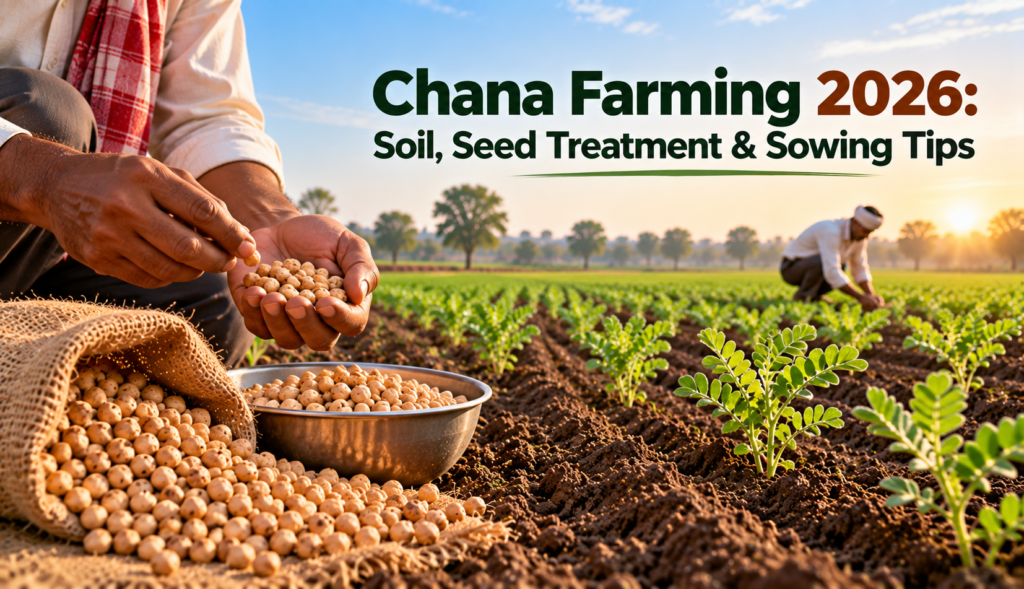
Chana Farming 2026: Soil, Seed Treatment & Sowing Tips
Chana farming in 2026 requires suitable soil preparation, quality seeds, proper seed treatment and timely sowing to support healthy crop establishment and better productivity. Chana, also known as chickpea or gram, is an important Rabi pulse crop in India and is widely cultivated for its protein-rich grains and market demand.
With the Rabi farming season approaching, farmers should focus on soil moisture, locally suitable chickpea varieties, balanced nutrient management and early pest prevention. Following these practices can help improve germination, reduce crop losses and support sustainable chickpea cultivation.
Best Soil for Chana Farming
Well-drained loamy and clay-loam soils are generally suitable for chana farming. The crop performs poorly in fields where water accumulates around the roots, making proper drainage an important factor in successful gram cultivation.
Before sowing, farmers should assess soil fertility, drainage and moisture conditions. A soil test can help determine nutrient deficiencies and guide fertilizer application.
Important soil preparation practices include:
- Remove weeds and unwanted crop residues from the field.
- Prepare a suitable seedbed with adequate soil tilth.
- Ensure proper drainage to prevent waterlogging.
- Avoid excessive tillage that may disturb soil structure.
- Retain suitable soil moisture to support seed germination.
Farmers cultivating chickpeas in rainfed areas should pay particular attention to conserving available soil moisture. Field preparation should be adapted to local soil conditions and the previous crop.
Chana Sowing Time in India for 2026
The suitable sowing time for chana depends on the region, variety, temperature and availability of soil moisture. Chickpea is primarily a Rabi crop, generally planted after the monsoon season when conditions become suitable for winter cultivation.
Farmers should follow the sowing window recommended by their state agricultural university or local Krishi Vigyan Kendra (KVK). Delayed sowing or unsuitable temperatures can affect flowering, pod development and final grain production.
Before sowing chana in 2026, farmers should consider the following factors:
- Soil moisture: Ensure sufficient moisture for uniform germination.
- Seed variety: Select varieties suited to the local agro-climatic zone.
- Weather conditions: Check local agricultural advisories before field operations.
- Previous crop: Consider the field’s nutrient status and disease history.
Timely sowing helps establish a uniform crop stand and allows plants to develop under more suitable growing conditions.
Selecting the Best Chana Seeds
Choosing quality seeds is an essential step in chickpea cultivation. Certified seeds of suitable varieties can help farmers achieve better crop establishment when combined with proper sowing and crop management.
Farmers should select chickpea varieties according to their region, maturity period, irrigation facilities, disease risks and market requirements. Desi and Kabuli are the two major chickpea types grown in India.
Desi chickpeas generally have smaller, darker seeds, while Kabuli varieties typically produce larger, lighter-coloured grains. The choice between them should depend on local recommendations and buyer demand.
Tips for selecting quality chana seeds:
- Purchase certified seeds from reliable suppliers.
- Check the seed label, variety name and germination information.
- Avoid damaged, shrivelled or visibly diseased seeds.
- Choose varieties recommended for local growing conditions.
- Use the seed rate and spacing advised for the selected variety.
Selecting suitable seeds can improve crop uniformity and reduce the risk of poor establishment.
Chana Seed Treatment Before Sowing
Seed treatment helps protect chickpea seeds and young seedlings against certain seed-borne and soil-borne diseases. It is an important preventive measure in chana farming, particularly where the field has a history of fungal diseases.
The treatment should be selected according to local disease risks and agricultural recommendations. ICAR’s Rabi advisory includes seed-treatment and biofertilizer guidance for gram cultivation.
Farmers should follow these precautions before sowing:
- Use only locally recommended seed-treatment products.
- Follow the product label for the correct dose and application method.
- Consider recommended biological treatments, such as Trichoderma, where appropriate.
- Use compatible Rhizobium and phosphate-solubilising bacteria (PSB) inoculants when recommended.
- Follow the correct treatment sequence and compatibility instructions provided by agricultural experts.
Do not mix chemical treatments and biological inoculants indiscriminately, as some combinations may reduce the effectiveness of beneficial microorganisms. Allow treated seeds to dry or handle them as directed on the product label before sowing.
Chana Seed Rate and Sowing Method
The appropriate seed rate depends on seed size, chickpea type, variety, germination percentage and planting conditions. Using too much seed can increase plant competition, while insufficient seed can result in a poor crop stand.
ICAR’s published Rabi advisory provides a general gram seed-rate reference of approximately 70–85 kg per hectare, along with guidance on seed placement and spacing. Farmers should confirm the appropriate rate for their chosen variety and region.
For effective sowing:
- Maintain the locally recommended row-to-row and plant-to-plant spacing.
- Place seeds at a suitable depth in moist soil.
- Ensure reasonably uniform seed distribution.
- Avoid sowing into waterlogged or excessively dry soil.
- Check germination after emergence to identify gaps in the field.
A properly established crop stand helps plants access sunlight, nutrients and available soil moisture more effectively.
Nutrient Management for Healthy Chickpea Growth
Balanced nutrient management supports root development, plant growth, flowering and pod formation. Since fertilizer requirements vary according to soil fertility and farming conditions, soil testing should guide nutrient application.
Farmers should apply well-decomposed farmyard manure (FYM) where available and use fertilizers according to local recommendations. Chickpea can benefit from appropriate phosphorus and sulphur nutrition, while nitrogen and other nutrients should be managed according to soil-test results and recommended practices.
Excessive fertilizer application can increase costs without necessarily improving yield. Farmers should also avoid unnecessary irrigation and maintain suitable drainage, particularly during periods of heavy rainfall.
Irrigation, Weed Control and Pest Management
Chickpea is commonly grown under rainfed conditions, although supplemental irrigation may be beneficial when soil moisture becomes inadequate. Irrigation requirements depend on rainfall, soil type and the crop’s growth stage.
Where irrigation is available, farmers should follow local guidance and avoid excessive watering. Waterlogging can increase the risk of root diseases and damage crop growth.
Early weed management is equally important because weeds compete with chickpea plants for nutrients, light and moisture. Timely intercultural operations or locally recommended weed-control methods can help reduce competition.
Farmers should regularly monitor crops for pod borer, wilt, collar rot and other locally prevalent problems. Use integrated pest management, field monitoring and approved control measures based on expert recommendations. Early identification can help prevent avoidable crop losses.
Conclusion
Successful chana farming in 2026 starts with well-drained soil, suitable seed selection, recommended seed treatment and timely sowing. Balanced nutrient management, careful irrigation, weed control and regular crop monitoring can further support healthy chickpea growth.
Farmers should adapt these practices to their local climate, soil conditions and agricultural advisories rather than follow a single recommendation for every region. Combining quality inputs with informed crop management can help improve crop establishment and support more sustainable Rabi pulse production.