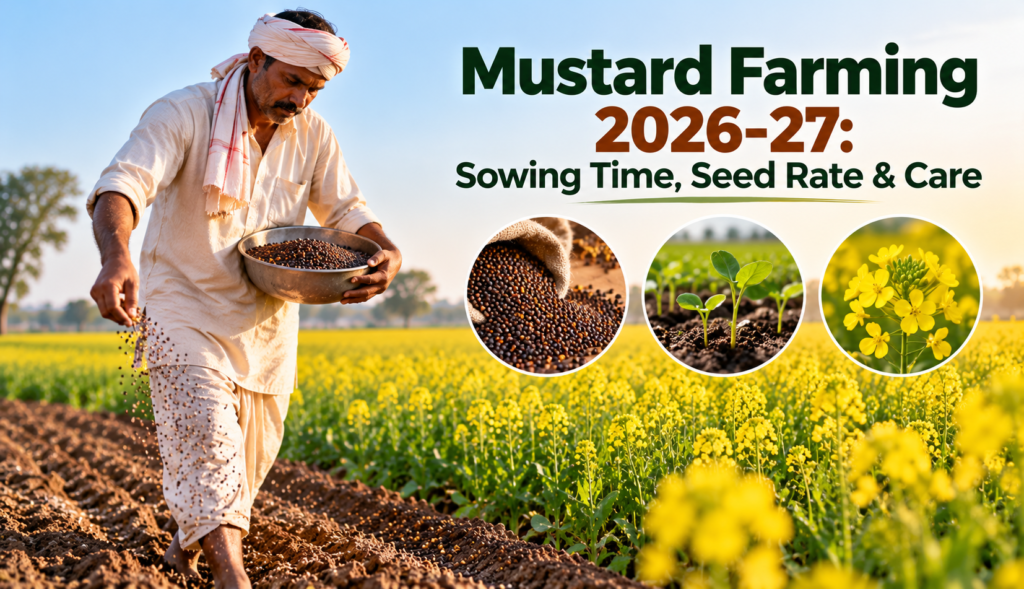
Mustard Farming 2026-27: Sowing Time, Seed Rate & Care
Mustard farming in 2026-27 can help Indian farmers diversify their Rabi crops and meet the demand for edible oil. Successful mustard cultivation depends on timely sowing, quality seeds, suitable soil conditions, balanced fertilisation, and effective management of irrigation, weeds, pests, and diseases.
Indian mustard, commonly known as sarson, is an important Rabi oilseed crop grown across Rajasthan, Uttar Pradesh, Haryana, Madhya Pradesh, Punjab, Gujarat, and other suitable regions. Farmers should select varieties according to their local climate, soil conditions, irrigation facilities, and recommendations from agricultural universities.
Mustard Sowing Time for the 2026-27 Rabi Season
The best sowing time for mustard generally falls between September and November, depending on the region, variety, and preceding crop. In many north Indian mustard-growing areas, October is an important sowing period, but farmers should follow their local agricultural advisories for the appropriate planting date.
Timely sowing helps the crop develop under favourable weather conditions and supports flowering, pod formation, and seed development. Research published through the ICAR-associated Journal of Oilseed Brassica also highlights the importance of sowing dates and local climatic conditions for mustard productivity.
Farmers should consider these points before sowing:
- Complete field preparation before the recommended planting window.
- Select varieties suited to the local agroclimatic zone.
- Ensure sufficient soil moisture for uniform germination.
- Avoid unnecessary delays after harvesting the preceding crop.
- Follow local recommendations for timely-sown or late-sown varieties.
Mustard Seed Rate per Acre and Seed Selection
The mustard seed rate depends on the variety, seed size, germination percentage, sowing method, and local recommendations. As a general planning estimate, approximately 1.5–2 kg of seed per acre may be sufficient for many line-sown Indian mustard crops. Farmers should confirm the recommended rate for their selected variety before purchasing seed.
Using too much seed can create overcrowded plants, increase competition for nutrients, and make crop management more difficult. Insufficient seed, on the other hand, may lead to poor plant population and uneven crop growth.
For better results, farmers should:
- Purchase certified or quality-assured seeds from reliable suppliers.
- Select high-yielding varieties recommended for their region.
- Check seed purity, germination, and the packaging date.
- Treat seeds only with locally recommended products and follow label instructions.
- Maintain suitable row spacing and thin excess seedlings where necessary.
Improved varieties can offer benefits such as better yield potential, suitable maturity duration, and resistance to particular diseases. ICAR’s rapeseed-mustard research programme continues to focus on productivity, oil quality, and climate resilience.
Land Preparation and Soil Requirements for Mustard
Mustard grows well in well-drained soils with suitable fertility and moisture conditions. Loamy and sandy-loam soils can be suitable, although the best soil type depends on the region and the variety being cultivated.
Prepare a firm, fine seedbed that allows seeds to be placed at a consistent depth. Excessive tillage should be avoided when it is unnecessary, as suitable reduced-tillage practices can help maintain soil health.
Before planting, farmers should:
- Remove weeds and manage crop residues appropriately.
- Prepare the field according to soil texture and moisture.
- Conduct a soil test to understand nutrient availability.
- Incorporate well-decomposed farmyard manure where appropriate.
- Ensure proper drainage to prevent waterlogging.
A soil test is particularly useful for deciding fertiliser requirements. Applying nutrients according to soil conditions and crop recommendations can improve nutrient-use efficiency and reduce unnecessary input costs.
Fertiliser Management for Healthy Mustard Growth
Balanced fertiliser management supports root development, vegetative growth, flowering, and seed formation. Nitrogen and phosphorus are important nutrients, while sulphur can play a significant role in mustard production and oil quality.
The exact fertiliser dose should be based on soil-test results, the expected yield, irrigation availability, and recommendations for the selected variety. Avoid applying excessive nitrogen without considering the crop’s actual nutrient requirements.
Farmers should pay attention to the following practices:
- Apply recommended basal fertilisers during field preparation or sowing.
- Use nitrogen in the recommended split doses where advised.
- Ensure an adequate sulphur supply according to soil-test and local recommendations.
- Apply micronutrients only when deficiencies or local recommendations justify their use.
- Avoid placing fertilisers directly against seeds unless the application method is specifically recommended.
According to the ICAR–Directorate of Rapeseed-Mustard Research, balanced nutrient management, including appropriate sulphur application, can support mustard yield and oil quality.
Irrigation Schedule for Mustard Farming
Mustard is often cultivated under rainfed conditions, while irrigated production can provide better control over crop moisture requirements. Irrigation scheduling should account for rainfall, soil type, crop growth stage, and available water.
The flowering and siliqua (pod) formation stages are particularly important for seed development. Moisture stress during critical growth stages can reduce yield, while excessive irrigation and waterlogging can damage roots and crop growth.
For effective mustard irrigation:
- Provide irrigation when soil moisture and crop conditions indicate a need.
- Prioritise critical growth stages according to local recommendations.
- Use sprinkler or drip irrigation where practical and suitable.
- Ensure proper field drainage after heavy rainfall.
- Avoid unnecessary watering that wastes resources or encourages disease.
Efficient irrigation helps conserve water and supports more consistent crop development.
Weed, Pest and Disease Management in Mustard
Weeds compete with mustard plants for nutrients, sunlight, moisture, and growing space. Early weed management is therefore essential, particularly while the crop is establishing.
Farmers can use timely interculture, manual weeding, and locally recommended weed-control methods. Herbicides should be used only when suitable for the crop, weed species, and application stage, following the product label and local agricultural advice.
Mustard crops may also be affected by aphids, Alternaria blight, white rust, and other pests or diseases. Regular field monitoring helps farmers identify problems before they spread widely.
Recommended practices include:
- Inspect leaves, stems, flowers, and developing pods regularly.
- Remove or manage affected plant material as advised.
- Maintain suitable plant spacing and avoid excessive nitrogen application.
- Use resistant or tolerant varieties where available.
- Seek expert advice before selecting pesticides or fungicides.
Integrated pest management combines monitoring, cultural practices, biological measures where appropriate, and need-based chemical control. This approach can help protect crop health while avoiding unnecessary pesticide applications.
Harvesting and Tips to Improve Mustard Yield in 2026-27
Mustard maturity varies according to the variety, temperature, and growing conditions. Harvest when most pods have reached the recommended maturity stage and seeds have developed properly. Harvesting too early may reduce seed quality, while excessive delay can increase the risk of shattering and field losses.
Farmers should use these practices to improve crop performance:
- Choose a suitable variety before the sowing season.
- Maintain the recommended seed rate and plant spacing.
- Follow soil-test-based nutrient management.
- Monitor moisture levels and irrigate when necessary.
- Inspect crops regularly for weeds, aphids, and diseases.
- Harvest at the appropriate maturity stage and dry seeds properly before storage.
Mustard farming in the 2026-27 Rabi season requires region-specific planning rather than a single schedule for every farm. By combining timely sowing, quality seed selection, balanced nutrition, efficient water management, and integrated crop protection, farmers can improve their chances of achieving a healthy crop and marketable seed yield.
For the latest variety recommendations and region-specific cultivation practices, farmers should consult their state agricultural university, Krishi Vigyan Kendra, or ICAR’s Directorate of Rapeseed-Mustard Research.