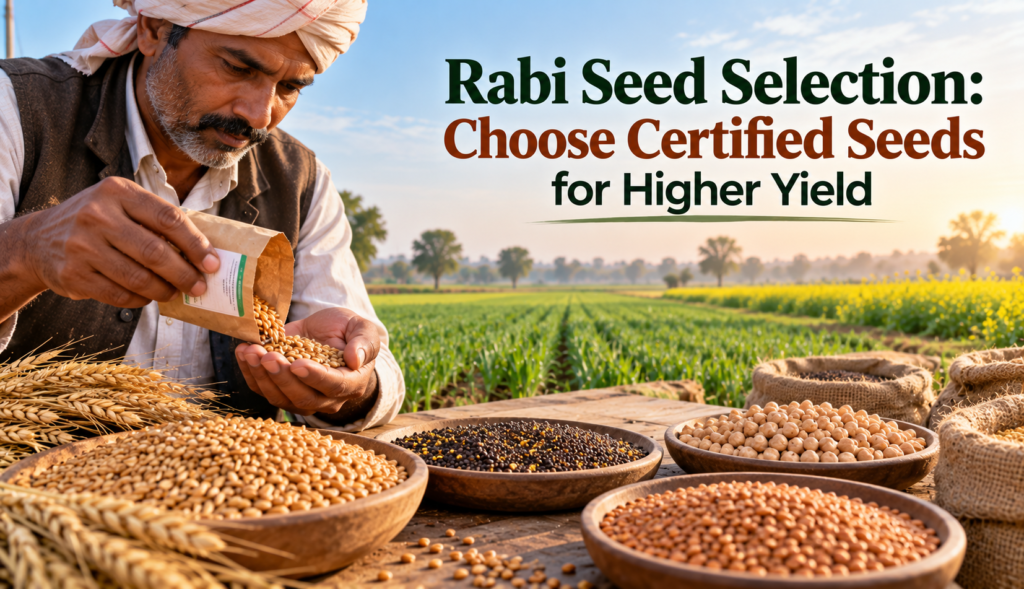
Rabi Seed Selection: Choose Certified Seeds for Higher Yield
Rabi seed selection is an important step in preparing for the winter cropping season in India. Choosing certified seeds suited to local soil, climate and sowing conditions can improve crop establishment, support healthy plant growth and help farmers achieve better yields. Before purchasing seeds for the 2026–27 Rabi season, farmers should check seed certification, germination information, variety suitability and recommended sowing time.
Why Is Rabi Seed Selection Important?
Selecting the right Rabi crop seeds helps farmers establish a uniform crop and use agricultural inputs more efficiently. Poor-quality seeds may result in uneven germination, weak seedlings and additional resowing costs.
Quality seed selection is particularly important for wheat, mustard, gram, lentil, barley and other winter crops. Farmers should choose varieties recommended for their region instead of selecting seeds based only on price or popularity.
The main benefits of choosing suitable, quality-tested seeds include:
- Better crop establishment and plant uniformity.
- Improved potential for yield and grain quality.
- Greater suitability to local growing conditions.
- More efficient use of irrigation, fertilisers and other inputs.
- Reduced risk of introducing weed seeds or poor-quality planting material.
However, certified seeds alone cannot guarantee a high yield. Soil fertility, weather, irrigation, pest management and timely agricultural operations also influence crop performance.
Which Seeds Should Farmers Choose for Rabi Crops?
The best seeds for Rabi cultivation depend on the crop, region, soil conditions, irrigation facilities and expected harvesting period. Farmers should consult local Krishi Vigyan Kendras (KVKs), state agriculture departments or agricultural universities for suitable varieties.
- Wheat Seeds
Wheat is one of India’s major Rabi crops. Farmers should select a wheat variety suited to their agro-climatic zone, sowing window and irrigation availability. Check the recommended seed rate, maturity duration, disease resistance and suitability for local farming conditions.
- Mustard Seeds
Mustard is widely cultivated for edible oil production. When selecting mustard seeds, consider the recommended variety, maturity period, local temperature conditions and resistance to prevalent diseases. Timely sowing and balanced nutrient management are also important for crop development.
- Gram and Chickpea Seeds
Gram, also known as chickpea, is an important pulse crop during the Rabi season. Farmers should select varieties suited to local rainfall, soil drainage and moisture availability. Disease tolerance, particularly against locally prevalent wilt and other crop diseases, should be considered when choosing a variety.
- Lentil and Barley Seeds
Lentil is a valuable pulse crop, while barley is grown for food, feed and industrial uses. Select varieties according to regional recommendations, soil conditions, crop duration and the intended market. Avoid purchasing unidentified or improperly labelled seeds.
How to Identify Certified Seeds Before Buying
Certified seeds are produced and inspected under an established seed certification system to meet prescribed quality standards. Farmers should verify the certification tag and seed-lot information rather than relying solely on a seller’s verbal assurance.
Use the following checklist before purchasing seeds:
- Check the certification tag: Look for the prescribed certification label, lot identification and other required details.
- Verify germination information: Check the stated germination percentage and applicable minimum standards for the crop.
- Inspect packaging: Avoid torn, damaged, damp or improperly sealed packets.
- Check the validity details: Review the test date, validity period or other date information applicable to the seed label.
- Confirm variety identity: Ensure the crop and variety match your farming requirements.
- Buy from a reliable dealer: Request a proper bill and retain the packet and label for reference.
India’s SATHI platform, or Seed Authentication, Traceability and Holistic Inventory, supports digital traceability across the seed supply chain. Farmers and other stakeholders can consult official seed-related resources to understand seed authentication and traceability.
Check Seed Quality and Germination Before Sowing
Seed quality involves more than the appearance of the seeds. Germination capacity, physical purity, genetic identity, seed health and appropriate moisture conditions all contribute to planting-material quality.
Farmers should check the information printed on the label and follow the applicable certification standards for their crop. Avoid using seeds that show signs of mould, insect damage or deterioration.
Where seed quality is uncertain, consult an authorised seed-testing laboratory or local agricultural expert. A germination test can help assess whether seeds sprout under suitable conditions, but a simple home test does not replace official seed-quality testing or certification.
Prepare the Soil and Plan Sowing Time
Even good seeds need suitable field conditions for successful establishment. Before sowing Rabi crops, prepare the field according to the crop’s requirements and local agricultural recommendations.
Farmers should focus on the following practices:
- Conduct soil testing to understand nutrient availability and soil pH.
- Prepare a suitable seedbed with adequate drainage.
- Follow the recommended sowing window for the selected variety.
- Maintain the prescribed seed rate, spacing and sowing depth.
- Apply fertilisers according to soil-test results and crop recommendations.
- Plan irrigation based on soil moisture, crop stage and water availability.
Timely sowing is especially important because unsuitable planting dates can affect crop establishment, flowering and maturity. Local weather conditions and state-specific agricultural advisories should guide final sowing decisions.
Common Mistakes to Avoid During Rabi Seed Selection
Farmers can reduce avoidable losses by avoiding a few common mistakes. Do not purchase seeds solely because they are inexpensive or promoted as high-yielding. A variety suitable for one district may not perform equally well under different soil and climate conditions.
Other mistakes include ignoring the seed label, using expired or poorly stored seeds, selecting varieties without checking disease risks and sowing without considering local recommendations.
Farmers should also store unused seeds according to the manufacturer’s instructions in a cool, dry and protected place. Keep seed packets separate from fertilisers, pesticides and other materials that could contaminate them.
Conclusion
Effective Rabi seed selection starts with choosing a regionally suitable variety and verifying seed quality before purchase. For the 2026–27 Rabi season, farmers growing wheat, mustard, gram, lentil and barley should prioritise certified or appropriately quality-assured seeds, reliable dealers, timely sowing and crop-specific agricultural advice.
Combining quality seeds with soil testing, balanced nutrient management, suitable irrigation and timely crop care can improve the chances of a healthy crop and better farm productivity. Farmers should consult their local KVK or state agriculture department for the latest variety recommendations and sowing advisories.