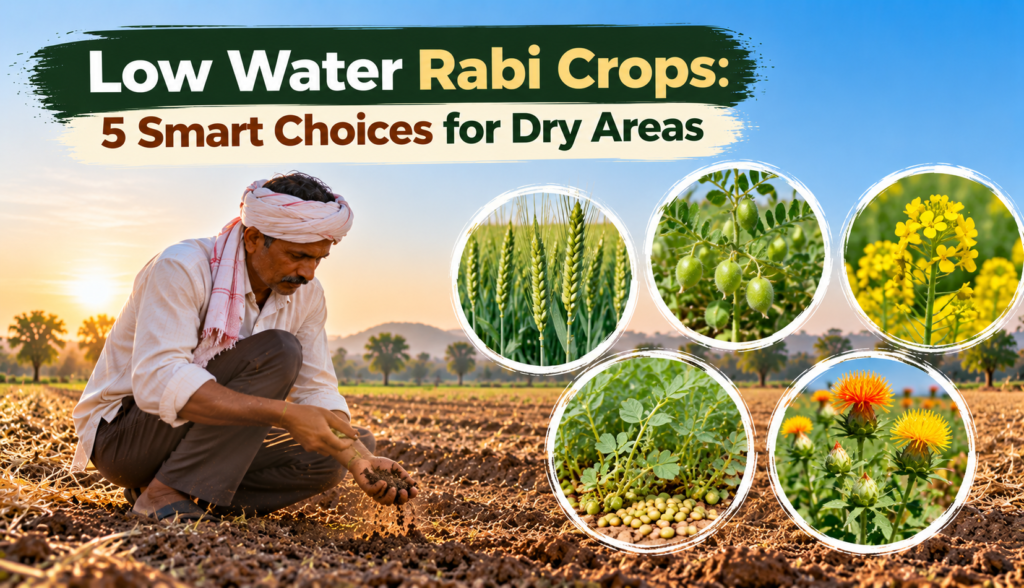
Low Water Rabi Crops: 5 Smart Choices for Dry Areas
Low-water Rabi crops can help farmers manage limited irrigation and declining soil moisture during the winter growing season. Crops such as chickpea, mustard, lentil, barley and safflower can be suitable options for certain rainfall-deficit areas, depending on soil type, local climate, sowing time and water availability.
In India, Rabi crops are generally sown during the cooler months and harvested in spring. However, delayed monsoon withdrawal, uneven rainfall and declining groundwater levels can create challenges for farmers who depend on stored soil moisture or limited irrigation. Selecting suitable crops and adopting water-saving farming practices can help reduce production risks and improve the efficient use of available water.
Why Choose Low-Water Rabi Crops?
Low-water Rabi crops are crops that can produce a reasonable harvest under relatively limited water availability when suitable varieties and management practices are used. Their actual water requirements vary according to temperature, soil conditions, crop duration and expected yield.
Choosing crops suited to local conditions can help farmers make better use of residual monsoon moisture, reduce dependence on irrigation and diversify farm income. However, low-water requirements do not mean that a crop can grow without water. Timely moisture availability during germination, flowering and grain or seed development remains important.
Before choosing a crop, farmers should assess soil moisture, available irrigation, field drainage, seed availability and local market demand. Advice from a Krishi Vigyan Kendra (KVK) or state agriculture department can help identify suitable crop varieties and sowing windows.
5 Low-Water Rabi Crops for Rainfall-Deficit Areas
- Chickpea: A Practical Pulse for Dryland Farming
Chickpea, also known as gram, is an important Rabi pulse crop in India. It is widely cultivated in rainfed farming systems because it can perform under relatively limited irrigation when soil moisture and seasonal conditions are suitable.
Chickpea also supports crop diversification and contributes protein-rich food to the agricultural supply chain. As a legume, it can form root nodules containing nitrogen-fixing bacteria, helping introduce biologically fixed nitrogen into the farming system.
Water-saving tips: Choose locally recommended varieties, sow at the appropriate time, avoid waterlogging and conserve soil moisture through suitable field preparation. Irrigation requirements depend on rainfall, soil type and the crop’s growth stage.
- Mustard: An Oilseed Option for Limited Irrigation
Mustard is an important Rabi oilseed crop that can be suitable for selected dryland and semi-arid regions. It provides farmers with an alternative to cereal-based cropping systems and contributes to domestic edible oil production.
Although mustard can tolerate some moisture stress, severe water shortages during flowering and seed development can reduce yield. Farmers should therefore select varieties suited to their region and manage available irrigation carefully.
Water-saving tips: Prepare a suitable seedbed, sow within the recommended window, control weeds early and use irrigation according to soil moisture and local agronomic guidance. Avoid excessive nitrogen application, which may increase crop water demand without delivering a proportional yield benefit.
- Lentil: A Pulse Crop for Suitable Cool-Season Conditions
Lentil is another valuable Rabi pulse that can be grown in areas with suitable winter temperatures and soil conditions. It can fit into crop rotations with cereals and other crops, helping diversify production and improve the balance of farm output.
Lentil performs best when establishment moisture is adequate and the field has good drainage. Prolonged drought, particularly during sensitive growth stages, can affect flowering and seed formation.
Water-saving tips: Use quality seed of a locally recommended variety, ensure proper drainage and avoid unnecessary irrigation. Where available, conserve residual soil moisture through suitable land preparation and timely weed management.
- Barley: A Cereal Alternative to Consider
Barley can be a useful alternative cereal in some water-limited and semi-arid farming areas. Compared with wheat, certain barley varieties and production systems can perform under relatively lower water availability, although the difference depends on the environment and expected yield.
Barley is used for food, feed and industrial purposes, creating different marketing opportunities in suitable production regions. Farmers should check whether local buyers, procurement facilities or feed markets are available before planting.
Water-saving tips: Select varieties suited to local conditions, maintain a uniform crop stand and schedule irrigation according to crop needs. Soil testing can also help prevent unnecessary fertilizer application and improve nutrient management.
- Safflower: An Oilseed for Selected Dryland Regions
Safflower is a traditional oilseed crop that can be considered in certain dryland farming systems. Its relatively deep root system can help the plant access moisture from deeper soil layers where soil conditions permit.
Safflower is not suitable for every region, and its performance depends on temperature, soil depth, drainage and local cultivation practices. Farmers should confirm its regional suitability and market potential before replacing an established crop.
Water-saving tips: Select a suitable field, establish the crop at the recommended sowing time and manage weeds during early growth. Follow locally recommended fertilizer and irrigation practices rather than assuming that the crop will perform without adequate moisture.
Water-Saving Farming Practices for Rabi Crops
Selecting suitable low-water Rabi crops is only one part of managing water scarcity. Field-level practices can also help farmers preserve moisture and use irrigation more efficiently.
- Conserve soil moisture: Use appropriate land preparation, retain crop residues where practical and minimise unnecessary soil disturbance.
- Improve rainwater harvesting: Farm ponds, field bunds and other suitable water-harvesting structures can help capture and store rainfall where feasible.
- Use irrigation efficiently: Drip or sprinkler systems may improve water-use efficiency for suitable crops and field conditions. Their cost, maintenance and suitability should be assessed before installation.
- Control weeds early: Weeds compete with crops for available soil moisture, nutrients and sunlight.
- Adopt soil-test-based fertilization: Apply nutrients according to soil test results and crop requirements to avoid unnecessary input costs.
- Choose suitable varieties: Prefer locally recommended varieties with appropriate maturity duration and tolerance to relevant environmental stresses.
Combining these measures with crop diversification can support climate-smart agriculture and improve resilience in rainfall-deficit areas.
How Farmers Can Select the Right Rabi Crop
The best crop for a dry area depends on more than its drought tolerance. Farmers should consider residual soil moisture, soil depth, expected winter rainfall, irrigation availability, seed costs, labour requirements and the price they can obtain at harvest.
For example, chickpea or lentil may suit a pulse-based rotation in some regions, while mustard or safflower may provide an oilseed alternative. Barley may be appropriate where local growing conditions and market demand support its cultivation.
Farmers should compare these factors with recommendations from local agricultural experts before changing their cropping pattern. Government agricultural extension services and KVKs can provide guidance on region-specific varieties, sowing times, nutrient management and water conservation.
Conclusion
Low-water Rabi crops offer Indian farmers practical options for managing limited irrigation and uncertain soil moisture. Chickpea, mustard, lentil, barley and safflower can each contribute to crop diversification where local conditions are suitable.
For better results, farmers should combine appropriate crop selection with soil moisture conservation, timely sowing, balanced fertilization and efficient irrigation. A region-specific cropping plan can help manage water-related risks while supporting soil health, farm income and sustainable agricultural production.
Title:- AI in Agriculture: 5 Ways Farmers Can Use Weather Data
Meta Title: AI in Agriculture: Weather & Crop Data for Farmers
Meta Description: Discover how AI in agriculture helps Indian farmers use weather forecasts, crop data and pest alerts to improve farm planning and manage climate risks.
Meta Keywords: AI in agriculture, artificial intelligence in farming, AI farming tools, weather forecasting for farmers, crop data analytics, precision farming in India, smart agriculture, climate-smart agriculture, AI crop monitoring, digital agriculture, agricultural technology, pest detection AI