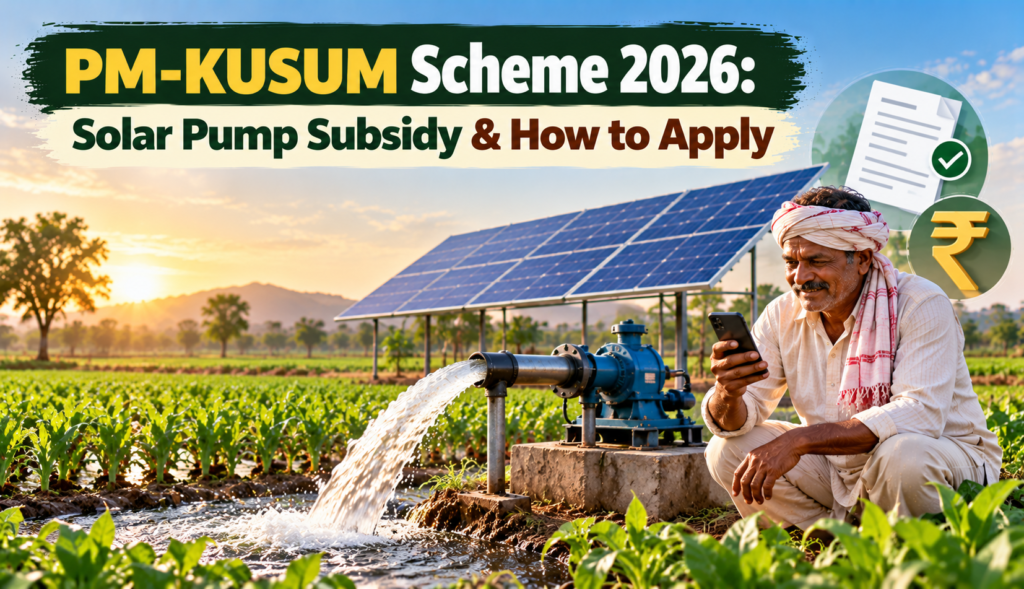
PM-KUSUM Scheme 2026: Solar Pump Subsidy & How to Apply
Farmers looking to reduce irrigation costs can explore the PM-KUSUM Scheme 2026, a Government of India initiative that promotes solar energy in agriculture. The scheme supports standalone solar agricultural pumps, the solarisation of existing electric pumps and decentralised solar power plants, subject to applicable guidelines and state-level implementation.
The scheme is officially known as Pradhan Mantri Kisan Urja Suraksha evam Utthaan Mahabhiyan (PM-KUSUM). Implemented through designated government agencies, it aims to reduce dependence on diesel-powered irrigation, improve access to reliable energy and create additional income opportunities for farmers.
What Is the PM-KUSUM Scheme 2026?
The PM-KUSUM scheme is an agricultural solar energy programme administered by the Ministry of New and Renewable Energy (MNRE). It encourages farmers to adopt solar-powered irrigation and renewable electricity generation to support more sustainable farming practices.
The scheme has three main components:
- Component A: Supports decentralised, grid-connected renewable energy power plants, generally ranging from 500 kW to 2 MW under the applicable guidelines.
- Component B: Supports the installation of standalone solar agricultural pumps, particularly to replace diesel-powered pumps in off-grid areas.
- Component C: Supports the solarisation of existing grid-connected agricultural pumps and agricultural feeders.
These components address different farming and energy requirements. Farmers should identify the appropriate component before applying because eligibility, project requirements and financial assistance vary.
PM-KUSUM Solar Pump Subsidy 2026: How Much Assistance Is Available?
Under the scheme guidelines, eligible farmers may receive central financial assistance of 30% of the applicable benchmark cost or tender-discovered price, whichever is lower, for qualifying standalone solar pumps and individual pump solarisation projects in most states. In specified northeastern states, hill states and island territories, the central assistance rate may be 50%.
State governments are generally expected to provide additional financial support under the applicable implementation arrangement. In the standard structure, central and state assistance can each account for 30%, leaving the remaining 40% for the beneficiary. In eligible special-category regions, the central share may be 50%, the state share at least 30%, and the farmer’s contribution the remaining 20%.
However, these percentages should not be treated as a guaranteed subsidy for every applicant. The applicable benchmark cost, tender price, state contribution, bank-finance arrangement and current state guidelines determine the actual amount payable by the farmer.
For example, if an eligible solar pump has an approved benchmark cost of ₹2 lakh, a 30% central contribution would equal ₹60,000. This is an illustration, not an official pump price or a guarantee of approval. The final subsidy calculation depends on the applicable scheme rules and sanctioned project cost.
Who Is Eligible for the PM-KUSUM Scheme?
Eligibility depends on the component selected and the rules issued by the implementing state or agency. Potential beneficiaries may include:
- Individual farmers who own or cultivate eligible agricultural land, subject to state requirements.
- Farmers seeking to replace eligible diesel-powered irrigation pumps with standalone solar pumps.
- Farmers with existing grid-connected agricultural pumps who want to explore pump solarisation.
- Farmer groups, cooperatives, panchayats, Farmer Producer Organisations (FPOs) and water user associations for eligible projects.
- Eligible landowners or project developers participating in decentralised solar power projects under Component A.
For Component A, the proposed power plant’s location, connection to a suitable electricity substation and arrangements with the local distribution company (DISCOM) are important considerations. Applicants should confirm all technical and land-related requirements before committing money to a project.
How to Apply for the PM-KUSUM Scheme Online
Farmers should apply through the official national portal or the designated state implementing agency, depending on the component and current application arrangements.
Step 1: Visit the official portal. Start at https://pmkusum.mnre.gov.in/ and check the available scheme information. For state-specific registration, use the relevant government portal linked to the implementing agency.
Step 2: Check registration availability. Confirm whether applications are open in your state or district, which component is accepting applications, and whether a beneficiary quota or application deadline applies.
Step 3: Select the appropriate component. Choose the option that matches your requirement, such as a standalone solar irrigation pump or solarisation of an existing agricultural pump.
Step 4: Complete the application form. Enter your personal details, land information, irrigation pump details and other requested information accurately. Requirements can differ by state.
Step 5: Upload the required documents. Submit the documents requested by the implementing authority and review the form before final submission.
Step 6: Track the application. Keep your application number and acknowledgement safe. Follow the official portal for verification, beneficiary selection, payment instructions and installation updates.
Farmers should not pay unverified agents or purchase equipment before receiving the necessary official approval. Installation and subsidy release must follow the applicable state process.
Documents Required for PM-KUSUM Registration
The exact document list varies by state and scheme component. Applicants may be asked to provide:
- Aadhaar or another accepted identity document.
- Proof of residence and farmer or landholding details.
- Bank account information and supporting documents.
- A recent photograph and a valid mobile number.
- Existing electricity connection or agricultural pump details, where applicable.
- Land records, irrigation details or other technical information requested by the implementing agency.
Some applications may require additional declarations, consent documents or verification certificates. Check the official state notification before submitting your application.
Benefits of the PM-KUSUM Solar Pump Scheme for Farmers
Solar-powered irrigation can help farmers reduce their reliance on diesel and conventional electricity supplies. Once installed and maintained properly, a solar pump can lower recurring energy expenses, although the actual savings depend on pump capacity, water requirements, maintenance and the farmer’s previous energy costs.
The scheme also supports the wider adoption of renewable energy in agriculture. Under Component A, eligible projects can generate electricity for sale to a local DISCOM under an approved tariff arrangement. Landowners may also explore leasing eligible land to a project developer, subject to applicable terms.
Solar irrigation is not a substitute for responsible water management. Farmers should assess groundwater availability, irrigation demand and the suitability of the proposed pump before investing.
PM-KUSUM Scheme 2026: Latest Updates and Important Precautions
The official PM-KUSUM portal publishes scheme information and implementation progress. However, nationwide scheme information does not automatically mean that fresh applications are open in every state. Farmers should verify current registration windows, available allocations, approved vendors and applicable deadlines with their state implementing agency.
Before applying, confirm the eligible pump capacity, approved equipment specifications, beneficiary contribution and subsidy calculation. Avoid relying on unofficial websites that promise guaranteed approval or advertise a fixed subsidy without explaining the applicable conditions.
Conclusion
The PM-KUSUM Scheme 2026 offers a framework for eligible farmers to explore solar irrigation, reduce dependence on conventional energy and participate in decentralised renewable energy projects. The available assistance and application process depend on the scheme component, state guidelines and current registration status.
Farmers should begin with the official MNRE portal, verify the latest state-level notification and prepare the required documents before submitting an application. Checking the rules in advance can help avoid unnecessary expenses, incomplete applications and confusion about subsidy eligibility.