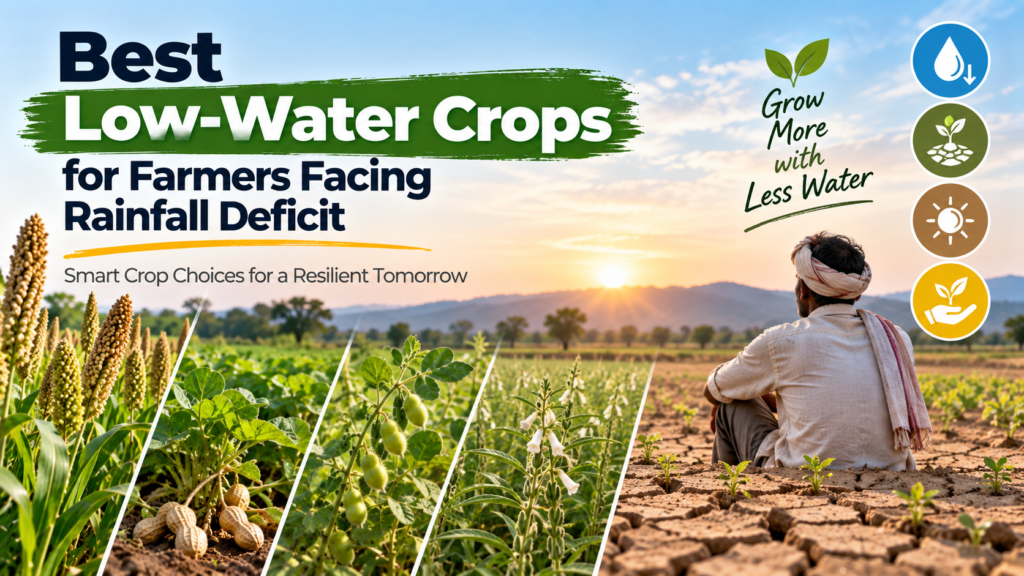
Best Low-Water Crops for Farmers Facing Rainfall Deficit
Changing rainfall patterns and prolonged dry spells are making water management increasingly important for Indian farmers. Low-water crops can help farmers reduce dependence on irrigation while maintaining productive use of available soil moisture. Millets, pulses and selected oilseeds are particularly relevant for rainfed and water-stressed farming conditions.
The 2026 monsoon season has also increased attention on rainfall variability and agricultural water management. The India Meteorological Department’s April 2026 long-range forecast projected seasonal rainfall at around 92% of the long-period average, indicating a below-normal monsoon scenario at the national level.
For farmers facing rainfall deficit, selecting the right crop is therefore an important part of climate-smart agriculture.
Why Low-Water Crops Matter During Rainfall Deficit
A rainfall deficit can reduce soil moisture, delay crop growth and increase irrigation costs. Crops that can perform reasonably well under limited moisture can provide farmers with greater flexibility.
Choosing low-water crops can help to:
- Reduce irrigation requirements
- Improve the use of available soil moisture
- Lower cultivation costs
- Reduce drought-related crop losses
- Support rainfed farming
- Improve farm resilience to irregular rainfall
- Diversify income sources
However, no crop is completely independent of water. Crop performance depends on soil type, rainfall distribution, temperature, sowing time, seed variety and local farming conditions.
1. Pearl Millet (Bajra)
Pearl millet is one of the most suitable drought tolerant crops for areas with limited and irregular rainfall. It is widely cultivated in dry and semi-arid regions and can perform under conditions where water availability is comparatively low.
ICAR identifies pearl millet as an important rainfed crop in drought-prone regions affected by scanty and uneven rainfall.
Farmers can consider improved varieties recommended for their local agro-climatic zone. Timely sowing, moisture conservation and balanced nutrient management can further improve crop establishment.
Best suited for: Dryland and semi-arid regions.
2. Sorghum (Jowar)
Sorghum is another important low-water crop for farmers dealing with moisture stress. It is used for food, fodder and industrial purposes, making it a versatile crop for mixed farming systems.
Sorghum can be considered where rainfall is uncertain and farmers want an alternative to crops with higher water requirements.
Key advantage: Dual-purpose grain and fodder production.
3. Finger Millet (Ragi)
Finger millet is widely known as a nutritious millet and can be included in climate-resilient farming systems. It is suitable for several rainfed production areas, particularly when farmers select locally recommended varieties.
Good field preparation and moisture conservation are important because even drought-tolerant crops require adequate moisture during establishment and critical growth stages.
Key advantage: Food, nutrition and rainfed farming potential.
4. Chickpea (Chana)
Chickpea is an important pulse crop and can be a useful option for farmers seeking water-efficient crops during the post-monsoon season.
Because chickpea is generally grown on residual soil moisture in many regions, proper sowing time and moisture conservation can significantly influence productivity.
Farmers should avoid unnecessary irrigation and focus on maintaining available soil moisture during critical crop stages.
Key advantage: Suitable for many relatively dry rabi farming environments
5. Pigeon Pea (Tur/Arhar)
Pigeon pea is a deep-rooted pulse crop that can tolerate relatively dry conditions better than several shallow-rooted crops. It can be incorporated into rainfed farming and intercropping systems.
Farmers can grow pigeon pea with suitable companion crops depending on their region, soil and rainfall pattern.
Key advantage: Useful for rainfed and diversified cropping systems.
6. Green Gram (Moong)
Green gram has a relatively short crop duration and can be considered where farmers need a shorter-duration pulse crop. It can fit into crop rotations and diversified farming systems.
Selecting an appropriate variety and sowing at the right time is important, particularly when rainfall is uncertain.
Key advantage: Short-duration crop with multiple cropping opportunities.
7. Sesame (Til)
Sesame is an important oilseed that can tolerate comparatively dry conditions once established. It can be considered among low rainfall crops in suitable regions.
Farmers should avoid waterlogging and select varieties recommended for their local growing conditions.
Key advantage: Oilseed diversification under relatively low-moisture conditions.
8. Groundnut
Groundnut can be included in water-efficient farming systems when the selected variety, soil and rainfall conditions are suitable. It performs best in well-drained soils and requires appropriate moisture management during important growth stages.
Farmers should avoid excessive irrigation and focus on efficient use of available water.
Key advantage: Oilseed and food crop with established market demand.
9. Little Millet
Little millet is gaining attention as a climate-smart crop because of its adaptability to marginal and low-input environments. ICAR describes little millet as a resilient crop capable of performing under drought and other environmental stresses.
Its growing relevance also connects with increasing consumer interest in nutritious and traditional grains.
Key advantage: Low-input potential and growing demand for nutritious millets.
10. Foxtail Millet
Foxtail millet is another option for farmers looking at drought resistant crops in India. Millets are particularly relevant to dryland agriculture because several species are adapted to low-to-moderate rainfall environments.
Farmers should select crops based on local rainfall, soil characteristics and market demand rather than choosing a crop solely because it requires less water.
How Farmers Can Save Water During Rainfall Deficit
Crop selection should be combined with practical water-saving farming techniques. Farmers can consider
- Mulching to reduce evaporation
- Conservation tillage where appropriate
- Farm ponds and rainwater harvesting
- Timely sowing after sufficient soil moisture
- Drought-tolerant or locally recommended varieties
- Drip or sprinkler irrigation where suitable
- Weed management to reduce competition for moisture
- Crop diversification and intercropping
- Soil testing and balanced fertilization
- Monitoring soil moisture before irrigation
These measures can help farmers make better use of limited rainfall instead of relying only on additional irrigation
How to Choose the Right Low-Water Crop
There is no single best crop for every rainfall-deficit region. Before selecting a crop, farmers should evaluate soil type, expected rainfall, water availability, crop duration, local temperature, market demand and access to irrigation.
For example, millets may be more suitable for some dryland areas, while pulses or oilseeds may fit better into particular rabi or rotational systems.
Farmers should also consult local agricultural universities, Krishi Vigyan Kendras (KVKs) or agriculture departments before selecting varieties for a specific location.