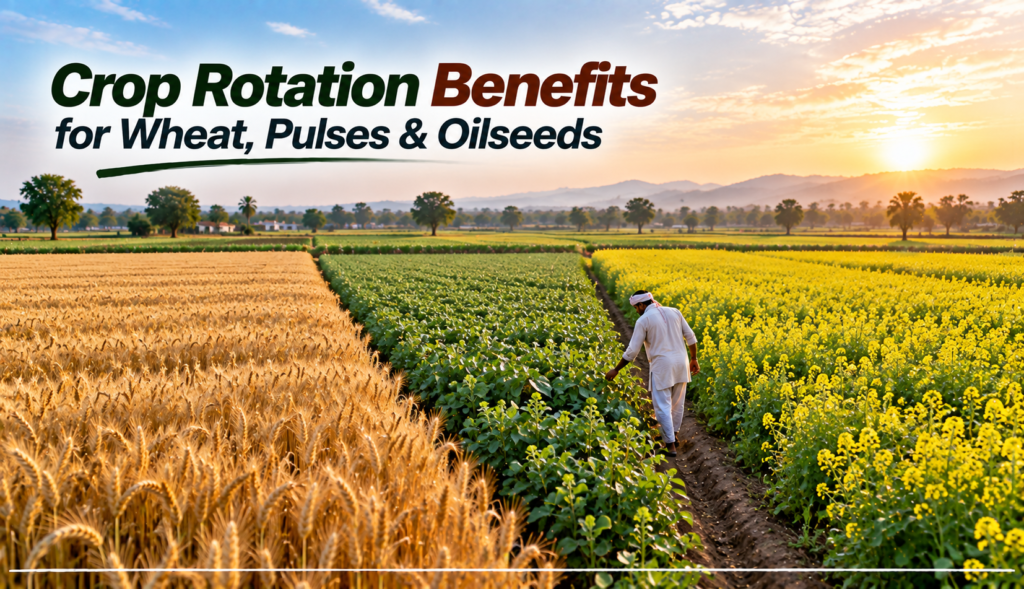
Crop Rotation Benefits for Wheat, Pulses & Oilseeds
Crop rotation is the practice of growing different crops on the same field in a planned sequence across different seasons or years. For wheat, pulses and oilseeds, a well-planned crop rotation can improve soil fertility, support nutrient cycling, reduce pest pressure and make farming systems more resilient.
Crop diversification and balanced nutrient management are receiving increased attention in Indian agriculture in 2026, particularly as farmers look for ways to protect soil productivity and improve input-use efficiency. ICAR initiatives have also emphasized crop diversification, inclusion of pulses, soil testing, green manuring and sustainable soil-health management.
What Is Crop Rotation?
Crop rotation means changing the crop grown on a particular piece of land instead of repeatedly planting the same crop. For example, a farmer may grow wheat in one season, followed by a pulse such as chickpea or green gram, and then an oilseed such as mustard depending on local climate, soil type and irrigation availability.
A good rotation combines crops with different nutrient requirements, root systems and growth cycles. This helps prevent continuous pressure on the same soil nutrients and can contribute to better long-term soil management.
Simple example of crop rotation
- Season 1: Wheat
- Season 2: Chickpea or another suitable pulse
- Season 3: Mustard or another suitable oilseed
- Optional: Green manure or cover crop where locally recommended
The exact sequence should be adjusted according to local agricultural recommendations, rainfall, irrigation, soil type and market conditions.
5 Major Benefits of Crop Rotation
- Improves Soil Fertility
One of the biggest crop rotation benefits is better management of soil fertility. Different crops remove different amounts of nutrients from the soil, so changing crops can reduce repeated depletion of particular nutrients.
Including legumes such as chickpea, lentil or green gram can be especially useful because legumes form associations with nitrogen-fixing bacteria and contribute biologically fixed nitrogen to the farming system.
ICAR has recently emphasized including at least one pulse crop in annual cropping systems as part of efforts to improve soil fertility, biological nutrient sources and farm sustainability.
- Supports Wheat Productivity
Wheat is an important Rabi crop, but continuously growing cereal crops can increase pressure on soil nutrients and create recurring weed, pest and disease management challenges.
A wheat crop rotation that includes pulses or other suitable crops can diversify the production system. Farmers can combine crop rotation with soil testing, balanced fertilization, residue management and appropriate irrigation practices for better resource management.
For wheat farmers, rotation is particularly valuable when it forms part of a wider conservation agriculture strategy rather than being treated as a standalone practice.
- Benefits Pulse and Oilseed Crops
Pulses and oilseeds play an important role in crop diversification. Chickpea, lentil, mustard, groundnut, soybean and other crops can be incorporated into rotations depending on the region and season.
Pulses are particularly important because of their role in soil fertility and nutritional security. Oilseeds, meanwhile, provide farmers with an additional production and income option.
ICAR’s 2026 agricultural programmes have highlighted crop diversification alongside the Pulses Mission and Oilseeds Mission as important components of sustainable agricultural development.
- Helps Manage Pests, Diseases and Weeds
Growing the same crop repeatedly can create favorable conditions for crop-specific pests, diseases and weeds. Changing crops interrupts their regular host and production cycle.
However, crop rotation should not be considered a complete substitute for integrated pest management. Farmers should combine rotation with certified seed, field sanitation, appropriate sowing time, balanced nutrition and locally recommended pest-control measures.
Crop Rotation and Soil Health
Soil health depends on physical, chemical and biological properties. Crop rotation can support soil health when combined with practices such as residue recycling, organic amendments, green manuring, biofertilizers and soil-test-based fertilizer application.
ICAR’s 2026 soil-health campaigns have specifically promoted crop rotation, green manuring, organic amendments, biofertilizers and soil-test-based nutrient management.
Crop diversification can also contribute to improved soil organic matter, microbial activity, water retention and nutrient-use efficiency. Research summarized by ICAR indicates that diversified and regenerative approaches can improve soil quality and strengthen resilience under climatic stress.
Best Crop Rotation Practices for Indian Farmers
Farmers planning a rotation should consider the following factors:
- Test the soil before planning the rotation. Soil-test results help identify nutrient deficiencies and guide fertilizer decisions.
- Include a pulse where suitable. Chickpea, lentil, green gram and other legumes can diversify cereal-heavy systems.
- Consider an oilseed crop. Mustard and other suitable oilseeds can provide production diversification.
- Avoid repeating the same crop continuously. Rotate crops with different nutrient and disease profiles.
- Use crop residues wisely. Residue retention or incorporation can contribute organic matter and reduce nutrient losses.
- Consider water availability. Choose crops according to rainfall, irrigation access and local agro-climatic conditions.
- Combine rotation with balanced fertilization. Crop rotation works best as part of an integrated soil-health strategy.
Why Crop Rotation Matters for Climate-Resilient Farming
Climate variability is making efficient management of soil, water and nutrients increasingly important. Crop diversification can reduce dependence on a single crop and help farmers build more flexible production systems.
Current Indian agricultural programmes are placing greater emphasis on climate-resilient agriculture, soil health, precision agriculture, integrated nutrient management and sustainable farming. These approaches can complement crop rotation and help farmers manage production risks more effectively.
Crop Rotation: A Practical Strategy for Better Farming
Crop rotation is more than simply changing crops every season. It is a planned approach to managing soil nutrients, crop diversity, pest pressure, water resources and farm profitability over time.
For wheat, pulses and oilseeds, a suitable rotation can contribute to healthier soil and a more diversified farming system. Farmers should select the crop sequence according to their soil test, local climate, irrigation availability, sowing window, market demand and recommendations from agricultural experts or local KVKs.
With increasing attention on soil health and sustainable agriculture, crop rotation remains a practical strategy for building productive and climate-resilient farm