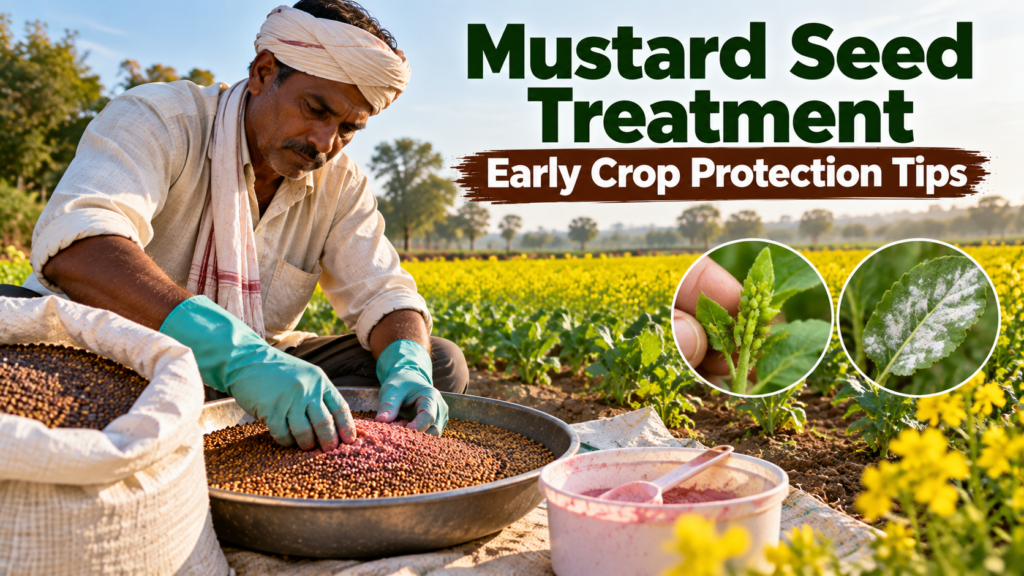
Mustard Seed Treatment: Early Crop Protection Tips
Mustard seed treatment is an important first step for establishing a healthy Rabi crop and reducing early disease risks. Along with quality seed, timely sowing, balanced nutrition, proper moisture management and regular field scouting can help farmers protect mustard during the critical early growth stages.
For the Rabi 2026-27 season, farmers should focus on preventive crop management rather than waiting for serious pest or disease symptoms to appear. ICAR advisories identify important mustard problems including aphids, Alternaria blight, white rust and other diseases, making early monitoring an important part of crop protection.
Why Mustard Seed Treatment Is Important
Mustard seed treatment helps protect seeds and young seedlings from seed-borne and soil-borne pathogens and supports uniform crop establishment. It should be combined with certified or quality seed, suitable varieties and recommended agronomic practices.
Before sowing, farmers should:
- Use clean, certified and locally recommended mustard seed.
- Remove damaged, shrivelled or visibly diseased seeds.
- Follow the seed-treatment recommendation provided for the selected variety and local conditions.
- Use only registered crop-protection products and follow the label dose.
- Consider recommended biological seed-treatment options where suitable.
- Avoid mixing different seed-treatment products unless compatibility is specifically recommended.
Seed treatment should not be considered a replacement for field monitoring. It is the first layer of protection, while timely scouting and integrated pest management provide protection throughout crop development.
Mustard Crop Protection Starts Before Sowing
Good mustard crop protection begins with field preparation, variety selection and timely sowing rather than only pesticide application after pest damage occurs.
Farmers should select varieties suited to their region, irrigation availability and sowing window. ICAR records several Indian mustard varieties with specific tolerance or resistance to problems such as aphids, white rust, Alternaria blight and Sclerotinia rot. Therefore, choosing a locally suitable variety can be an important part of an integrated disease-management strategy.
Timely sowing is also important because delayed planting can increase exposure to certain pests and diseases. ICAR regional recommendations have highlighted delayed sowing and inadequate moisture as constraints in rapeseed-mustard production.
Early Mustard Crop Protection: What Farmers Should Monitor
Farmers should inspect mustard fields regularly from seedling establishment onward for insect activity, leaf symptoms, wilting and abnormal plant growth. Early identification allows farmers to take corrective action before damage becomes widespread.
- Mustard Aphid
Aphids are among the major insect pests affecting mustard. They generally colonise tender shoots, leaves and flowering portions of the plant and can reduce plant vigour and yield when populations become high.
For mustard aphid management, farmers should:
- Inspect tender shoots and flowering branches regularly.
- Check the underside of leaves for colonies.
- Monitor the crop more closely when weather conditions favour aphid multiplication.
- Encourage beneficial insects and natural enemies.
- Avoid unnecessary insecticide applications.
- Apply an approved insecticide only when pest levels justify treatment and according to the current local recommendation and label.
ICAR’s mustard guidance specifically highlights aphid monitoring as an important crop-protection activity.
- White Rust in Mustard
White rust can appear as pale or white pustules, particularly on the undersides of leaves, and requires regular field monitoring. Excess moisture and favourable weather can increase disease risk.
Farmers should monitor lower and upper leaves and look for unusual spots, pustules or distortion. If symptoms appear, management should follow recommendations from the local agricultural university, KVK or plant-protection authority.
ICAR’s Rabi advisory recommends monitoring for white rust and taking treatment measures when symptoms appear rather than applying fungicides unnecessarily.
- Alternaria Blight
Alternaria blight can cause dark spots on mustard leaves and may become more damaging under favourable weather conditions. Regular scouting helps farmers detect symptoms early.
Crop rotation, suitable varieties, balanced fertilisation, proper field management and timely disease monitoring are important components of mustard disease management.
Use Integrated Pest Management in Mustard
Integrated Pest Management (IPM) combines preventive, cultural, biological and chemical measures instead of depending entirely on pesticides.
A practical mustard IPM approach includes:
- Start with quality treated seed.
- Select locally recommended varieties.
- Follow the recommended sowing window.
- Maintain suitable plant population.
- Monitor the field at regular intervals.
- Conserve beneficial insects.
- Remove or manage severely affected plant material where appropriate.
- Use pesticides only when economically and agronomically justified.
- Follow the recommended dose and waiting period on the product label.
- Wear appropriate protective equipment when handling crop-protection products.
Current ICAR guidance also emphasises farmer training on identifying major mustard pests and diseases and using IPM approaches for better productivity and profitability.
Rabi 2026-27 Mustard Farming Tips
For Rabi 2026-27, farmers should combine timely sowing, quality seed, mustard seed treatment, moisture management and regular pest scouting.
The most useful practices include:
- Test soil where possible before applying fertilisers.
- Choose a suitable mustard variety for the local agro-climatic condition.
- Treat seed according to current recommendations.
- Avoid excessive seed rate and overcrowding.
- Maintain adequate soil moisture during establishment.
- Monitor aphids during vulnerable crop stages.
- Scout for white rust and Alternaria symptoms.
- Avoid unnecessary pesticide sprays.
- Follow current state/KVK recommendations before using any chemical treatment.
This preventive approach can reduce avoidable crop losses and improve the efficiency of crop-protection inputs.
Conclusion
Mustard seed treatment is one of the first steps toward better crop establishment, but effective protection requires an integrated approach throughout the Rabi season. Farmers should combine quality seed, timely sowing, suitable varieties, moisture management, regular scouting and need-based pest and disease control.
For Rabi 2026-27 mustard farming, early identification of aphids, white rust and Alternaria blight can help farmers respond before problems become severe. Following recommendations from ICAR, state agricultural universities, KVKs and local agriculture departments is the safest way to select current treatment options and application doses.