Power Tiller vs Mini Tractor: Which Is Best for Small Farms?
Choosing the right agricultural machinery is important for small and marginal farmers who want to reduce labour costs, improve productivity and manage farming expenses. A power tiller and a mini tractor are two practical options for small landholdings in India, but they serve different farming requirements.
A power tiller is generally suitable for narrow fields, wet paddy cultivation and small plots, while a mini tractor offers greater versatility for transportation, inter-cultivation and operating multiple agricultural implements. The right choice depends on farm size, soil conditions, crop type, budget and the frequency of machinery use.
What Is a Power Tiller?
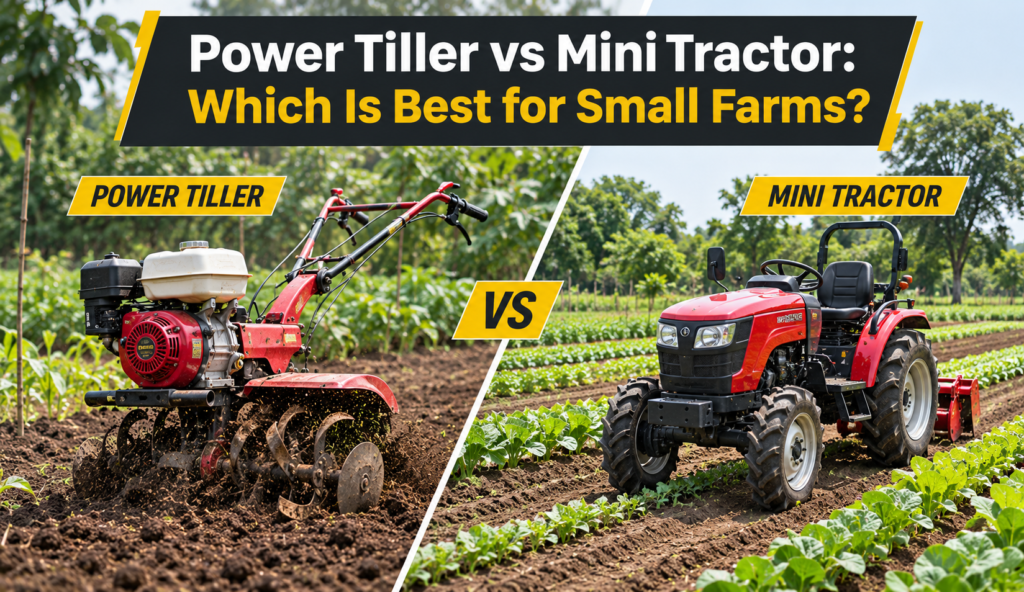
A power tiller is a two-wheel, engine-powered agricultural machine used for soil preparation and other farming activities. It is particularly useful for small and fragmented landholdings where operating a conventional tractor may be difficult.
Power tillers are commonly used for ploughing, rotavating, puddling, weeding, intercultural operations and preparing seedbeds. Depending on the model, farmers can attach suitable implements such as rotary tillers, cultivators, trailers and water pumps.
According to CSIR-Central Mechanical Engineering Research Institute (CMERI), power tillers are designed to support small-scale agricultural operations while requiring relatively lower investment and operating costs than conventional tractors. They are especially useful in paddy-growing areas and challenging field conditions.
What Is a Mini Tractor?
A mini tractor is a compact agricultural vehicle designed to perform different farming operations on small and medium-sized farms. It generally has four wheels, a driver’s seat, steering, a power take-off (PTO) and a hydraulic lifting system, depending on its configuration.
Mini tractors are commonly available in lower horsepower categories, making them suitable for orchards, vegetable farms, horticulture, inter-cultivation and light transportation.
Farmers can connect compatible implements such as rotavators, cultivators, seed drills, sprayers and trailers. Some models also offer four-wheel drive (4WD), which can provide better traction in suitable field conditions.
Power Tiller vs Mini Tractor: Key Differences
Both machines help farmers reduce manual labour, but their design, working capacity and applications differ.
Comparison Factor | Power Tiller | Mini Tractor |
Design | Two-wheel walk-behind machine | Compact four-wheel vehicle |
Operation | Operator walks behind the machine | Operator drives while seated |
Main purpose | Tillage and small-field operations | Multiple agricultural operations |
Field suitability | Narrow, fragmented and wet fields | Orchards, vegetable farms and accessible plots |
Implements | Model-specific attachments | PTO and compatible tractor implements |
Transportation | Limited, with suitable trailer | Better suited to farm transportation |
Initial investment | Generally lower | Generally higher |
Operator comfort | Requires walking and physical handling | More comfortable seated operation |
Manoeuvrability | Useful in narrow spaces | Depends on turning radius and tractor width |
Versatility | Depends on available attachments | Wider range of compatible implements |
Actual performance, fuel consumption and implement compatibility depend on the machine model and working conditions.
- Which Machine Is More Affordable?
A power tiller generally requires a lower initial investment than a mini tractor. This makes it an attractive option for farmers with limited budgets who mainly need machinery for land preparation, puddling and intercultural operations.
A mini tractor involves a higher purchase cost, but it can perform several activities throughout the agricultural season. Farmers who regularly use different implements may find its broader functionality useful.
However, the purchase price should not be the only consideration. Farmers should also calculate fuel expenses, maintenance, spare parts, insurance, implement costs and expected annual usage before making a decision.
- Fuel Efficiency and Maintenance
Power tillers generally consume less fuel than larger tractors because of their smaller engines and lower operating capacity. They can be economical for specific small-scale operations, although actual diesel consumption depends on engine power, soil type, working depth and load.
Mini tractors may consume more fuel when performing heavier operations, but their higher working capacity can help complete certain tasks in less time.
For both machines, regular maintenance is essential. Farmers should check engine oil, air filters, transmission oil, tyres or wheels, belts, blades and other moving components according to the manufacturer’s maintenance schedule.
- Which Machine Is Better for Different Crops?
The choice also depends on the crop and farming system.
Paddy farming: Power tillers are useful for puddling, wet-field preparation and operations in small paddy plots. Suitable cage wheels and attachments can improve their performance in flooded fields.
Vegetable farming: Both machines can support vegetable cultivation. Power tillers are useful for preparing narrow beds and small plots, while mini tractors can operate compatible seed drills, sprayers and cultivators.
Horticulture and orchards: Mini tractors are useful for inter-row cultivation, spraying and transportation, provided their dimensions match orchard spacing. Power tillers can also work in smaller spaces where larger machines cannot easily enter.
Wheat and other field crops: Mini tractors offer greater flexibility for seedbed preparation, spraying and light transportation. Power tillers can support smaller-scale soil preparation and selected intercultural operations.
- Government Subsidies for Farm Machinery in India
Government assistance can reduce the financial burden of purchasing agricultural machinery. The Sub-Mission on Agricultural Mechanization (SMAM), implemented through state governments, supports farm mechanisation and promotes access to equipment for small and marginal farmers.
The Ministry of Agriculture and Farmers Welfare also encourages Custom Hiring Centres (CHCs), allowing farmers to rent machinery instead of purchasing expensive equipment individually.
In addition, subsidy programmes may be available for eligible mini tractor and power tiller purchases through state agricultural departments. The subsidy amount, eligibility, application process and approved machinery vary by state and scheme.
- Power Tiller vs Mini Tractor: Which One Should You Choose?
There is no single winner because both machines are designed for different agricultural requirements.
Choose a power tiller if you:
- Own a small or fragmented agricultural plot.
- Primarily cultivate paddy or work in wet soil.
- Need affordable machinery for tillage and seedbed preparation.
- Operate in narrow fields, terraces or areas with limited turning space.
- Want a machine for specific farming operations rather than extensive transportation.
Choose a mini tractor if you:
- Need one machine for multiple agricultural activities.
- Manage an orchard, vegetable farm or accessible field.
- Frequently use tractor-compatible implements.
- Require a vehicle for carrying agricultural inputs and harvested produce.
- Want seated operation and greater flexibility across farming seasons.
Before purchasing, compare the machine’s horsepower, working width, turning radius, ground clearance, PTO specifications, hydraulic lifting capacity, service availability and spare parts.
Conclusion
A power tiller and a mini tractor can both improve farm mechanisation, but the better investment depends on the farmer’s actual requirements. Power tillers are practical for small plots, wet paddy fields and focused tillage operations, whereas mini tractors are more versatile for farmers who need multiple implements, transportation and regular field operations.
Small farmers should evaluate their landholding, crop pattern, soil conditions, annual machinery usage and available budget before making a purchase. They can also explore government subsidies or Custom Hiring Centres to reduce the cost of agricultural mechanisation.
The most economical machine is not necessarily the cheapest one; it is the machine that completes the required farming operations efficiently at a sustainable operating cost.