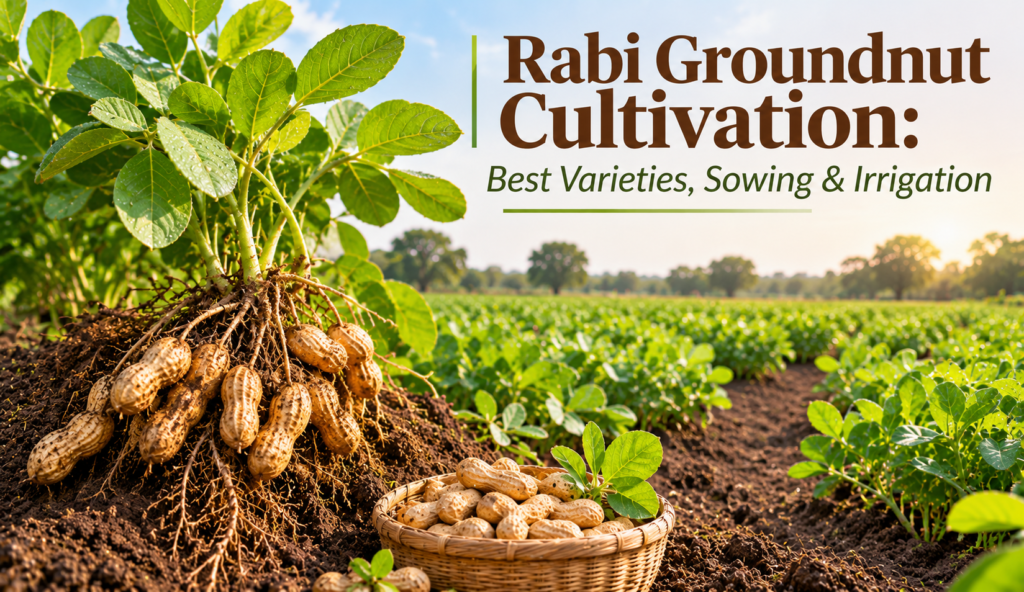
Rabi Groundnut Cultivation: Best Varieties, Sowing & Irrigation
Rabi groundnut cultivation is an important opportunity for farmers in regions with suitable temperatures and reliable irrigation facilities. Groundnut (Arachis hypogaea) is a major oilseed crop in India, valued for its edible oil, protein-rich kernels and use in food processing. Successful production depends on selecting regionally suitable varieties, preparing well-drained soil, following the correct sowing time and providing adequate water during critical growth stages.
With better seed selection and scientific crop management, farmers can improve groundnut productivity while managing irrigation costs and maintaining soil health.
- Suitable Soil and Climate for Rabi Groundnut Farming
Groundnut grows best in loose, friable and well-drained sandy loam or loamy soils. The soil should allow easy penetration of pegs and proper development of underground pods. Waterlogged, heavy clay and poorly drained fields should be avoided because excess moisture can damage roots and developing pods.
The crop generally performs well under warm conditions, with adequate sunlight and moderate temperatures. Cool weather during germination and early growth can affect crop establishment. Farmers should therefore select a sowing window based on their local climate and agricultural university recommendations.
Ideal field conditions include:
- Well-drained sandy loam or loamy soil.
- Good soil aeration and adequate organic matter.
- A friable soil structure for proper pod development.
- Access to irrigation during dry periods.
- Fields with minimal waterlogging risk.
- Best Groundnut Varieties for Rabi Cultivation
Selecting the right groundnut variety is essential for achieving good germination, healthy plant growth and better pod production. Farmers should choose varieties according to their region, crop duration, irrigation availability, soil conditions and resistance or tolerance to locally prevalent diseases.
Some groundnut varieties and cultivars mentioned in Indian agricultural recommendations include:
Groundnut variety | Important consideration |
TAG-24 | Popular Spanish bunch-type cultivar |
TG 37A | Improved cultivar used in different groundnut-growing regions |
GG-20 | Gujarat-recommended semi-spreading type |
GJG-22 | Gujarat-recommended semi-spreading type |
GJG-17 | Gujarat-recommended spreading type |
GG-11 | Gujarat-recommended spreading type |
TAG-73 | Cultivar included in regional groundnut advisories |
Variety suitability differs across states and growing seasons. A variety recommended for one region should not automatically be considered suitable for every Rabi groundnut-growing area. Farmers should purchase certified seeds from authorised dealers and check recommendations from their nearest Krishi Vigyan Kendra (KVK) or agricultural university.
- Rabi Groundnut Sowing Time in India
The correct sowing time helps groundnut establish properly and complete its reproductive stages under favourable weather conditions. Rabi groundnut sowing periods vary by region, temperature and irrigation availability.
In several southern and eastern growing regions, November to December is an important Rabi sowing window. In other regions, sowing calendars may differ according to local agroclimatic conditions. Farmers should follow state-specific recommendations rather than using a single nationwide date.
For successful sowing:
- Prepare the field to obtain a fine, friable seedbed.
- Ensure sufficient moisture before planting.
- Select healthy, mature and disease-free kernels.
- Avoid sowing in excessively wet or cold soil.
- Use a seed drill or suitable dibbling method for uniform placement.
Proper sowing depth and plant spacing should follow the selected variety’s package of practices.
- Seed Rate and Spacing for Groundnut Farming
The seed rate depends on the variety, kernel size, germination percentage and planting arrangement. Bunch-type and spreading-type varieties generally require different spacing.
For many conventional planting systems, bunch varieties are planted at approximately 30 × 10 cm, while spreading varieties may require around 45–60 cm between rows, with suitable plant-to-plant spacing.
Farmers should calculate the seed requirement using the recommended seed rate for the specific variety. Do not confuse kernel seed rate with the weight of unshelled pods, as their quantities differ.
Seed treatment and Rhizobium inoculation should be carried out according to agricultural university recommendations and the product label. This supports healthy crop establishment and biological nitrogen fixation.
- Irrigation Schedule and Water Requirements for Rabi Groundnut
Water management is one of the most important factors in Rabi groundnut cultivation because the crop is grown with limited rainfall in many regions. Timely irrigation supports flowering, pegging and pod development, which directly influence the final harvest.
The irrigation schedule should depend on soil type, weather, crop stage and available water.
Important irrigation stages include:
- Before sowing: Provide pre-sowing irrigation if the soil does not have sufficient moisture for proper germination.
- Germination and establishment: Maintain adequate moisture without creating waterlogged conditions.
- Flowering: Provide timely irrigation to prevent moisture stress and support flower development.
- Pegging: Ensure sufficient soil moisture because pegs enter the soil and develop into pods.
- Pod formation and filling: Avoid moisture stress during underground pod development.
- Crop maturity: Reduce or stop irrigation according to crop maturity and local harvesting recommendations.
In water-limited areas, drip or sprinkler irrigation can help improve water-use efficiency when properly designed and managed. Farmers should avoid excessive irrigation because waterlogging can increase the risk of root diseases and poor pod development.
- Fertiliser and Nutrient Management
Balanced nutrient management is essential for healthy groundnut growth and better pod formation. Although groundnut is a legume that fixes atmospheric nitrogen through root nodules, it still requires appropriate phosphorus, potassium, calcium and sulphur.
Apply well-decomposed farmyard manure (FYM) during field preparation to improve soil structure and organic matter. Use soil-test-based fertiliser recommendations rather than applying excessive chemical fertilisers.
Calcium is particularly important for proper pod development. Gypsum is commonly recommended in groundnut production to supply calcium and sulphur, but its application rate and timing should follow local agricultural recommendations.
- Weed, Pest and Disease Management
Weed management during the early growth period is important because weeds compete with groundnut plants for nutrients, sunlight and moisture. Carry out timely intercultural operations and hand weeding according to crop growth and field conditions.
Farmers should regularly monitor their fields for common groundnut problems, including:
- Leaf spot and rust diseases.
- Collar rot and root rot.
- White grub and other soil insects.
- Aphids and other sucking pests.
Use integrated pest management (IPM), crop monitoring, clean planting material and recommended plant-protection measures. Apply pesticides only when required, following approved product labels and local agricultural advisories.
- Harvesting and Post-Harvest Management
Groundnut harvesting should be carried out when the crop reaches physiological maturity. Yellowing of leaves, mature pod shells and the development of characteristic markings inside the shell can help farmers assess crop maturity.
Dig the plants carefully to minimise pod loss and damage. Allow harvested plants to dry properly before separating pods. Groundnut should be dried to a safe storage moisture level and stored in clean, dry and well-ventilated conditions.
Proper drying and storage help reduce fungal growth and the risk of aflatoxin contamination, protecting both produce quality and market value.
Conclusion
Rabi groundnut cultivation can provide an additional oilseed production opportunity for farmers with suitable climatic conditions and dependable irrigation. Selecting the right variety, following the recommended sowing window, maintaining balanced nutrition and providing timely irrigation during flowering, pegging and pod development are essential for successful production.
Farmers should adopt region-specific agricultural recommendations, use quality seeds and monitor crop health regularly. Scientific water management and proper post-harvest drying can further improve crop quality and farm profitability.