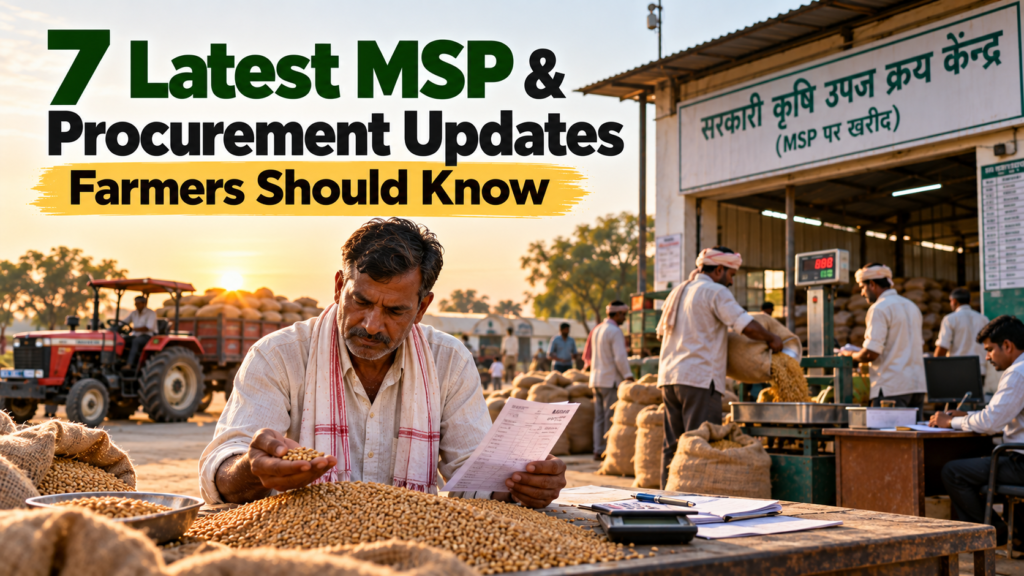
7 Latest MSP and Procurement Updates Farmers Should Know
Farmers should keep track of MSP and procurement updates because government price support can directly affect crop marketing decisions and farm income. For the 2026-27 marketing season, the government has announced higher MSPs for Kharif and Rabi crops, while PM-AASHA continues to strengthen procurement and price-support mechanisms.
From higher MSP for pulses and oilseeds to expanded procurement support, these changes are important for farmers planning harvesting, storage and crop sales in the coming months.
- Kharif MSP 2026-27 Has Increased
The latest MSP and procurement updates include higher Minimum Support Prices for all 14 mandated Kharif crops for the 2026-27 marketing season. The largest absolute MSP increase is ₹622 per quintal for sunflower seed, followed by cotton at ₹557, nigerseed at ₹515 and sesamum at ₹500.
Some important Kharif MSPs for 2026-27 are:
Crop | MSP 2026-27 |
Paddy – Common | ₹2,441/quintal |
Maize | ₹2,410/quintal |
Tur/Arhar | ₹8,450/quintal |
Moong | ₹8,780/quintal |
Urad | ₹8,200/quintal |
Soybean | ₹5,708/quintal |
Groundnut | ₹7,517/quintal |
Cotton – Medium Staple | ₹8,267/quintal |
The government has stated that the revised MSPs are intended to provide remunerative prices and encourage diversification towards pulses, oilseeds and nutri-cereals.
- Rabi MSP 2026-27 Remains Important for Farmers
Rabi farmers should also monitor the MSP and procurement updates before making crop-marketing decisions. The government approved higher MSPs for all six mandated Rabi crops for Marketing Season 2026-27.
The revised Rabi MSPs include:
- Wheat: ₹2,585 per quintal
- Gram: ₹5,875 per quintal
- Lentil (Masur): ₹7,000 per quintal
- Rapeseed & Mustard: ₹6,200 per quintal
- Barley: ₹2,150 per quintal
- Safflower: ₹6,540 per quintal
Safflower received the highest increase at ₹600 per quintal, while lentil received an increase of ₹300 per quintal. Wheat MSP increased by ₹160 per quintal.
- PM-AASHA Strengthens Price Support
One of the major MSP and procurement updates is the continued strengthening of the Pradhan Mantri Annadata Aay Sanrakshan Abhiyan, or PM-AASHA. The scheme supports price assurance and aims to reduce distress sales when market prices weaken.
For 2026-27, PM-AASHA has a budget allocation of ₹7,200 crore. The framework includes mechanisms such as the Price Support Scheme (PSS), Price Deficiency Payment Scheme (PDPS), Price Stabilization Fund and Market Intervention Scheme.
For pulses, oilseeds and copra, procurement under PSS can help farmers receive price support when market prices fall below MSP, subject to applicable rules and registration requirements.
- Pulses and Oilseeds Get Greater Attention
Pulses and oilseeds are an important part of the latest agricultural procurement strategy. Higher MSPs for crops such as tur, moong, urad, soybean, sunflower, mustard and lentils are intended to encourage production diversification.
The government has also allowed procurement of Tur, Urad and Masur up to 100% of a state’s production under the specified PM-AASHA procurement framework. This can be particularly relevant for farmers looking for stronger price assurance in pulse-producing regions.
However, farmers should check state-level procurement announcements, registration requirements, quality specifications and procurement-centre details before taking their produce to a designated centre.
- Digital Procurement Is Becoming More Important
Another important development is the increasing use of digital systems in agricultural marketing and procurement. Government information highlights tools such as e-NAM, e-Samriddhi and e-Samyukti to improve transparency, farmer authentication and procurement efficiency.
Digital agricultural markets can help farmers access market information and improve visibility of available trading opportunities. However, online registration or market participation does not automatically guarantee procurement at MSP; eligibility and applicable procurement conditions still matter.
Farmers should therefore verify information through official government portals or their state agriculture department before selling crops.
- Farmers Should Check Procurement Rules Before Selling
Knowing the MSP alone is not enough. Farmers should also understand where, when and under what conditions procurement will take place.
Before selling produce, farmers should check:
- Crop eligibility for MSP procurement
- Registration requirements
- Approved procurement centres
- Land and farmer identification documents
- Quality and moisture specifications
- Procurement opening and closing dates
- Payment process and bank-account details
- State-specific procurement rules
This is especially important because procurement arrangements can differ by crop, state and marketing season.
- What Farmers Should Watch Next
The next important MSP and procurement updates will involve procurement operations, crop arrivals, market prices and state-level implementation. Farmers should compare the applicable MSP with local mandi prices rather than relying only on national announcements.
For example, a farmer may consider whether immediate sale, temporary storage or sale through an organised procurement channel is more suitable based on crop quality, storage costs, local prices and procurement availability.
The government’s latest data also highlights the scale of procurement. Between 2014-15 and 2025-26, procurement of 14 Kharif crops was reported at 8,746 lakh metric tonnes, while MSP payments to farmers growing those crops were reported at ₹18.99 lakh crore.
What These MSP Updates Mean for Farmers
The latest MSP and procurement updates indicate continued emphasis on remunerative crop prices, pulses and oilseeds, digital procurement and reducing distress sales. Farmers should use MSP as an important reference point but also consider local mandi prices, crop quality, storage costs and actual procurement availability.
For upcoming Rabi planning, farmers growing wheat, gram, mustard, lentil, barley or safflower should keep the 2026-27 MSP figures in mind while planning production and marketing.