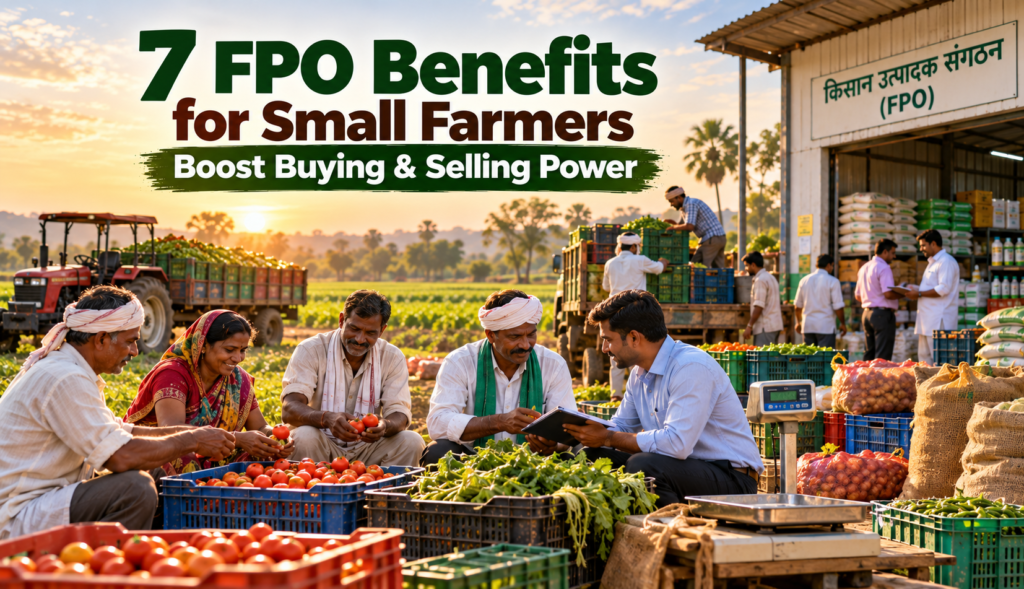
7 FPO Benefits for Small Farmers: Boost Buying & Selling Power
Small farmers often face higher input costs, limited bargaining power and difficulty accessing profitable markets. FPO benefits for small farmers include collective purchasing, better market access, improved bargaining power, value addition and stronger opportunities to increase farm income.
Farmer Producer Organisations (FPOs) bring individual farmers together so they can operate more like a collective business while retaining ownership of their farms. With agriculture increasingly focused on organised marketing, digital marketplaces, value addition and efficient supply chains, FPOs are becoming an important part of India’s agricultural ecosystem.
What Is a Farmer Producer Organisation?
A Farmer Producer Organisation (FPO) is a collective organisation formed by primary producers, mainly farmers, to improve their economic position through joint business activities. Instead of purchasing inputs or selling produce individually, members can work together for procurement, aggregation, processing, marketing and other agricultural activities.
The Government of India has promoted the formation and development of FPOs through the Central Sector Scheme for the Formation and Promotion of 10,000 Farmer Producer Organisations. SFAC continues to provide information on the scheme, registered FPOs, credit guarantee support and operational guidelines.
7 FPO Benefits for Small Farmers
The biggest advantage of an FPO is collective strength. When farmers combine their demand and produce, they can potentially negotiate better terms than they could individually.
- Bulk Purchase of Farm Inputs
FPOs can help farmers purchase seeds, fertilisers, pesticides and other agricultural inputs collectively. Buying in larger quantities can improve procurement efficiency and may provide better prices or terms.
For small farmers, this can be particularly useful because purchasing power is often limited when buying individually.
- Better Bargaining Power
One of the most important FPO benefits for small farmers is stronger bargaining power.
An individual farmer may have a small quantity of produce to sell. However, an FPO can aggregate produce from many members and negotiate with buyers using a larger marketable quantity.
This collective approach can improve the farmer’s position when negotiating with traders, processors, retailers and institutional buyers.
- Improved Market Access
FPOs can help connect farmers with organised markets and potential buyers. Instead of depending entirely on local traders, producer organisations can explore direct marketing, institutional sales, processors, retailers and digital platforms.
NABARD has highlighted collectivisation through FPOs as a way to address challenges such as limited marketable surplus and poor access to markets faced by small and marginal farmers.
- Better Selling Opportunities
Collective selling can make agricultural produce easier to market because an FPO can aggregate quantities from multiple farmers.
For example, farmers growing the same crop can pool their produce, sort and grade it, and approach buyers with a larger consignment. This can create opportunities that may not be practical for an individual smallholder.
However, actual prices still depend on crop quality, demand, location, market conditions and the FPO’s business capabilities.
- Value Addition and Processing
Another important FPO benefit is the ability to move beyond selling raw agricultural produce.
Depending on its business model, an FPO can support activities such as:
- Cleaning and grading
- Sorting and packaging
- Processing
- Branding
- Storage
- Primary value addition
- Direct marketing
Value addition can help farmers participate in more stages of the agricultural value chain instead of relying only on raw-produce sales.
- Access to Finance and Business Support
A professionally managed FPO can create a structured platform for accessing institutional finance and business support.
NABARD reports that its FPO initiatives include capacity building, credit facilitation and market linkages. Its recent research also identifies collectivisation through FPOs and SHGs as an important policy enabler for improving access to agricultural support.
Government-backed FPO programmes can also provide support mechanisms such as training, handholding and credit guarantee facilities, subject to applicable scheme guidelines and eligibility.
- Shared Access to Technology and Farm Services
Modern agriculture increasingly depends on technology, mechanisation, quality inputs and professional farm management. FPOs can make it easier for members to access services collectively.
For example, an FPO may help farmers explore:
- Custom hiring of farm machinery
- Soil testing
- Digital agriculture tools
- Crop advisory services
- Storage facilities
- Transport and logistics
- Improved seeds and inputs
- Market information
NABARD has also highlighted shared ownership and use of modern farm machinery through FPOs, SHGs and cooperatives as a potential approach for small-sized farms.
How FPOs Improve Buying and Selling Power
The basic FPO model works through aggregation. Farmers combine their purchasing requirements and agricultural produce, allowing the organisation to operate at a larger scale.
For buying, the FPO can aggregate demand for inputs. For selling, it can aggregate farm produce and approach larger or more organised buyers.
This creates two important advantages:
Buying power: Farmers can collectively negotiate for inputs and services.
Selling power: Farmers can aggregate produce and potentially negotiate better commercial terms with buyers.
Therefore, FPOs can help address two common challenges faced by small farmers: high input costs and limited market access.
Can FPOs Increase Farmers’ Income?
FPOs can create opportunities to improve farm income, but they do not automatically guarantee higher earnings. Results depend on management quality, member participation, crop selection, market linkages, infrastructure, financial planning and the organisation’s ability to operate as a sustainable business.
NABARD’s research identifies collectivisation and better access to policy enablers as relevant factors for improving agricultural income, while its FPO initiatives focus on capacity building, finance and market linkages.
FPO Scheme and the Future of Small Farmers
The continued focus on FPOs reflects a broader shift towards collective farming businesses, organised agricultural marketing, value-chain development and farmer-led enterprises.
SFAC’s official FPO resources include operational guidelines, information on FPOs under the 10,000-FPO scheme, credit guarantee information and convergence with other government schemes.
For small farmers, the long-term opportunity is not simply to sell more produce. It is to participate more effectively in the complete agricultural value chain—from input procurement and production to aggregation, processing, branding and marketing.
Conclusion
FPO benefits for small farmers go beyond collective selling. By bringing farmers together, FPOs can strengthen purchasing power, improve market access, support value addition, facilitate finance and create opportunities for better participation in agricultural value chains.
As Indian agriculture becomes more organised and technology-driven, strong and professionally managed FPOs can play an important role in helping small farmers build sustainable market-oriented businesses.