Rotavator vs Cultivator: Which Is Better for Farmers?
Farmers often compare a rotavator vs cultivator when preparing fields for sowing. The right implement depends on the soil condition, required working depth, crop residue, tractor HP, and whether the goal is primary or secondary tillage.
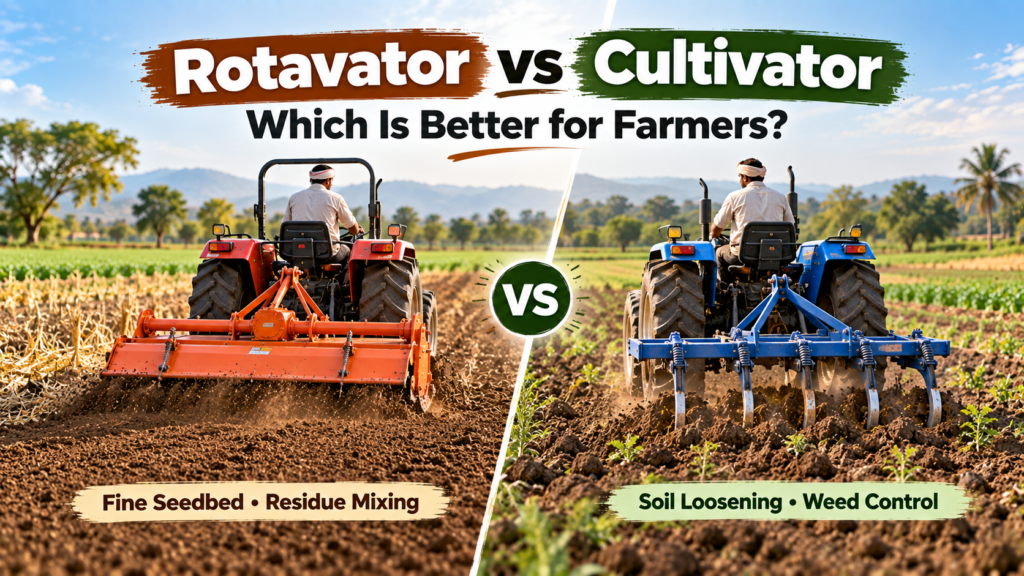
A cultivator is generally suitable for loosening soil, breaking clods and controlling weeds, while a rotavator provides more intensive soil pulverisation and mixes crop residues into the soil. Understanding these differences can help farmers select the right tractor implement for efficient and economical field preparation.
What Is a Cultivator?
A cultivator is a tractor-mounted farm implement primarily used for loosening and aerating the soil, breaking clods and controlling weeds between crop cycles. It normally uses multiple tines or shanks that penetrate the soil and disturb it without cutting and mixing the soil as intensively as a rotavator.
Cultivators are commonly used for:
- Secondary tillage
- Soil loosening
- Weed control
- Breaking small soil clods
- Preparing seedbeds
- Incorporating some crop residues
- Maintaining soil aeration
Cultivators are available in different configurations and working widths, making them suitable for farms with different tractor capacities and field sizes.
What Is a Rotavator?
A rotavator, also called a rotary tiller, is a PTO-driven tractor implement that uses rotating blades to cut, break and mix soil. It is particularly useful when farmers need a finer seedbed and better incorporation of crop residues.
Common rotavator uses include:
- Seedbed preparation
- Soil pulverisation
- Mixing crop residues
- Breaking hard soil layers
- Preparing fields for crops such as wheat, paddy, vegetables and pulses
- Reducing the number of separate tillage operations
Because the blades rotate at high speed, a rotavator generally performs more intensive soil preparation than a conventional cultivator.
Rotavator vs Cultivator: Key Differences
The main difference between a rotavator and cultivator is their working mechanism. A cultivator uses tines or shanks to loosen and disturb soil, whereas a rotavator uses rotating blades powered through the tractor’s PTO to cut and pulverise the soil.
Feature | Rotavator | Cultivator |
Working mechanism | Rotating blades | Tines/shanks |
PTO requirement | Yes | Usually no PTO required |
Soil pulverisation | High | Moderate |
Residue mixing | Excellent | Moderate |
Weed control | Good | Good |
Seedbed preparation | Excellent | Good |
Fuel requirement | Generally higher | Generally lower |
Operation | More intensive | Comparatively simple |
Best suited for | Fine seedbeds and residue mixing | Loosening and secondary tillage |
Which Is Better for Soil Preparation?
For fine seedbed preparation, a rotavator is generally the better choice because its rotating blades break and mix the soil more intensively. However, a cultivator can be more practical when the farmer only needs to loosen the soil, control weeds or perform routine secondary tillage.
The choice should depend on:
- Soil type: Hard or compacted soil may require different tillage strategies.
- Crop requirement: Crops requiring a fine seedbed can benefit from rotary tillage.
- Crop residue: A rotavator can effectively mix residues into the soil.
- Tractor HP: The implement should match the tractor’s available power and PTO capacity.
- Farm size: Larger farms may require wider implements for faster field coverage.
- Fuel budget: More intensive rotary operation can increase fuel consumption.
Tractor HP Required for Rotavator and Cultivator
The required tractor HP depends on implement width, soil condition, working depth and operating speed. A smaller rotavator may work with a lower-horsepower tractor, while wider and heavier models generally require more power.
For example, farmers should not select a rotavator only by its width. Tractor HP for rotavator selection should also consider soil hardness, blade configuration, field conditions and PTO performance.
Similarly, a cultivator should be matched with the tractor’s lifting capacity, implement weight and working width. Selecting an implement that is too large for the tractor can reduce field efficiency and increase fuel consumption and mechanical stress.
Rotavator vs Cultivator: Which One Should Farmers Buy?
Choose a rotavator if your priority is fine soil pulverisation, residue incorporation and seedbed preparation in fewer passes. Choose a cultivator if you mainly need soil loosening, weed control and routine secondary tillage at a comparatively simple operating setup.
Choose a Rotavator When:
- You need a fine seedbed.
- Crop residues need to be mixed into the soil.
- You want intensive soil preparation.
- You want to reduce repeated tillage passes.
- Your tractor has adequate PTO power.
Choose a Cultivator When:
- Soil needs basic loosening.
- Weed control is an important requirement.
- You want a relatively simple tillage operation.
- Your farming operation does not require intensive pulverisation.
- You want to perform routine secondary tillage.
How Farmers Can Improve Tillage Efficiency
Modern farming increasingly focuses on reducing unnecessary field passes, improving fuel efficiency and selecting implements according to actual soil conditions. Instead of choosing an implement only based on its price, farmers should compare working width, tractor compatibility, operating depth, blade or tine configuration, maintenance requirements and expected field performance.
Farmers should also avoid excessive tillage because repeated soil disturbance can affect soil structure and increase operating costs. Using the appropriate implement at the appropriate soil moisture level can improve field preparation and reduce unnecessary tractor operations.
Final Verdict: Rotavator or Cultivator?
There is no single winner in the rotavator vs cultivator comparison because both implements perform different jobs. A rotavator is better for intensive soil pulverisation, seedbed preparation and residue incorporation, while a cultivator is better suited to soil loosening, weed management and conventional secondary tillage.
Before purchasing, farmers should consider tractor HP, soil type, crop, field size, implement width, working depth, fuel consumption and local farming conditions. Matching the implement to the actual field requirement can deliver better productivity and lower operating costs.