How to Choose Tractor HP for Rabi Field Preparation
Choosing the right tractor HP for rabi field preparation is important because the tractor must provide enough power for ploughing, soil conditioning, seedbed preparation and other operations without wasting fuel. For most small and medium farms, the ideal tractor HP depends on land size, soil type, implement size, field conditions and the type of Rabi crops being grown.
As farmers prepare for the Rabi season 2026-27, selecting the right tractor can improve field productivity, reduce unnecessary fuel consumption and make farm operations more efficient.
Why Tractor HP Matters for Rabi Field Preparation
Tractor horsepower determines how effectively a tractor can operate agricultural implements under different field conditions. A tractor with insufficient HP may struggle with heavy soil and large implements, while an unnecessarily powerful tractor can increase purchase and operating costs.
For Rabi farming, tractors are commonly used for:
- Primary and secondary tillage
- Ploughing
- Rotavator operations
- Cultivator work
- Harrowing
- Seedbed preparation
- Sowing operations
- Levelling and field preparation
Therefore, farmers should select tractor HP according to the actual workload instead of choosing a tractor only because it has higher horsepower.
What Tractor HP Is Suitable for Rabi Farming?
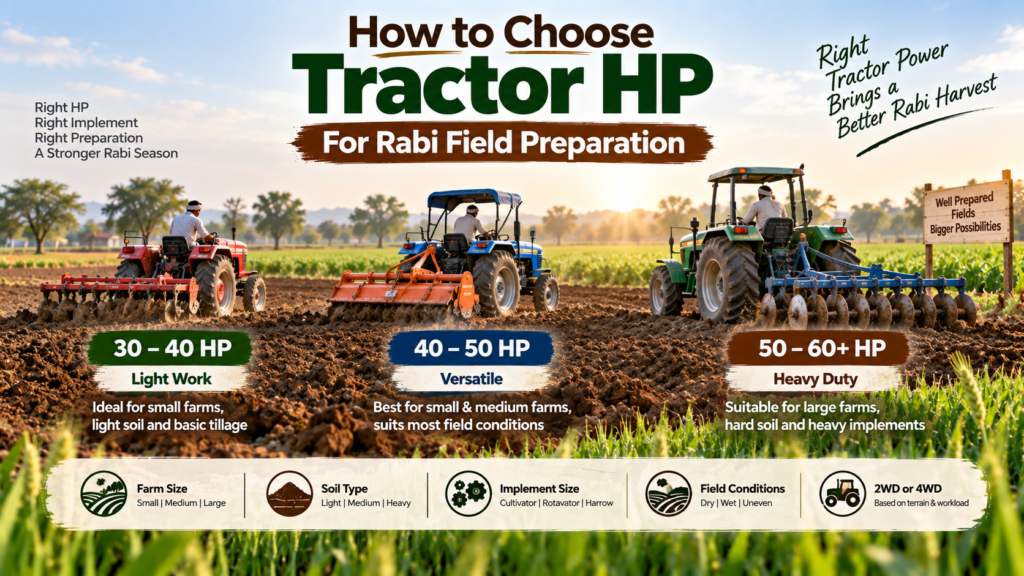
The suitable tractor HP for rabi farming generally ranges from around 30 HP to 60 HP or more, depending on farm size, soil conditions and implements.
30–40 HP Tractors
These tractors are suitable for small farms and lighter agricultural operations. They can be useful for:
- Small cultivators
- Light-duty rotavators
- Seed drills
- Harrows
- Intercultural operations
- Orchard and vegetable farming
For farmers with smaller landholdings and relatively light soil, a 35–40 HP tractor can provide a practical balance between performance and fuel economy.
40–50 HP Tractors
A 40–50 HP tractor is a versatile option for many small and medium-sized farms. It can handle a wider range of implements used for Rabi field preparation, including cultivators, rotavators and ploughs.
This HP range can be considered when farmers need one tractor for multiple operations rather than purchasing separate machines for different tasks.
50–60 HP Tractors
For larger farms, hard soil or heavy-duty implements, 50–60 HP tractors can provide greater pulling capacity and operating performance.
These tractors are particularly useful when field preparation involves deeper tillage, larger rotavators, heavier cultivators or repeated operations in difficult soil conditions.
How Soil Type Affects Tractor HP Requirement
Soil condition is one of the most important factors when deciding tractor HP for rabi field preparation. Hard, compact or clay-heavy soil generally requires more drawbar pull than loose or sandy soil.
For example:
- Light soil: Lower HP may be sufficient.
- Medium soil: Medium HP tractors can handle common implements.
- Heavy clay soil: Higher HP may be required.
- Dry and compact soil: Additional traction and pulling power may be necessary.
Farmers should therefore consider the actual condition of their fields instead of relying only on acreage when selecting tractor power.
Match Tractor HP With Agricultural Implements
The tractor should be matched with the implement before making a purchase. An implement that is too large for a tractor can overload the engine, reduce working efficiency and increase fuel consumption.
For example, farmers using a 6-foot rotavator should check the manufacturer’s recommended HP range before attaching it to a tractor. Similarly, cultivators, disc harrows, mouldboard ploughs and seed drills have different power requirements.
A simple rule is:
Larger and heavier implements generally require higher tractor HP and adequate hydraulic lifting capacity.
2WD or 4WD Tractor for Rabi Field Preparation?
The choice between 2WD and 4WD depends mainly on field conditions and the type of work.
2WD tractors can be suitable for normal agricultural operations on relatively level and firm fields. They are often considered when farmers want lower initial investment and straightforward maintenance.
4WD tractors, on the other hand, provide better traction in challenging conditions. They can be useful for:
- Wet or slippery fields
- Heavy soil
- Uneven land
- Heavy implements
- Deep tillage
- Operations requiring additional traction
Therefore, farmers working in difficult field conditions should consider 4WD tractors for farming where the additional traction justifies the investment.
How to Choose the Best Tractor HP for Your Farm
Before buying a tractor for Rabi field preparation, consider these five factors:
- Farm size: Larger acreage can justify higher HP.
- Soil type: Heavy and compact soil generally requires more power.
- Implement size: Match tractor HP with rotavator, cultivator and plough requirements.
- Type of farming: Intensive farming may require a more versatile tractor.
- Future requirements: Consider implements and operations you may add later.
This approach helps farmers avoid both underpowered and unnecessarily oversized tractors.
Tractor HP and Fuel Efficiency
Higher horsepower does not automatically mean better performance or higher productivity. A tractor should be appropriately matched to the implement and workload.
An appropriately powered tractor can help farmers maintain efficient engine loading, complete field operations effectively and avoid unnecessary fuel consumption.
For Rabi farming 2026-27, farmers should therefore focus on the combination of tractor HP, torque, PTO performance, hydraulic capacity, traction and implement compatibility, rather than horsepower alone.
Final Checklist Before Buying a Tractor
Before selecting a tractor for Rabi field preparation, check:
- Recommended HP for your implements
- Soil and field conditions
- Farm acreage
- 2WD or 4WD requirement
- PTO speed
- Hydraulic lifting capacity
- Fuel efficiency
- Maintenance and service availability
- Tractor price and financing options
- Future implement requirements
Conclusion
The right tractor HP for rabi field preparation depends on more than farm size. Soil type, implement requirements, field conditions, acreage and the type of agricultural operations should all be considered before choosing a tractor.
For many small and medium farms, 40–50 HP tractors can offer a versatile solution, while larger farms and heavy-duty operations may benefit from 50–60 HP or higher tractors. By matching tractor power with implements and actual field requirements, farmers can improve operational efficiency and prepare their land effectively for the Rabi season 2026-27.