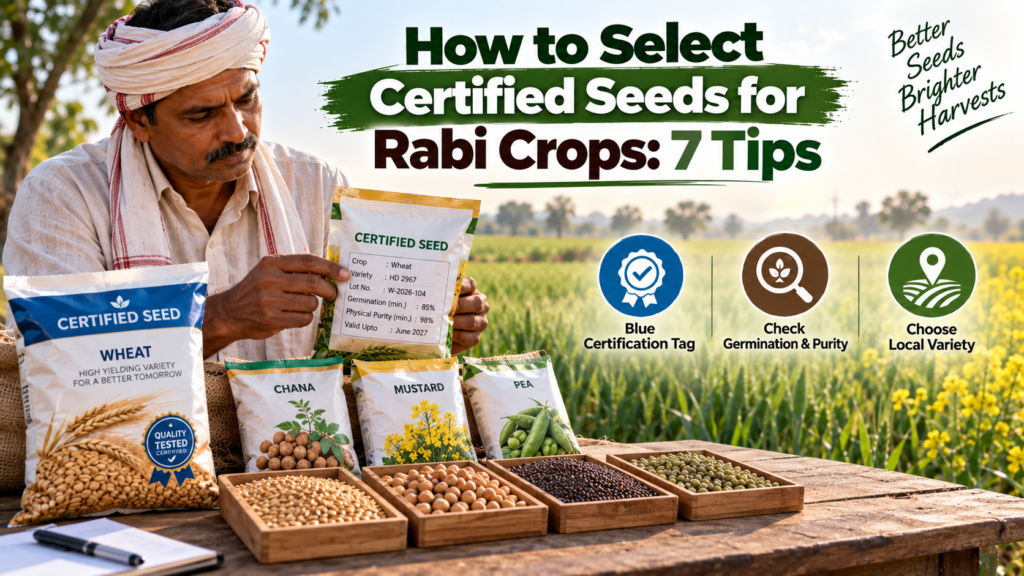
How to Select Certified Seeds for Rabi Crops: 7 Tips
Choosing the right certified seeds for Rabi crops can directly influence crop establishment, plant population and yield potential. Before sowing wheat, gram, mustard, peas or other Rabi crops in the 2026-27 season, farmers should check the seed variety, certification, germination, purity, packaging, production date and suitability for local conditions.
Quality seed is one of the most important inputs in profitable farming because even good soil, fertilizer and irrigation cannot fully compensate for poor planting material. ICAR and agricultural research institutions continue to promote improved and quality seed varieties, including varieties developed for specific climatic and regional conditions.
- Check the Seed Certification Tag
- Check the Seed Certification Tag
The first step in selecting certified seeds for Rabi crops is to examine the certification tag and package carefully. In India, certified seed carries a blue certification tag, while foundation seed uses a white tag under the applicable seed certification system.
Before purchasing, check:
- Crop and variety name
- Lot number
- Seed producer details
- Germination percentage
- Purity information
- Certification details
- Testing or validity information
- Packaging and sealing condition
Do not purchase a bag if the certification tag or seal appears damaged or tampered with. The Seeds Rules specify important information that must appear on certification documentation, including variety, lot number, producer, germination and certification validity.
- Select a Variety Suitable for Your Region
The best Rabi seed is not necessarily the variety with the highest advertised yield. Farmers should select a variety according to climate, soil type, irrigation availability, sowing time, disease pressure and local agricultural recommendations.
For example, wheat varieties can differ in their suitability for timely or early sowing and different agro-climatic zones. ICAR lists improved wheat varieties with specific regional and agronomic characteristics.
Before buying seed, ask the local agriculture department, Krishi Vigyan Kendra or agricultural university about:
- Recommended varieties for your region
- Suitable sowing window
- Disease resistance
- Water requirement
- Expected maturity period
- Local climate suitability
This becomes especially important when farmers are choosing climate-resilient seeds for areas affected by irregular rainfall, temperature fluctuations or water shortages.
- Check Germination and Physical Purity
High-quality seed should have good germination and acceptable physical purity. Germination determines how many seeds are likely to produce healthy seedlings under suitable conditions, while physical purity indicates the proportion of desired seed compared with inert matter and unwanted seeds.
When checking Rabi seed quality, look for:
- Uniform seed size
- Proper colour and appearance
- Low presence of broken seeds
- Absence of insects
- No visible fungal growth
- Minimal weed seeds or foreign material
- Appropriate germination information on the package
Farmers should avoid buying loose seed from an unknown source simply because it is cheaper. A lower purchase price can become expensive if poor germination results in gaps in the field and additional sowing costs.
- Check the Seed Lot and Validity Details
Every farmer should check the lot number, test details and validity information before purchasing certified seed. Seed quality can decline during improper or prolonged storage, so the age and storage condition of the seed matter.
Choose properly packaged seed from an authorised or reliable source and retain the purchase bill and seed packet until crop establishment.
A simple record of the variety, lot number and purchase date can also help farmers trace the seed if a quality-related problem occurs.
- Choose Seeds According to the Rabi Crop
Different Rabi crops require different varieties and seed characteristics. Therefore, farmers should not select seed only on the basis of brand popularity.
Wheat
For wheat farming, select varieties recommended for the local agro-climatic zone and intended sowing period. Farmers should also consider disease resistance, irrigation availability and expected maturity.
Gram or Chana
For chana farming, select quality seed of a locally recommended variety and check the seed carefully for insect damage, disease symptoms and physical impurities.
Mustard
For mustard cultivation, variety selection should consider local climate, sowing time, disease tolerance and production conditions. ICAR highlights improved mustard varieties with specific regional recommendations and agronomic traits.
Peas and Other Rabi Crops
For peas and other Rabi crops, farmers should similarly choose varieties recommended for their region and market requirement rather than selecting seed solely on price.
- Ask About Seed Treatment Before Sowing
Seed treatment can be an important part of Rabi crop management, particularly where seed-borne diseases or early-stage soil-borne problems are a concern. However, the treatment should be selected according to the crop, seed type and recommendation of an agricultural expert or the product label.
Farmers should not randomly mix multiple chemicals or apply excessive doses. Follow the recommended treatment method and safety instructions.
For some crops, farmers may also receive recommendations involving biological seed treatment or other integrated approaches. The objective is to improve early crop establishment while reducing avoidable disease pressure.
- Prefer Improved and Climate-Suitable Seed
For the Rabi 2026-27 season, farmers can consider varieties with traits suited to local weather and production conditions. Climate-resilient agriculture is becoming increasingly important as farmers deal with changing rainfall patterns, temperature stress and water availability.
ICAR reports that improved varieties have been developed for different stresses, including drought, heat, salinity and waterlogging.
However, farmers should not assume that a climate-resilient variety will perform equally well everywhere. Local recommendation remains essential. Select a variety that has been evaluated or recommended for your particular region and farming conditions.
Certified Seeds vs Ordinary Seeds: What Should Farmers Choose?
For commercial Rabi cultivation, certified seeds are generally a safer choice when farmers want documented seed quality and varietal identity. Certified seed is produced from the prescribed seed multiplication system and handled according to certification standards for genetic identity and purity.
The important point is that farmers should look beyond the word “certified” on the package. Check the certification tag, lot details, germination information, packaging condition and recommended variety before making the purchase.