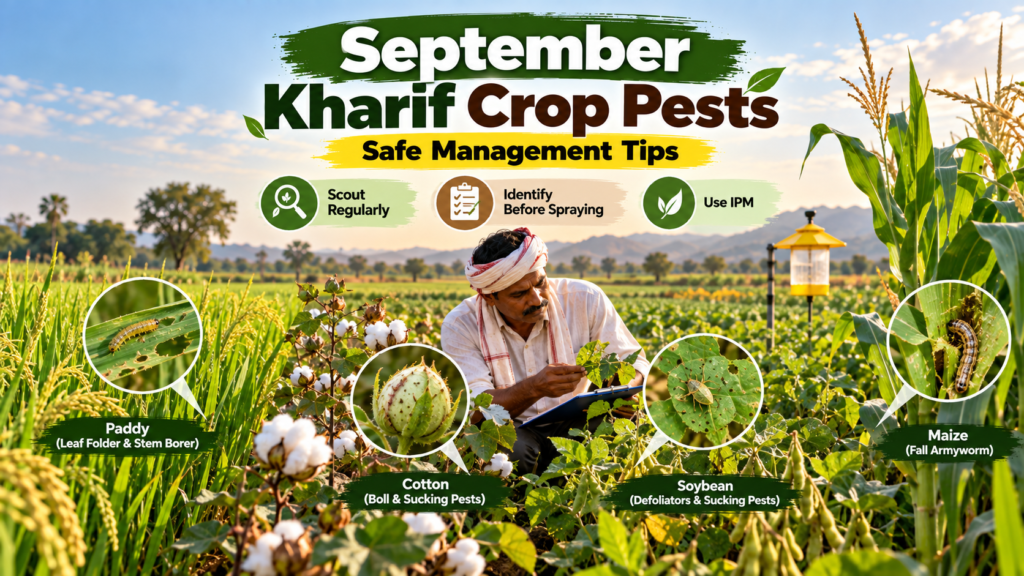
September Kharif Crop Pests: Safe Management Tips
Kharif crop pests in September can become a serious concern as crops enter important vegetative, flowering or reproductive stages. Farmers should regularly inspect paddy, cotton, soybean, maize and pulse fields and use integrated pest management (IPM) instead of applying pesticides automatically.
September is an important crop-protection month because many Kharif crops are moving toward critical growth stages. Recent ICAR guidance emphasizes prevention, regular pest monitoring and informed decision-making, with biological, cultural, mechanical and other non-chemical measures preferred before chemical control where appropriate.
Common Kharif Crop Pests in September
The most important pests vary according to the crop, weather, crop stage and region. Farmers should therefore identify the pest correctly before selecting any control measure.
- Paddy: Leaf Folder and Yellow Stem Borer
Leaf folder and yellow stem borer are important pests to monitor in September paddy fields. Leaf folders damage leaves by folding them and feeding inside, while yellow stem borer larvae can enter stems and cause symptoms such as dead hearts during vegetative growth and white ears at later stages.
ICAR-NIBSM recently advised farmers to increase surveillance of leaf folder and yellow stem borer in paddy and use control measures when necessary rather than treating fields automatically. Recommended approaches include field scouting, destruction of visible egg masses, pheromone traps and biological control options such as Trichocards where suitable.
What farmers should do:
- Inspect paddy fields regularly.
- Look for folded or damaged leaves.
- Check plants for egg masses and dead-heart symptoms.
- Avoid unnecessary insecticide applications.
- Follow local agricultural advisories and economic threshold levels.
- Cotton: Pink Bollworm and Sucking Pests
Cotton farmers should closely monitor pink bollworm and sucking pests such as whitefly, aphids and jassids during the crop season. Pink bollworm is particularly important because resistance to some Bt cotton technologies has emerged as a major concern.
In July 2026, ICAR reported research aimed at addressing pink bollworm resistance to Bollgard II, highlighting the continuing importance of this pest in Indian cotton production.
Farmers can include pheromone-based monitoring, field sanitation, crop scouting and conservation of beneficial insects in an integrated cotton pest management programme. Avoid repeated spraying without confirming the pest and its economic importance.
The government’s Mission for Cotton Productivity, approved in May 2026, also places emphasis on improved technologies, pest- and disease-resistant varieties and stronger extension support.
- Soybean: Girdle Beetle, Defoliators and Sucking Pests
Soybean fields should be inspected for girdle beetle, defoliating insects and sucking pests during September. Girdle beetle damage can weaken stems, while defoliators can reduce the crop’s leaf area and affect plant growth.
Farmers should inspect stems, leaves and the underside of foliage rather than depending only on visible adult insects. Damaged plant parts can be removed where practical, while biological and need-based control measures should be considered according to local recommendations.
Correct pest identification is essential because symptoms caused by insects, diseases and nutrient deficiencies can sometimes look similar.
- Maize: Fall Armyworm
Fall Armyworm is one of the major pests that maize farmers should watch during the Kharif season. The larvae commonly feed in the whorl, producing ragged leaves and characteristic feeding damage.
Farmers should inspect maize plants regularly, especially the whorl region. Early detection can make management easier and can reduce the need for repeated chemical applications.
ICAR’s Kharif advisory recommends integrated approaches for Fall Armyworm, including field monitoring, physical removal of egg masses or larvae where practical, pheromone traps and biological or botanical measures.
Safe Kharif Pest Management Methods
The safest approach to Kharif pest control is integrated pest management, or IPM. IPM combines monitoring, cultural, mechanical, biological and chemical measures instead of depending on pesticides alone.
Farmers should follow these steps:
- Scout the field regularly: Inspect leaves, stems, flowers and growing points.
- Identify the pest: Do not spray based only on crop damage symptoms.
- Use economic thresholds: Control measures should be considered when pest populations reach locally recommended economic levels.
- Remove affected plant parts: Destroy heavily infested leaves, shoots or egg masses where practical.
- Use traps: Pheromone and sticky traps can support pest monitoring for suitable pests.
- Protect beneficial insects: Avoid unnecessary broad-spectrum pesticide applications.
- Use biological options: Neem-based products, microbial biocontrol agents or natural enemies may be useful depending on the pest and crop.
- Use pesticides only when required: Select only products registered/recommended for the specific crop and pest.
- Follow the label: Use the approved dose, waiting period and application precautions.
- Seek expert advice: Contact a KVK, agriculture department or qualified crop expert when infestation is severe or uncertain.
ICAR’s September 2026 IPM guidance specifically recommends combining multiple management approaches and using pesticides judiciously when necessary.
How Weather Can Affect Kharif Pest Incidence
Weather conditions can influence pest multiplication and crop vulnerability, so farmers should combine weather awareness with regular field scouting. Rainfall, humidity, temperature, cloudy conditions and changes in crop moisture can influence insect activity and disease development.
This is why a fixed spray calendar is generally less useful than weather-based crop monitoring and pest surveillance. Farmers should follow state-level advisories when unusual pest pressure is reported.
The government has also highlighted the use of digital technologies for crop protection. Under the National Pest Surveillance System, AI and machine learning are being used to support pest detection and advisories from field images.
Key Takeaway for Farmers
The best way to manage Kharif crop pests in September is early detection followed by need-based IPM. Regular scouting, correct pest identification, biological and mechanical measures, conservation of natural enemies and responsible pesticide use can help protect crop yield while reducing unnecessary chemical applications.
Farmers should not copy pesticide doses from general internet articles because recommendations can vary by crop, pest, variety, location and crop stage. Always follow the latest label-approved recommendation or advice from the local agriculture department, KVK or qualified agricultural expert.