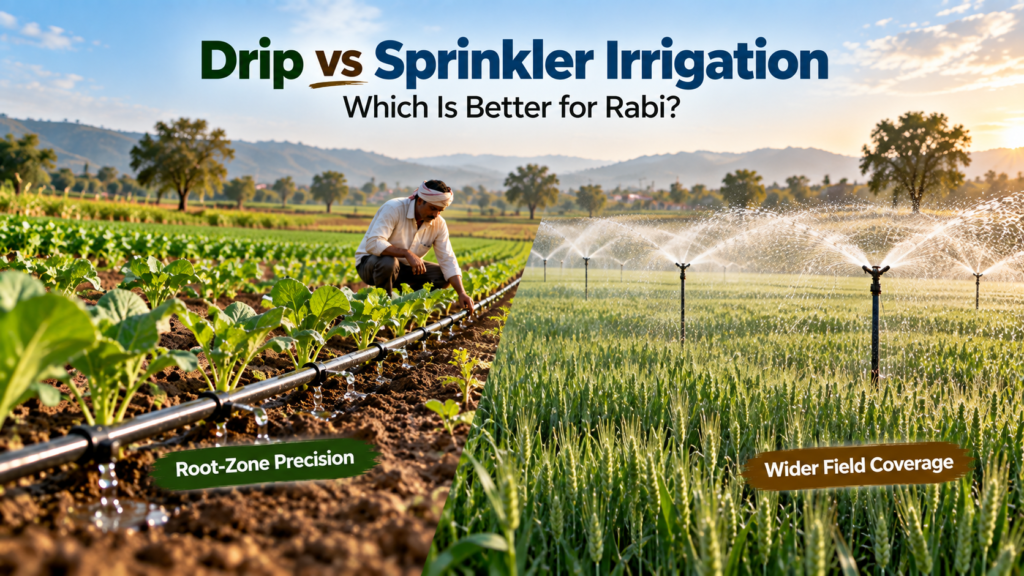
Drip vs Sprinkler Irrigation: Which Is Better for Rabi?
Efficient Rabi crop irrigation is important for maintaining soil moisture, protecting crop growth and improving water-use efficiency during the winter season. When comparing drip irrigation vs sprinkler irrigation, the better option depends mainly on the crop, soil type, field conditions, available water and irrigation budget.
For farmers growing wheat, mustard, gram, vegetables and other Rabi crops, choosing the right irrigation system can help reduce water wastage and support more efficient farming.
What Is Drip Irrigation?
Drip irrigation supplies water slowly and directly near the root zone of individual plants through emitters. This makes it particularly useful for crops planted in rows and situations where water conservation is a major priority.
The system can also support fertigation, where soluble nutrients are delivered along with irrigation water. This allows farmers to manage water and nutrients more precisely.
Drip irrigation is generally suitable for vegetables, fruits, horticultural crops and certain row crops. For Rabi farming, it can be useful where water availability is limited and crops require controlled irrigation.
What Is Sprinkler Irrigation?
Sprinkler irrigation distributes water through pipes and sprinkler nozzles in the form of small droplets, similar to rainfall. It can cover a larger area and is useful for crops that require relatively uniform surface irrigation.
Sprinklers are commonly considered for wheat, pulses, oilseeds, vegetables and other field crops, particularly where the land is uneven or sandy and conventional irrigation may result in inefficient water distribution.
For Rabi crops, sprinkler irrigation can provide relatively uniform coverage when the system is correctly designed and operated.
Drip Irrigation vs Sprinkler Irrigation: Key Differences
The main difference between drip irrigation vs sprinkler irrigation is how water reaches the crop. Drip delivers water close to the root zone, while sprinklers distribute water over the crop and soil surface.
Factor | Drip Irrigation | Sprinkler Irrigation |
Water application | Directly near roots | Sprayed over the field |
Water efficiency | Very high when properly managed | High when properly designed |
Best suited for | Row, vegetable and horticultural crops | Field crops and uneven land |
Fertigation | Highly suitable | Possible with suitable equipment |
Wind sensitivity | Low | Higher |
Installation | More complex | Comparatively simpler |
Maintenance | Emitters require regular checking | Sprinkler nozzles require maintenance |
Field coverage | Plant/root-zone focused | Wider area coverage |
Therefore, neither system is automatically better for every farm. The correct choice depends on crop requirements, field layout and water availability.
Which Is Better for Rabi Crops?
For Rabi crops, sprinkler irrigation can be a practical choice for crops such as wheat, mustard and pulses where broad field coverage is required. Drip irrigation may be more advantageous for vegetables, horticultural crops and row-planted crops where precise root-zone irrigation is valuable.
Farmers should consider the following before selecting a system:
- Wheat: Sprinkler irrigation can be considered where uniform field coverage is required.
- Mustard: Sprinklers can provide controlled irrigation, particularly in suitable field conditions.
- Gram: Irrigation should be carefully scheduled because excessive moisture can affect crop performance.
- Rabi vegetables: Drip can be highly useful because it delivers water directly around the root zone.
- Horticultural crops: Drip is generally preferred for precise irrigation and fertigation.
The choice should also consider soil texture, groundwater availability, farm size, electricity supply, installation cost and local climate.
Why Water-Efficient Irrigation Matters in Rabi Season
Rabi crops are generally cultivated during the cooler months, but irrigation remains important because rainfall may not meet crop water requirements at critical growth stages. Efficient irrigation can help farmers maintain suitable soil moisture without unnecessary water application.
Current government initiatives are also putting greater emphasis on micro irrigation, water-use efficiency and climate-smart agriculture. The Per Drop More Crop programme promotes drip and sprinkler systems as methods for improving water-use efficiency.
As of July 2026, more than 115 lakh hectares had been brought under micro-irrigation through Per Drop More Crop, according to a Government of India backgrounder.
Government Support for Micro Irrigation
Farmers considering drip irrigation for Rabi crops or sprinkler systems should also check the applicable state and central government schemes.
Under Per Drop More Crop, financial assistance is provided for micro-irrigation systems, with assistance levels varying by farmer category and scheme guidelines. Government programmes also encourage efficient irrigation, fertigation and improved water management.
Since subsidy rules and application procedures can differ by state, farmers should verify the latest guidelines through their state agriculture or horticulture department before purchasing equipment.
How to Choose the Right Irrigation System
Before installing a system, farmers should evaluate:
- Crop type: Check whether the crop requires root-zone or broad-area irrigation.
- Water availability: Limited water availability may favour highly controlled irrigation.
- Soil type: Sandy, loamy and clay soils have different water-holding capacities.
- Field topography: Sprinklers can be useful in certain uneven fields.
- Farm size: Installation and operating costs should match the farm’s scale.
- Maintenance: Filters, pipes, emitters and sprinkler nozzles require regular inspection.
- Budget and subsidy: Compare installation costs with available financial assistance.
Farmers should also schedule irrigation according to crop growth stage rather than applying water simply according to a fixed calendar.
Drip or Sprinkler: Which Should Rabi Farmers Choose?
There is no single answer to drip irrigation vs sprinkler irrigation because the best system depends on the crop and farm conditions. Sprinkler irrigation is often a practical option for broad-acre Rabi crops such as wheat, mustard and pulses, while drip irrigation is better suited to many vegetables, horticultural crops and situations requiring precise root-zone water application.
For water-scarce areas, both systems can contribute to more efficient irrigation when correctly designed, operated and maintained. Farmers should compare water availability, crop requirements, installation costs and local subsidy support before making a final decision.