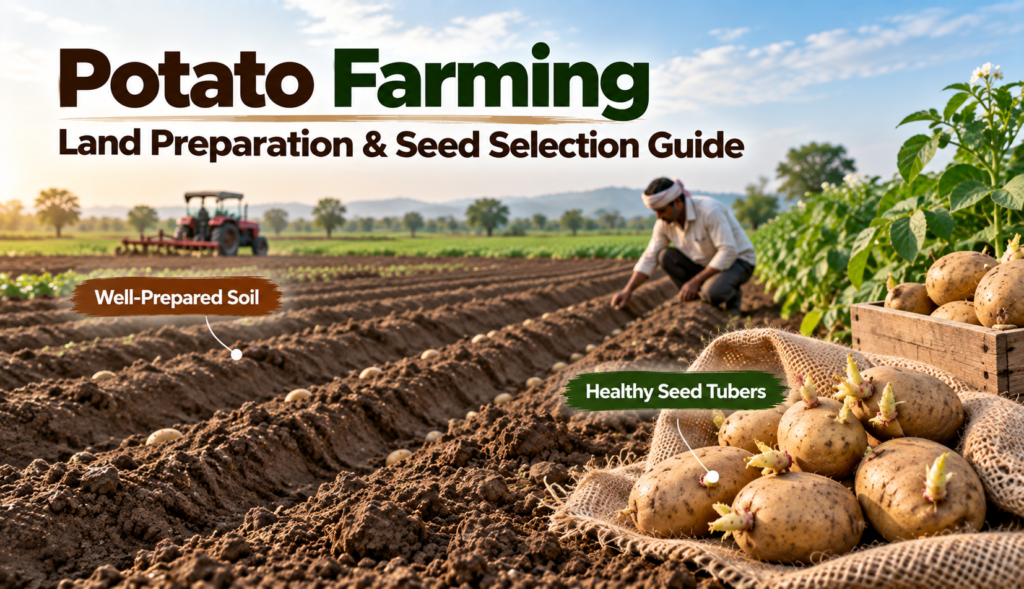
Potato Farming: Land Preparation & Seed Selection Guide
Potato farming starts with two important decisions that strongly influence crop establishment: preparing a loose, well-drained seedbed and selecting healthy, reliable seed tubers. For farmers preparing for the 2026–27 rabi potato season, proper land preparation, quality seed selection and timely planting can help achieve uniform emergence and reduce avoidable crop risks.
Why Land Preparation Matters in Potato Farming
Potato tubers develop below the soil surface, so the field should be loose, well-aerated and properly drained. Compacted soil can restrict tuber development, while waterlogging can increase the risk of disease and rotting.
Begin potato land preparation with ploughing to loosen the soil, followed by harrowing or cultivation to break large clods and create a fine tilth. Well-decomposed farmyard manure can be incorporated during final field preparation. Fertiliser application should preferably be based on soil-test results and local agricultural recommendations.
Light to medium-textured soils with good drainage are generally suitable for potato cultivation. Fields with prolonged waterlogging, severe salinity or poor drainage should be avoided.
Potato Land Preparation Steps
Farmers can follow these basic steps before potato planting:
- Remove previous crop residues and persistent weeds.
- Plough the field properly to loosen the tuber-development zone.
- Use a cultivator or harrow to break large soil clods.
- Incorporate well-decomposed organic manure during final preparation.
- Prepare ridges or furrows according to the variety and local recommendation.
- Make sure irrigation and drainage channels are ready before planting.
The objective is to create loose soil that allows stolons and tubers to expand easily while ensuring excess water can drain from the field.
How to Select Quality Potato Seed
Potato seed selection is one of the most important steps in successful cultivation because potatoes are commonly propagated through seed tubers. Healthy planting material can support uniform emergence and help reduce problems associated with seed-borne diseases.
Choose seed potatoes that are:
- Healthy and disease-free
- Firm and properly matured
- Free from visible rot and severe bruising
- Free from insect damage
- Uniform in size
- Properly sprouted before planting
- Sourced from a reliable or certified supplier
ICAR highlights the importance of healthy quality seed in potato production because seed-borne diseases can contribute to yield deterioration. India’s potato seed system includes breeder, foundation and certified seed stages to maintain seed health.
For the 2026–27 potato season, seed selection is particularly relevant. The government has notified new ICAR-CPRI varieties, while state horticulture departments are also making improved potato planting material available. Farmers should select varieties according to their local climate, market demand, maturity period and disease resistance, rather than selecting a variety only because it is newly released.
Seed Potato Size and Sprouting
Uniform and healthy seed tubers are preferred for better crop establishment. The appropriate seed size depends on the variety, planting system and local recommendation.
The National Horticulture Board notes that healthy, well-sprouted seed tubers are important planting material, while seed size and spacing influence the amount of seed required.
Large tubers may be cut where recommended, but cutting should be done carefully because fresh wounds can increase the risk of infection. Use clean equipment and follow local agricultural guidance for curing and treatment of cut tubers.
Avoid planting potatoes with long, weak, damaged or diseased sprouts. Strong and healthy sprouts generally provide better conditions for uniform crop establishment.
Potato Seed Treatment Before Planting
Potato seed treatment can help reduce certain seed- and soil-borne disease risks when the correct treatment is used. However, farmers should not apply a chemical dose simply because it is recommended for another crop or region.
Always follow the product label and recommendations from a Krishi Vigyan Kendra (KVK), agricultural university, state agriculture department or horticulture department.
If seed tubers need to be cut, clean cutting equipment should be used and the cut surfaces should be properly cured according to local recommendations before planting.
Best Time for Potato Planting
Potato is a cool-season crop, so the potato planting season varies by region. In the northern plains, the main crop is generally planted during the cooler part of the year, while planting schedules differ across central India, western regions and hill areas.
Farmers should follow the planting window recommended for their specific location and variety. Temperature, soil moisture and crop duration can influence germination, tuber initiation and final yield.
For the upcoming rabi season, farmers should also monitor soil moisture and weather conditions before planting. Current agricultural planning is placing greater emphasis on weather variability and timely availability of quality planting material.
Potato Planting: Spacing and Depth
After land preparation, potato planting should provide adequate soil coverage and uniform spacing. National Horticulture Board guidance commonly recommends furrows around 50–60 cm apart, with seed tubers placed according to seed size, variety and local recommendations.
Proper planting depth helps protect developing tubers from exposure while avoiding excessive depth that can delay emergence.
For larger farms, a tractor-operated potato planter can help improve uniformity in spacing and planting depth while reducing manual labour. ICAR material also highlights mechanised planting as a way to maintain more consistent planting operations.
Common Mistakes to Avoid in Potato Farming
- Planting poor-quality or visibly diseased seed potatoes
- Using weak or damaged sprouts
- Preparing a compacted seedbed
- Ignoring field drainage
- Selecting a variety without considering market demand
- Applying fertilisers without considering soil-test recommendations
- Using pesticides or seed treatments without proper guidance
- Planting outside the recommended regional window
- Ignoring soil moisture before planting
Conclusion
Successful potato farming begins before the seed tuber enters the soil. A well-prepared, well-drained field combined with healthy and reliable planting material provides a stronger foundation for uniform emergence and tuber development.
Farmers should select potato varieties and seed sources according to local climate, market requirements, disease considerations and regional agricultural recommendations. Proper land preparation, seed selection, seed treatment and timely planting can help create better conditions for a productive potato crop.