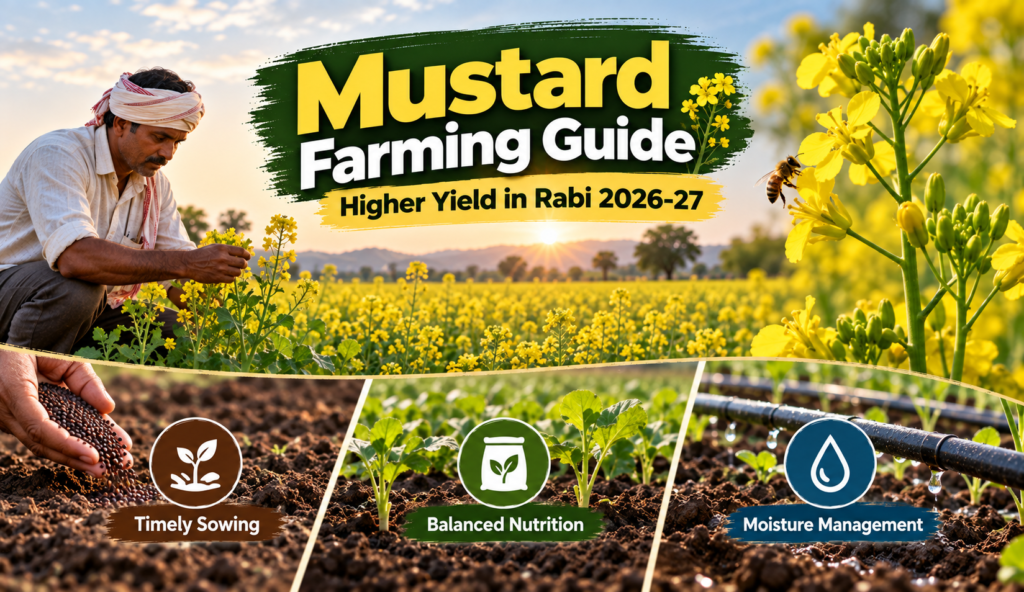
Mustard Farming Guide for Higher Yield in Rabi 2026-27
Mustard farming is an important Rabi-season oilseed activity in India, and proper sowing time, soil preparation, balanced nutrition and timely crop protection can significantly influence yield. For Rabi 2026-27, farmers should focus on timely establishment of the mustard crop, efficient moisture management and early monitoring of pests and diseases.
The government has fixed the MSP for rapeseed and mustard at ₹6,200 per quintal for the 2026-27 marketing season, up from ₹5,950 per quintal in the previous season. This makes efficient mustard cultivation an important consideration for farmers planning their Rabi crop.
Best Time for Mustard Sowing in Rabi 2026-27
The mustard sowing time generally falls from October to early November, depending on the region, variety and availability of soil moisture. ICAR’s Rabi advisory recommends starting mustard sowing from the first week of October and completing it by the second week of November.
Timely sowing helps the crop establish before temperatures become unfavorable. Delayed sowing can affect plant growth and may increase the risk of pest and disease problems.
Key mustard sowing tips:
- Complete sowing within the recommended regional window.
- Use certified and suitable varieties.
- Maintain proper row and plant spacing.
- Avoid sowing in poorly prepared or waterlogged soil.
- Ensure adequate moisture for uniform germination.
Soil and Land Preparation for Mustard Farming
Mustard performs well in well-drained soils with good fertility. Before sowing, farmers should prepare a fine and firm seedbed while avoiding excessive pulverization.
Remove previous crop residues and weeds and ensure proper drainage. If the field lacks sufficient moisture, pre-sowing irrigation can help achieve better seed germination.
ICAR recommends suitable field preparation along with balanced fertilizer application for improved mustard productivity.
Mustard Seed Treatment and Spacing
Mustard seed treatment can help improve early crop establishment and reduce the risk of seed- and soil-borne problems. Farmers should use locally recommended seed-treatment practices and follow the label or agricultural department recommendations for any biological or chemical treatment.
For rapeseed and mustard, ICAR’s advisory recommends approximately 30 cm row spacing, 10–15 cm plant spacing and 4–5 cm sowing depth.
Avoid placing seed too deep because poor emergence can result. Uniform spacing also improves sunlight penetration and makes intercultural operations easier.
Mustard Fertilizer Management for Higher Yield
Balanced nutrition is one of the most important mustard farming tips for achieving better yield. Nitrogen, phosphorus, potassium and sulphur should be supplied according to soil-test results and local recommendations.
Farmers should avoid applying excessive nitrogen because more fertilizer does not automatically mean higher yield. Nutrient management should consider soil fertility, irrigation availability, variety and previous crop.
Sulphur is particularly important in oilseed production. ICAR notes that sulphur application in mustard can support grain yield and soil health.
For better fertilizer management:
- Conduct a soil test where possible.
- Apply recommended basal nutrients during sowing.
- Use nitrogen in appropriate split applications.
- Ensure adequate sulphur availability.
- Avoid over-application of fertilizers.
Irrigation Management in Mustard Crop
Efficient mustard irrigation is important because both moisture stress and excessive water can affect crop performance. Irrigation requirements depend on soil type, rainfall, temperature and variety.
Critical crop stages should receive adequate moisture, particularly around flowering and pod development. However, farmers should avoid standing water because mustard is sensitive to waterlogging.
Where irrigation facilities are limited, moisture conservation practices can help improve water-use efficiency.
Weed, Pest and Disease Management
Early weed control is essential because weeds compete with mustard plants for nutrients, moisture and sunlight. Farmers should monitor the field regularly during the early growth stage and use suitable mechanical, cultural or approved herbicide-based methods according to local recommendations.
Important mustard pest management concerns include aphids, while diseases such as Alternaria blight and white rust can also affect production. ICAR identifies mustard aphid, Alternaria blight and white rust among important production constraints in some regions.
Regular field scouting is better than waiting until pest or disease damage becomes severe. Any pesticide should be used only according to the registered label, recommended dose and local agricultural advisory.
Mustard Varieties for Rabi Cultivation
Farmers should select varieties according to their agro-climatic region, sowing window, irrigation availability and local recommendations rather than choosing a variety only because of its advertised yield.
ICAR lists varieties such as Pusa Mahak, Pusa Bold and Sej 2 among suitable mustard options in its Rabi advisory, while other varieties are recommended for different growing conditions and regions.
For example, ICAR’s information on Pusa Double Zero Mustard 31 reports an average seed yield of 23.2 quintals per hectare, 41% oil content and 142-day maturity, with recommendations for specific northern regions.
How to Increase Mustard Yield in Rabi 2026-27
Farmers looking to improve mustard yield should concentrate on the complete production cycle rather than depending on a single input.
Five practical steps include:
- Complete sowing within the suitable regional window.
- Use quality seed and recommended varieties.
- Maintain optimum plant population and spacing.
- Follow soil-test-based fertilizer management.
- Monitor irrigation, weeds, aphids and diseases regularly.
Good crop establishment during the first few weeks can have a major impact on final productivity.
Mustard Farming Outlook for 2026-27
The higher MSP announced for rapeseed and mustard provides an important price-support benchmark for the Rabi 2026-27 marketing season. The MSP of ₹6,200 per quintal represents an increase of ₹250 per quintal over 2025-26.
However, profitability will depend on actual farm-gate prices, yield, input costs, irrigation expenses and local market conditions. Farmers should therefore calculate the expected cost of cultivation before making production decisions.