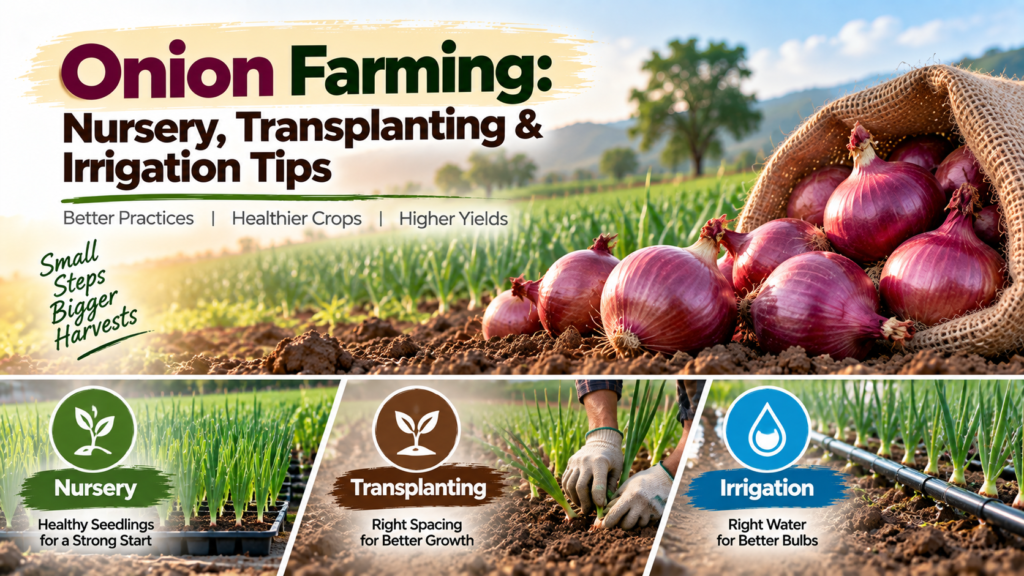
Onion Farming: Nursery, Transplanting & Irrigation Tips
Onion farming can give good returns when farmers manage nursery preparation, timely transplanting, spacing and irrigation properly. For successful onion cultivation, healthy seedlings and consistent soil moisture are especially important during bulb formation.
India grows onion in kharif, late-kharif and rabi seasons, so the ideal nursery and transplanting schedule depends on the region, variety and local weather. For farmers planning the next onion crop, proper nursery management and efficient irrigation can improve crop establishment and bulb development.
Onion Farming: Why Nursery Management Matters
A healthy nursery is the foundation of successful onion farming. Strong seedlings establish faster after transplanting and can produce more uniform bulbs when soil, nutrition and irrigation are properly managed.
Farmers should select:
- Healthy and certified onion seed
- A suitable variety for the local season
- Well-drained nursery soil
- A location with adequate sunlight
- A reliable irrigation source
- Disease-free planting material
The nursery should have fine, well-prepared soil without excessive waterlogging. Raised or properly drained beds are useful in areas that receive heavy rainfall.
For rabi onion farming, seedlings are generally older at transplanting than kharif seedlings. The National Horticulture Board notes that approximately 8–9-week-old seedlings are commonly used for rabi transplanting, while kharif seedlings are generally around 6–7 weeks old.
Onion Nursery Preparation and Seedling Care
Good onion nursery management starts with proper bed preparation and uniform seed placement. The nursery should be kept moist but not continuously waterlogged because excessive moisture can weaken seedlings and encourage disease.
Important nursery practices
- Prepare a fine soil tilth.
- Use good-quality seed suitable for the growing season.
- Maintain adequate spacing between nursery rows.
- Provide light irrigation when required.
- Remove weeds regularly.
- Monitor seedlings for damping-off and other diseases.
- Avoid excessive nitrogen application in the nursery.
- Harden seedlings before transplanting when required.
Farmers should avoid using weak, damaged or over-aged seedlings because uneven seedlings can lead to irregular crop establishment and bulb size.
When to Transplant Onion Seedlings?
The correct onion transplanting time depends on the season, location and variety. Rabi onions generally use older seedlings than kharif onions, while local agricultural advisories should be followed for the exact sowing and transplanting window.
Before transplanting, farmers should ensure that:
- The field has adequate moisture.
- Seedlings are healthy and vigorous.
- The field is properly levelled.
- Drainage is available.
- Weeds have been removed.
The National Horticulture Board recommends immediate irrigation after transplanting. It also lists 10 × 10 cm spacing for rabi onion and 15 × 10 cm for kharif onion as general planting practices.
However, farmers should follow recommendations for their specific variety and local agro-climatic conditions rather than applying one spacing universally.
Land Preparation for Onion Cultivation
Onion has a relatively shallow root system, so a fine and well-levelled seedbed is important. The soil should be loose enough for bulb development while providing adequate drainage.
Before transplanting:
- Prepare the field to a fine tilth.
- Incorporate well-decomposed organic manure according to local recommendations.
- Remove crop residues and weeds.
- Make suitable beds and channels.
- Ensure excess water can drain from the field.
Good drainage is particularly important because standing water can damage onion roots and increase disease pressure.
Onion Irrigation: How Much Water Does the Crop Need?
Onion irrigation should maintain uniform soil moisture without creating waterlogging. Water demand changes with the season, soil type, weather and crop growth stage.
According to the National Horticulture Board, onion should receive irrigation immediately after transplanting, followed by light and frequent irrigation. For rabi onion, the general requirement can be around 15–20 irrigations, depending on conditions.
Critical irrigation stages
The most important periods include:
- Immediately after transplanting
- Early vegetative growth
- Bulb initiation
- Bulb development
- The period of active bulb enlargement
Moisture stress during bulb development can reduce yield and contribute to problems such as splitting and premature maturity.
At the same time, excessive irrigation should be avoided because continuously wet soil can increase disease risk and affect bulb quality.
Drip Irrigation for Onion Farming
Drip irrigation is an efficient option for onion cultivation because it supplies water close to the root zone and can be combined with fertigation. It is particularly useful where farmers need better control over water and fertilizer application.
ICAR has reported that drip and sprinkler irrigation technologies can improve water-use efficiency in onion, while drip fertigation can reduce nutrient losses by delivering nutrients directly to the root zone.
Benefits of drip irrigation
- Better control over water application
- Reduced water wastage
- More uniform soil moisture
- Suitable for fertigation
- Reduced nutrient leaching
- Useful in water-stressed areas
Farmers should still adjust irrigation according to soil moisture, rainfall and crop stage instead of following a fixed schedule throughout the season.
Weed and Crop Management Tips
Weeds compete with onion plants for water, nutrients and sunlight. Because onion grows relatively slowly during its early stages, timely weed management is important.
Farmers can combine:
- Manual weeding
- Intercultural operations
- Mulching where suitable
- Recommended herbicides where locally approved
Integrated weed management is preferable to relying on a single method.
ICAR research has also documented integrated nutrient and weed-management approaches for rabi onion, showing the importance of balanced nutrition and timely weed control.
Onion Farming Tips for Better Yield
For better onion yield, farmers should focus on the complete crop cycle rather than only irrigation.
Key practices include:
- Select region-specific varieties.
- Use healthy and uniform seedlings.
- Follow the recommended transplanting window.
- Maintain proper plant spacing.
- Keep the soil evenly moist.
- Avoid prolonged waterlogging.
- Control weeds during early crop growth.
- Apply fertilizers based on soil testing and local recommendations.
- Monitor pests and diseases regularly.
- Reduce irrigation as the crop approaches maturity.
- Harvest only after proper bulb maturity.
For example, ICAR has documented successful onion production using improved varieties and scientific crop management, including timely irrigation and careful withdrawal of irrigation before harvest.
When Should Irrigation Be Stopped Before Onion Harvest?
Irrigation should be reduced or stopped as the onion crop reaches maturity. The exact timing depends on the season, soil and local conditions.
The National Horticulture Board recommends stopping irrigation when rabi onion tops mature and begin falling. It also notes that the final irrigation approximately 10–15 days before harvest can help reduce storage losses.
Farmers should avoid unnecessary irrigation close to harvesting because excessive moisture can affect bulb maturity, quality and storage performance.
Conclusion
Successful onion farming depends on several connected practices, but nursery quality, timely transplanting and irrigation management are among the most important. Healthy seedlings, proper spacing, good drainage and uniform moisture can help farmers achieve better bulb development and crop quality.
For rabi onion cultivation, farmers should follow their state agricultural university, KVK or local horticulture department recommendations for variety selection, sowing dates, fertilizer doses and crop protection. Efficient irrigation methods such as drip can be especially useful where water availability is limited.