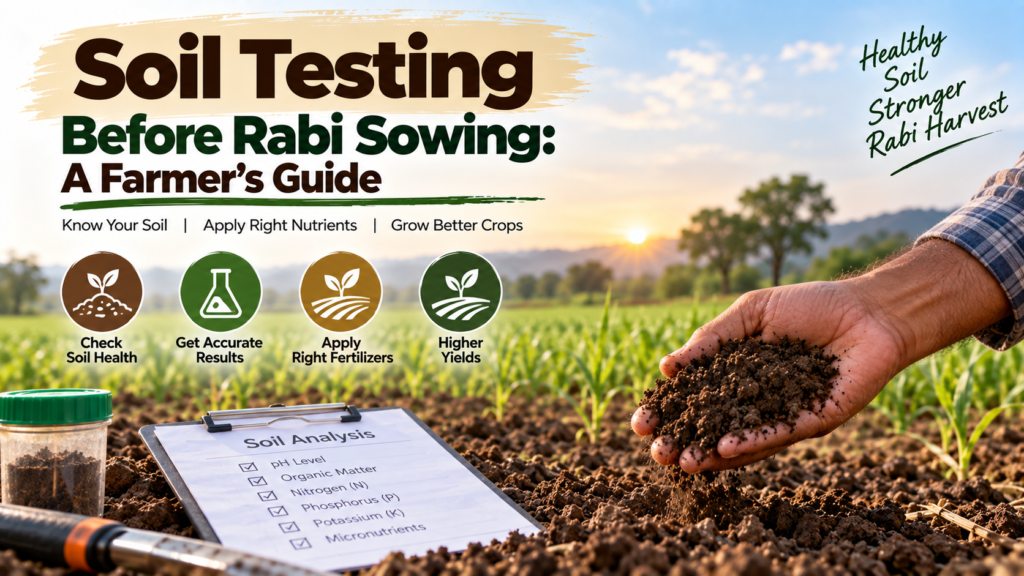
Soil Testing Before Rabi Sowing: A Farmer’s Guide
Soil testing before Rabi sowing helps farmers understand the nutrient status, pH and fertility condition of their fields before applying fertilizers. For Rabi 2026-27, testing the soil can support more balanced nutrient management, reduce unnecessary fertilizer use and help farmers plan crop nutrition according to actual field conditions.
Why Is Soil Testing Before Rabi Sowing Important?
Soil testing before Rabi sowing tells farmers what their soil actually needs instead of relying only on previous fertilizer practices. This is especially important when farmers are preparing fields for wheat, gram, mustard, chickpea, lentil and other Rabi crops.
A soil test can provide information about important parameters such as:
- Nitrogen (N)
- Phosphorus (P)
- Potassium (K)
- Sulphur (S)
- Zinc, iron, manganese, copper and boron
- Soil pH
- Electrical conductivity (EC)
- Organic carbon
The Government’s Soil Health Card system covers 12 such parameters and provides fertilizer and soil-amendment recommendations based on the test results.
For farmers, this means fertilizer application can be planned according to soil conditions rather than applying the same quantity across every field.
How Soil Testing Helps Rabi Crop Preparation
A soil test helps farmers make better decisions about fertilizer application, soil amendments and nutrient management before sowing Rabi crops.
For example, wheat may require a different nutrient management strategy from gram or mustard. The previous Kharif crop may also have affected the available nutrients in the field.
Soil testing can help farmers:
- Identify nutrient deficiencies.
- Avoid unnecessary fertilizer application.
- Plan balanced NPK management.
- Identify unsuitable soil pH conditions.
- Improve nutrient-use efficiency.
- Support better soil fertility management.
- Reduce input costs over time.
ICAR Rabi advisory material has also recommended collecting soil samples after Kharif harvest so that nutrient management can be planned scientifically for upcoming Rabi crops.
What Should Farmers Test Before Rabi Sowing?
Farmers should check both major nutrients and important soil properties before finalizing their Rabi fertilizer plan. The exact testing requirements can vary according to soil type, crop, previous crop and local agricultural recommendations.
- Soil pH
Soil pH indicates whether the soil is acidic, neutral or alkaline. An unsuitable pH can affect nutrient availability and crop growth.
- Nitrogen, Phosphorus and Potassium
NPK are among the most important nutrients for crop development. Testing helps determine whether fertilizer application needs to be adjusted according to existing soil nutrient levels.
- Organic Carbon
Organic carbon is an important indicator of soil quality and is associated with nutrient cycling and soil structure.
- Secondary and Micronutrients
Sulphur, zinc, iron, boron and other micronutrients can also influence crop performance. A deficiency may not always be visible during the early stages of crop growth.
The Soil Health Card framework includes macro-nutrients, secondary nutrients, micronutrients and physical parameters such as pH, EC and organic carbon.
How to Collect a Soil Sample for Testing
Correct soil sampling is essential because an inaccurate sample can lead to an unreliable soil test result. Farmers should ideally take help from trained agricultural personnel, a soil testing laboratory, KVK or the local agriculture department.
According to the Soil Health Card guidance, soil samples are generally collected from around 15–20 cm depth using a V-shaped cut, with samples taken from different parts of the field and mixed properly before the final sample is prepared. Shaded or unusual areas should be avoided.
Farmers should also provide relevant information such as:
- Field location
- Area of the plot
- Soil type
- Previous crop
- Proposed crop
- Irrigation source
- Other relevant field conditions
This information can make the final nutrient recommendation more useful.
When Should Farmers Test Soil for Rabi Crops?
The ideal time for soil testing is generally when there is no standing crop, particularly after harvesting the previous crop. The Soil Health Card programme states that soil samples are generally collected after Rabi and Kharif harvesting.
For farmers preparing for Rabi 2026-27, testing after the Kharif crop and before final land preparation can provide useful information for fertilizer planning.
However, farmers should not wait until the last moment. Soil testing, laboratory analysis and interpretation of recommendations should be completed before major fertilizer decisions are made.
Soil Health Card and Rabi Farming
A Soil Health Card can help farmers understand the nutrient condition of their field and follow crop-specific fertilizer recommendations. The system is designed to provide soil nutrient information along with recommendations for fertilizers and required soil amendments.
In 2026, soil health and balanced fertilizer use continue to receive attention in agricultural extension programmes. ICAR’s 2026 Khet Bachao Abhiyan highlighted soil health management, soil testing, balanced fertilizer application and the use of Soil Health Cards.
This makes soil testing before Rabi sowing particularly relevant for farmers looking to improve input efficiency and adopt more sustainable farming practices.
Avoid Excessive Fertilizer Without Soil Testing
Applying more fertilizer does not automatically mean higher crop yield. Excessive or unbalanced fertilizer use can increase production costs and may negatively affect long-term soil health.
A soil-test-based fertilizer plan can help farmers apply nutrients more precisely. Farmers should follow the recommendations in their soil test report or consult qualified agricultural experts rather than independently increasing fertilizer doses.
Balanced fertilization is also an important part of climate-smart and sustainable agriculture because efficient nutrient management can reduce unnecessary input use while supporting crop productivity.
Final Checklist Before Rabi Sowing
Before sowing wheat, gram, mustard or other Rabi crops, farmers should:
- Complete soil testing before fertilizer application.
- Check the soil pH and nutrient status.
- Review the previous Kharif crop.
- Identify major and micronutrient deficiencies.
- Check the Soil Health Card or latest soil test report.
- Follow crop-specific fertilizer recommendations.
- Add organic manure or soil amendments where recommended.
- Plan fertilizer application according to crop requirements.
- Consult a KVK, soil testing laboratory or agriculture department when results are unclear.
Conclusion
Soil testing before Rabi sowing is a simple but important step for scientific crop planning. By knowing the nutrient status and condition of their fields, farmers can make better decisions about fertilizers, soil amendments and crop nutrition for Rabi 2026-27.
Instead of following a one-size-fits-all fertilizer approach, farmers can use soil-test information to move towards balanced fertilization, better nutrient-use efficiency, improved soil health and potentially lower input costs.