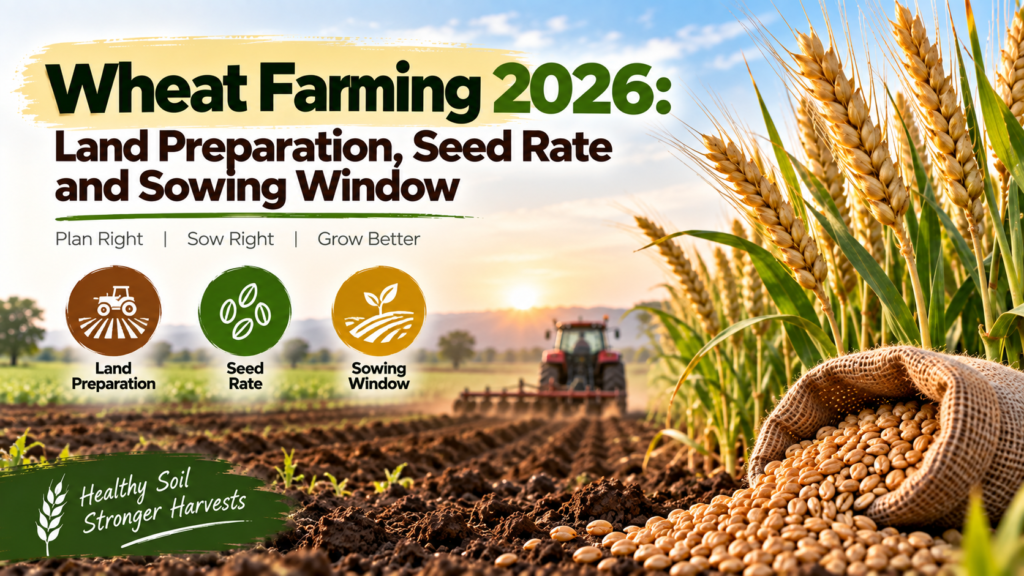
Wheat Farming 2026: Land Preparation, Seed Rate and Sowing Window
Wheat farming in 2026 requires timely land preparation, quality seed selection, the correct seed rate and sowing within the recommended window. For most wheat-growing regions of India, farmers should select varieties according to their agro-climatic zone and sowing conditions rather than using the same variety everywhere.
Wheat remains one of India’s major Rabi crops, and recent government data showed strong wheat sowing during the 2025–26 Rabi season. As of January 9, 2026, wheat had been sown across 334.17 lakh hectares, compared with 328.04 lakh hectares during the corresponding period of the previous season.
For the upcoming wheat farming season 2026–27, farmers can focus on timely sowing, efficient irrigation, balanced fertilizer use and climate-resilient varieties to support better crop establishment.
Land Preparation for Wheat Farming
Good land preparation creates a fine, firm and level seedbed that supports uniform wheat germination. The field should be cleared of the previous crop residue and prepared according to the soil type, available moisture and sowing method.
Farmers should generally:
- Plough the field properly after the previous crop.
- Break large soil clods and create a fine seedbed.
- Level the field to improve irrigation efficiency.
- Avoid unnecessary tillage that can increase moisture loss.
- Ensure adequate soil moisture before sowing.
- Consider zero-till or conservation agriculture where locally recommended.
Conservation agriculture is becoming increasingly important in modern wheat cultivation because it can help reduce soil disturbance and improve resource-use efficiency. ICAR has also highlighted wheat varieties developed specifically for conservation agriculture.
Wheat Sowing Time 2026
The ideal wheat sowing window depends on the variety, region and previous crop, but timely sowing is generally important for achieving good yield. Farmers should follow recommendations issued for their specific agro-climatic zone.
For example, ICAR lists November 5–25 as the sowing window for HD 3226 under irrigated, timely-sown conditions in its recommended North Western Plain Zone.
The exact wheat sowing time 2026 can vary depending on whether the crop is timely sown, early sown or late sown. Farmers should therefore avoid delaying sowing simply because soil preparation is incomplete.
Timely sowing can also help the crop complete important growth stages before severe late-season heat. This is particularly relevant because the government reported that unusually high temperatures during February 2026 affected grain-filling duration in some wheat areas.
Wheat Seed Rate per Hectare
The recommended wheat seed rate depends on the variety, sowing method, seed quality and planting time. Using too little seed can result in a thin crop stand, while excessive seed can increase competition between plants.
As an example, ICAR recommends a 100 kg/ha seed rate for HD 3226 under irrigated, timely-sown conditions.
Before purchasing seed, farmers should check:
- Recommended seed rate for the selected variety
- Germination percentage
- Seed purity
- Recommended sowing method
- Local agriculture department or KVK guidance
Using certified or quality seed can improve crop establishment and reduce the risk of poor germination.
Choose the Right Wheat Variety
Farmers should select wheat varieties according to their region, sowing date, irrigation availability and disease risk. A variety performing well in one agricultural zone may not deliver the same results in another.
ICAR lists several improved wheat varieties suited to different production conditions. For example, HD 3226 is recommended for timely-sown irrigated conditions in the North Western Plain Zone and has resistance against several major wheat diseases.
Newer varieties are also attracting attention because of their climate resilience, disease resistance and adaptability. ICAR recently highlighted improved wheat varieties and research focused on productivity, quality, climate resilience and efficient use of soil and water resources.
Farmers should therefore consider locally recommended varieties instead of selecting seed only on the basis of yield claims.
Fertilizer and Irrigation Management
Balanced fertilizer application and timely irrigation are essential for healthy wheat growth and yield formation. Nitrogen, phosphorus and potassium requirements should be determined according to soil conditions and the selected variety.
For example, ICAR’s recommendation for HD 3226 includes nitrogen, phosphorus and potash application, with nitrogen split across crop stages. The institute also recommends the first irrigation around 21 days after sowing for this variety under the stated conditions.
Farmers should avoid excessive nitrogen because over-application can increase crop lodging and unnecessary input costs. Irrigation should also be scheduled according to soil moisture and crop growth rather than following a fixed schedule for every field.
Weed and Disease Management in Wheat
Early weed management helps wheat compete effectively for nutrients, water and sunlight. Farmers should identify weeds at an early stage and use mechanical, cultural or recommended herbicide-based control methods according to local agricultural recommendations.
Disease monitoring is equally important. Farmers should regularly inspect wheat fields for symptoms of yellow rust, brown rust, powdery mildew and other diseases.
Choosing disease-resistant varieties can provide an important first line of protection. For instance, ICAR reports strong resistance to several major diseases in HD 3226.
Wheat Farming 2026: Climate-Smart Farming Tips
The focus on climate-resilient wheat varieties is increasing as farmers face changing temperatures and weather patterns. ICAR’s recent wheat research has emphasized climate resilience, productivity, quality and conservation of soil and water resources.
For the 2026–27 season, farmers can focus on:
- Selecting region-specific wheat varieties.
- Sowing within the recommended window.
- Using quality and treated seed.
- Maintaining optimum soil moisture.
- Avoiding excessive fertilizer application.
- Monitoring weeds and diseases regularly.
- Using efficient irrigation practices.
- Considering zero-tillage where suitable.
- Monitoring temperature and weather forecasts.
- Following advisories from KVKs and agricultural institutions.
Conclusion
Successful wheat farming in 2026 will depend heavily on timely sowing, suitable varieties, proper seed rate, efficient land preparation and balanced crop management. Farmers should avoid following a single wheat cultivation formula because recommendations can vary by region, soil type and variety.
With increasing attention on climate-smart agriculture and resilient wheat varieties, farmers can combine improved seed, better water management and timely crop operations to improve productivity while controlling input costs.