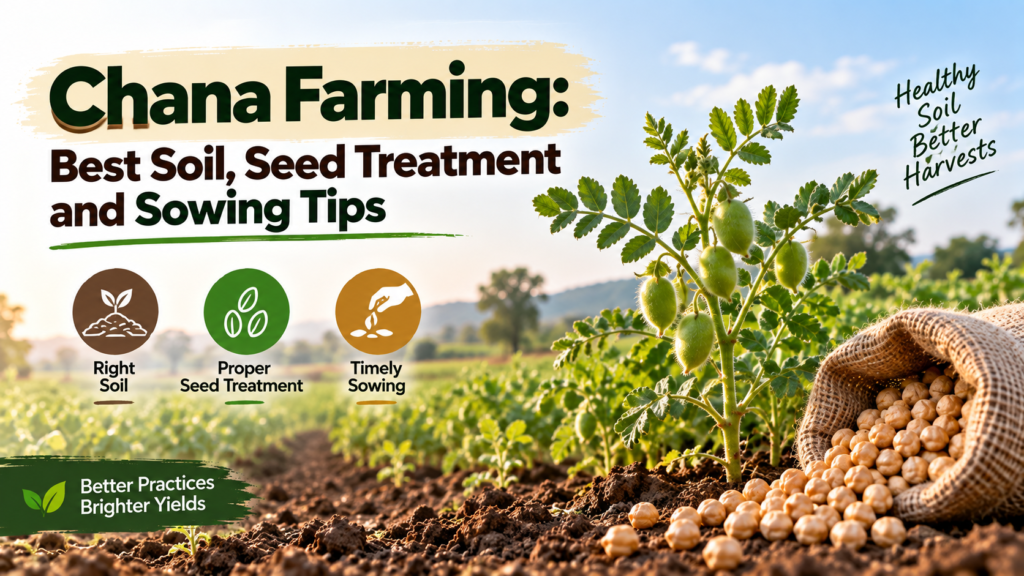
Chana Farming: Best Soil, Seed Treatment and Sowing Tips
Chana farming is an important part of India’s rabi pulse production, with chickpea grown mainly for its protein-rich grain and suitability to relatively dry growing conditions. For better crop establishment, farmers should focus on well-drained soil, timely sowing, quality seed, proper seed treatment and balanced crop management.
Chickpea, also known as gram or chana, is widely cultivated across different parts of India. Proper chana farming practices can help improve germination, plant stand and yield while reducing the risk of early crop diseases.
Best Soil for Chana Farming
Chickpea performs well in well-drained loamy to clay-loam soils that do not remain waterlogged. Good drainage is particularly important because excessive moisture around the root zone can increase the risk of root diseases.
Before starting gram cultivation, farmers should prepare the field to a suitable fine tilth and remove excess weeds and crop residues where necessary. A soil test is also useful for deciding fertilizer and micronutrient requirements rather than applying nutrients without considering soil conditions.
For successful chickpea cultivation in India, farmers should pay attention to:
- Well-drained soil with good moisture-holding capacity
- Adequate organic matter
- Proper field drainage
- Soil fertility based on soil-test recommendations
- Avoiding fields with prolonged waterlogging
Chana Sowing Time
Chana sowing time is one of the most important factors affecting crop performance. For many chickpea-growing regions, mid-October to the end of October is considered an important sowing window for desi chickpea, while Kabuli types may be sown somewhat later depending on the region and recommended variety. ICAR advisories specifically recommend avoiding very early sowing of desi chickpea because of increased disease risk in some conditions.
However, the ideal sowing date can vary according to state, variety, soil moisture, temperature and irrigation availability. Farmers should therefore follow recommendations from their local agricultural university or extension department.
Important Chana Sowing Tips
- Sow after adequate soil moisture is available.
- Avoid very early sowing unless locally recommended.
- Use certified or quality seed.
- Maintain recommended row and plant spacing.
- Avoid excessive seed depth.
- Ensure proper seed-to-soil contact.
- Prefer line sowing for better crop management.
Chana Seed Treatment: Why Is It Important?
Chana seed treatment helps protect emerging seedlings from seed- and soil-borne diseases and can support better crop establishment. Seed treatment is an important part of modern chickpea cultivation because early disease or poor germination can lead to an uneven crop stand.
Agricultural recommendations include the use of suitable biological seed-treatment products such as Trichoderma and Rhizobium, depending on local recommendations and product labels. TNAU, for example, lists Trichoderma-based treatment among chickpea disease-management practices.
Basic Seed Treatment Process
- Select clean, healthy and certified seed.
- Treat the seed with an appropriate recommended biocontrol or fungicidal treatment.
- Where recommended, apply a suitable Rhizobium culture after compatible treatments.
- Follow the product label and local agricultural advisory for dosage.
- Dry treated seed in shade before sowing when recommended.
- Sow the treated seed as soon as practical.
Important: Fungicides, biological products and biofertilizers may not always be compatible when mixed together. Farmers should follow the product label and local agriculture department recommendations rather than combining products randomly.
Chana Varieties and Seed Selection
Selecting the right variety is another important chana farming tip. Farmers should choose varieties according to their region, soil type, irrigation availability, maturity duration and resistance to locally important diseases.
Both desi chickpea and Kabuli chickpea are cultivated in India. ICAR recommendations show that suitable varieties can differ according to irrigated and rainfed conditions, demonstrating why regional variety selection is important.
For better crop establishment, seed should have:
- Good germination capacity
- Uniform size
- Good physical purity
- No visible pest or disease damage
- Certification or a reliable source
Irrigation and Weed Management in Chana Farming
Chickpea generally requires careful moisture management because excess irrigation can be harmful. The crop should not be exposed to prolonged waterlogging, while critical growth stages may require irrigation depending on rainfall, soil and production system.
Weed control is equally important during the early stages of chana cultivation. Keeping the field relatively weed-free during the initial growth period reduces competition for moisture, nutrients and sunlight.
Farmers should use mechanical, cultural or chemical weed-management methods only according to locally recommended practices and product labels.
Protecting Chana Crop from Pests and Diseases
Farmers should regularly monitor chickpea fields instead of waiting until pest or disease damage becomes severe. Gram pod borer, wilt and dry root rot are among the issues that can affect chickpea production.
Integrated pest management can include:
- Regular field scouting
- Use of recommended resistant or tolerant varieties
- Maintaining appropriate sowing time
- Seed treatment
- Bird perches where recommended
- Pheromone traps or other monitoring methods
- Conservation of beneficial insects
- Recommended biological or chemical control when economic thresholds are reached
TNAU recommends integrated approaches such as monitoring pod borer, conserving natural enemies and using biological or botanical measures where appropriate.
Key Chana Farming Tips for Better Yield
For successful chickpea farming, farmers should focus on the complete production cycle rather than relying on a single practice.
Key points to remember:
- Choose a regionally recommended chickpea variety.
- Use healthy and quality seed.
- Follow proper chana seed treatment.
- Sow within the recommended local sowing window.
- Maintain suitable spacing and sowing depth.
- Use soil-test-based nutrient management.
- Avoid excess irrigation and waterlogging.
- Control weeds during early crop growth.
- Monitor for pod borer and disease symptoms.
- Harvest when the crop reaches proper maturity.
Conclusion
Successful chana farming starts with the right combination of soil preparation, quality seed, seed treatment and timely sowing. Farmers can improve crop establishment by selecting regionally suitable varieties, maintaining appropriate moisture and following integrated pest and disease-management practices.
Because chana sowing time, seed rate, variety and crop-management recommendations vary by region, farmers should also consult their local agriculture department or agricultural university before making input decision.