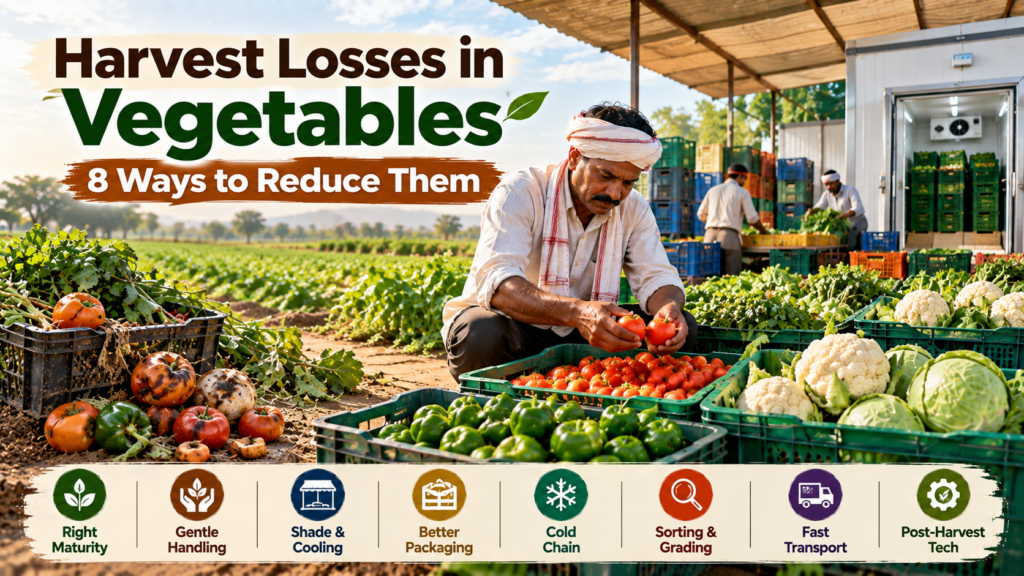
Harvest Losses in Vegetables: 8 Ways to Reduce Them
Vegetables can lose quality and market value quickly after harvesting because of bruising, excessive heat, poor packaging, improper storage and transportation delays. Farmers can reduce post-harvest losses in vegetables by harvesting at the right maturity, handling produce carefully, using suitable packaging, maintaining proper temperature and improving storage and transportation practices.
Post-harvest management is becoming increasingly important in India as farmers, traders and agricultural businesses look for ways to protect produce quality and improve farm income. Recent agricultural initiatives are also focusing on better storage, packaging, preservation and transportation technologies to reduce losses across the supply chain.
What Causes Post-Harvest Losses in Vegetables?
Post-harvest losses in vegetables are mainly caused by physical damage, heat, moisture imbalance, microbial spoilage, poor packaging, improper storage and delays during transportation. These problems can occur between harvesting and the final market.
Common causes include:
- Harvesting vegetables at the wrong maturity stage
- Rough handling during harvesting and sorting
- Bruising, cuts and mechanical damage
- Leaving freshly harvested vegetables under direct sunlight
- Poor ventilation in packaging
- Inadequate cold storage
- Long transportation delays
- Improper temperature and humidity
- Poor sanitation during handling
- Overloading crates and vehicles
Even small injuries can accelerate deterioration because damaged surfaces can become entry points for microorganisms. Careful harvesting and handling therefore play an important role in maintaining vegetable quality.
- Harvest Vegetables at the Right Stage
Harvesting vegetables at the correct maturity stage is one of the simplest ways to reduce post-harvest losses. Farmers should follow crop-specific maturity indicators rather than harvesting too early or too late.
Vegetables harvested too early may have poor size, colour or taste, while over-mature produce can become soft and more vulnerable to damage.
Farmers should also consider harvesting during cooler parts of the day, particularly for highly perishable vegetables. Reducing exposure to field heat can help preserve freshness before the produce reaches the packing or storage facility.
- Handle Produce Carefully After Harvest
Gentle handling can significantly reduce bruising, cuts and other mechanical damage that shorten vegetable shelf life. Farmers should avoid throwing, dropping or unnecessarily moving vegetables between containers.
Useful practices include:
- Use clean harvesting tools.
- Avoid overfilling baskets and crates.
- Keep produce away from sharp edges.
- Do not drag vegetable-filled containers.
- Separate damaged vegetables from healthy produce.
- Use rigid, reusable crates where appropriate.
Reducing the number of handling stages can also lower the possibility of physical damage.
- Protect Vegetables From Heat
Keeping freshly harvested vegetables away from direct sunlight is an important low-cost method of reducing post-harvest losses. High temperatures increase respiration and accelerate deterioration, particularly in highly perishable crops.
Farmers can:
- Harvest during cooler morning hours.
- Move produce into shade immediately.
- Use ventilated collection areas.
- Avoid leaving filled crates in open fields.
- Arrange transportation as soon as practical.
For larger operations, pre-cooling can rapidly remove field heat before storage or transportation.
- Improve Vegetable Packaging
Good packaging protects vegetables from bruising while providing ventilation and helping control temperature, moisture and gas exchange. Packaging should be selected according to the vegetable, transportation distance and storage conditions.
Farmers should consider ventilated plastic crates, suitable cartons and other crop-appropriate packaging instead of unsuitable containers that can cause crushing or puncturing.
Overpacking should also be avoided because excessive pressure can damage vegetables at the bottom of a stack.
- Use Cold Storage and Cold Chain Management
A reliable cold chain helps slow deterioration and maintain vegetable quality from harvest through transportation and marketing. Pre-cooling, cold storage, refrigerated transportation and temperature-controlled handling can work together to extend marketable life.
Importantly, there is no single storage temperature suitable for every vegetable. Different crops have different temperature and humidity requirements, and inappropriate cooling can itself cause chilling injury.
For small and remote farms, emerging options such as solar-powered cold storage can provide an alternative where conventional electricity-based infrastructure is difficult to access. FAO has highlighted renewable-energy-based cooling as an opportunity for reducing food losses in areas with limited energy access.
- Improve Sorting and Grading
Sorting vegetables immediately after harvest helps separate damaged, diseased and market-ready produce. Farmers can grade vegetables according to size, maturity, appearance and quality.
This provides several benefits:
- Better market prices for quality produce
- Reduced spread of spoilage
- Easier packaging and transportation
- Better inventory management
- Opportunities for processing lower-grade produce
Vegetables that are unsuitable for the fresh market can sometimes be redirected toward processing, drying, pickling or other value-added uses instead of being discarded.
- Reduce Transportation Delays
Fast and well-managed transportation is essential for reducing vegetable losses because fresh produce continues to deteriorate after harvest. Farmers should minimize unnecessary loading, unloading and waiting periods.
For longer-distance transportation, temperature-controlled vehicles may be appropriate for highly perishable crops. Proper stacking and ventilation are also important to prevent crushing and heat buildup.
Digital tools such as IoT temperature sensors and supply-chain monitoring can increasingly help businesses track storage and transportation conditions.
- Adopt Better Post-Harvest Technology
Modern post-harvest technology can help farmers monitor quality, temperature, storage conditions and movement from farm to market. Smart packaging, digital temperature monitoring, improved grading equipment and efficient cold-chain systems are emerging areas in agricultural supply chains.
ICAR highlighted smart and intelligent packaging systems in 2026 as an area of growing attention for agricultural products, alongside improved storage, transportation, preservation and value addition.
These technologies can be particularly useful for farmer groups, FPOs, aggregators, processors and larger horticultural businesses.
Why Reducing Vegetable Losses Matters
Reducing post-harvest losses helps farmers protect the quantity and quality of their produce while improving the efficiency of the agricultural supply chain. Better post-harvest management can also reduce unnecessary resource use because the water, labour, fertilizer and energy invested in producing wasted food provide little economic return.
Improved storage can give farmers more flexibility to avoid distress sales during periods of excess supply. FAO notes that adequate storage can help producers hold produce for better market opportunities while reducing losses.
Key Takeaway for Farmers
The most effective way to reduce post-harvest losses in vegetables is to combine careful harvesting, gentle handling, rapid cooling, suitable packaging, proper storage and efficient transportation. Farmers do not always need expensive technology; basic improvements such as shade, better crates, timely transportation and correct handling can make a significant difference.
For larger operations, investments in cold chain infrastructure, solar-powered storage, smart packaging and IoT monitoring can further strengthen the farm-to-market supply chain.