Wheat Seed Treatment Before Sowing: Step-by-Step Guide
Wheat seed treatment is an important pre-sowing practice that helps protect seeds from seed-borne diseases and supports healthy crop establishment. Proper treatment can improve early seedling vigour and reduce the risk of diseases such as loose smut, while the exact treatment should be selected according to the wheat variety, disease history and recommendations for the local area.
As farmers prepare for the Rabi wheat season 2026, choosing quality seed and following the correct seed treatment method can make an important difference to crop establishment. ICAR-Indian Institute of Wheat and Barley Research (IIWBR) recommends seed treatment options for diseases such as loose smut and also supports integrated approaches involving bioagents such as Trichoderma.
What Is Wheat Seed Treatment?
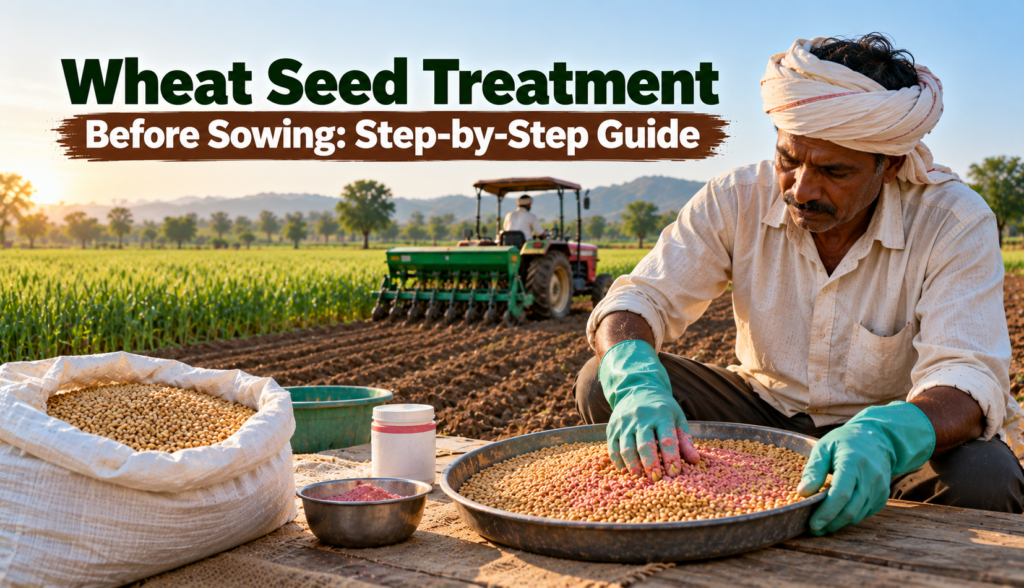
Wheat seed treatment means treating wheat seed with an appropriate fungicide, bioagent or other recommended treatment before sowing to protect the emerging crop from specific seed-borne or soil-related problems. It is normally performed shortly before sowing and should be carried out according to the product label and local agricultural recommendations.
The main objectives of wheat seed treatment are to:
- Protect seed from certain seed-borne pathogens.
- Support healthy germination and early establishment.
- Reduce the risk of diseases such as loose smut.
- Improve initial crop vigour.
- Provide an additional layer of protection where disease pressure is known.
Seed treatment is not a substitute for certified seed, suitable varieties, proper sowing time or balanced nutrient management. It should be considered one part of an integrated wheat crop management plan.
Step-by-Step Wheat Seed Treatment Before Sowing
- Select Good-Quality Wheat Seed
Start with clean, healthy and preferably certified or quality-assured wheat seed suitable for the local agro-climatic zone. Avoid seed that is visibly damaged, mouldy, insect-infested or poorly stored.
Good seed quality is the foundation of successful wheat establishment. Farmers should also select varieties recommended for their region, irrigation conditions and sowing window.
- Clean and Grade the Seed
Remove broken grains, weed seeds, dust and other foreign material before treatment. Uniform seed generally provides better sowing performance and helps maintain an even crop stand.
Do not mix treated seed with untreated seed after the treatment process.
- Identify the Main Disease Risk
The treatment should match the problem expected in the field. For example, loose smut is a seed-borne disease of wheat, and IIWBR recommends specific seed-treatment options for its management.
Where a field has a known history of a particular disease, farmers should obtain advice from a local agricultural university, Krishi Vigyan Kendra or agriculture department before selecting a treatment.
- Apply the Recommended Fungicide or Bioagent
For wheat, treatment options can include recommended fungicides or biological agents such as Trichoderma. ICAR-IIWBR lists carboxin, carbendazim and tebuconazole options for loose-smut management, along with an integrated approach using reduced-dose carboxin and Trichoderma viride.
Some ICAR advisories have also recommended thiram or Trichoderma spp. for wheat seed treatment in particular production regions.
- Mix the Treatment Uniformly
Spread the required quantity of seed on a clean surface and apply the treatment evenly. Mix carefully so that the treatment covers the seed surface without excessive wetting.
For biological products, follow the manufacturer’s instructions because microbial products can have different application methods and storage requirements.
- Dry Treated Seed in Shade
After treatment, allow the seed to dry appropriately in shade rather than exposing freshly treated seed to strong direct sunlight. Handle treated seed separately and avoid mixing it with untreated grain.
IIWBR specifically advises that some treated wheat seed should be dried in shade after treatment.
- Sow the Treated Seed at the Right Time
Use the treated seed for sowing within the recommended period for the treatment. Wheat sowing time varies by region, variety, irrigation availability and whether the crop is timely or late sown.
For example, ICAR information for HD 3226 specifies a 5–25 November sowing window under timely-sown irrigated conditions, illustrating why farmers should follow variety-specific recommendations instead of using one sowing date for every location.
Wheat Seed Treatment With Trichoderma
Trichoderma is a beneficial fungal bioagent used in some wheat seed-treatment programmes to support biological disease management. ICAR-IIWBR recommends Trichoderma viride as part of an integrated loose-smut management strategy.
When using a biological seed treatment:
- Purchase a quality product from a reliable source.
- Check the expiry date and storage instructions.
- Follow the manufacturer’s recommended dose.
- Avoid exposing microbial products to unsuitable storage conditions.
- Check compatibility before combining them with chemical treatments.
IIWBR notes that, in its integrated loose-smut approach, T. viride treatment is applied before the fungicide treatment, with specific intervals. Farmers should follow the current local recommendation rather than copying an old schedule.
Why Wheat Seed Treatment Is Important for Rabi Farming 2026
Wheat seed treatment can help farmers establish a healthier crop by addressing certain seed-borne disease risks before the crop emerges. It is particularly useful as part of an integrated disease-management strategy rather than as a standalone solution.
For Rabi wheat farming 2026, farmers should combine seed treatment with:
- Quality and regionally suitable seed
- Timely sowing
- Soil testing and balanced fertilization
- Proper seed depth and row spacing
- Efficient irrigation
- Early weed monitoring
- Regular crop scouting
- Integrated pest and disease management
ICAR’s wheat resources continue to emphasize region-specific crop management and improved varieties. The IIWBR also maintains crop advisories for wheat across different periods and production zones.
Common Mistakes to Avoid During Wheat Seed Treatment
Avoid these mistakes when preparing wheat seed:
- Using poor-quality or damaged seed.
- Applying an incorrect chemical dose.
- Mixing products without checking compatibility.
- Using expired fungicides or bioagents.
- Leaving treated seed exposed to unsuitable conditions.
- Mixing treated seed with untreated seed.
- Using the same treatment for every disease without identifying the actual risk.
- Ignoring local agricultural recommendations.
Farmers should also remember that seed treatment does not eliminate every wheat disease or pest. Field history, variety selection, weather, soil conditions and subsequent crop management all influence disease development.
Final Takeaway
The correct wheat seed treatment process involves selecting quality seed, identifying the major disease risk, applying an appropriate recommended treatment uniformly, drying the seed safely and sowing it within the suitable crop window. For Rabi wheat 2026, farmers should combine seed treatment with timely sowing, suitable varieties, soil-test-based nutrition and regular crop monitoring.
For disease-specific treatment, always verify the latest label recommendation and local agricultural advisory before application, because registered products and recommendations can change.