Digital Agriculture in India: 7 Trends Transforming Farming
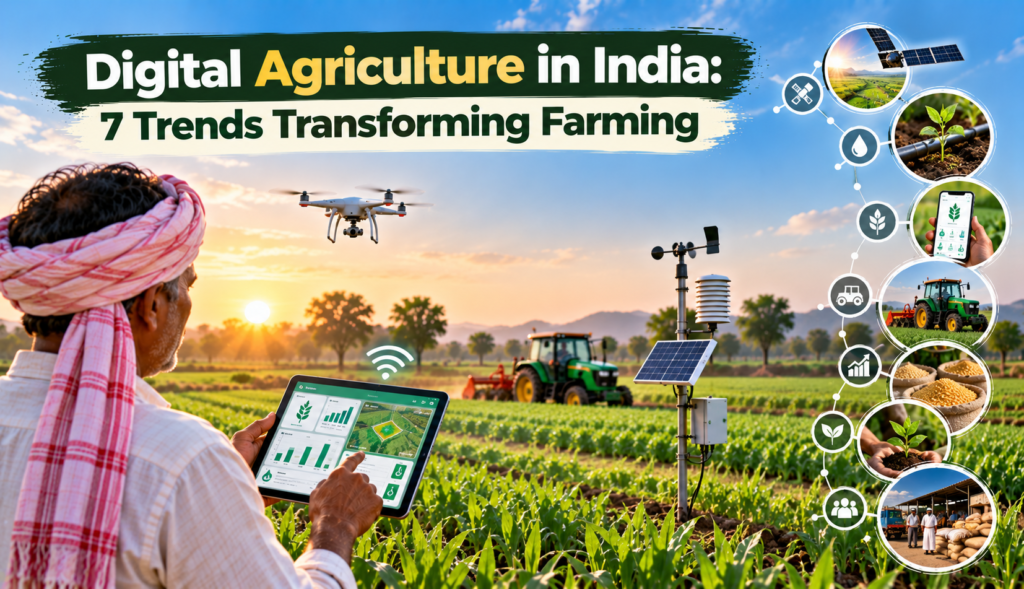
Digital agriculture in India is changing how farmers access government services, monitor crops, plan irrigation and make farm-management decisions. Technologies such as Farmer IDs, digital crop surveys, artificial intelligence (AI), satellite imagery and precision farming are helping build a more data-driven agricultural system.
What Is Digital Agriculture?
Digital agriculture is the use of digital technologies, data and connected tools to improve farming decisions and agricultural services. It includes digital farmer records, mobile-based crop monitoring, weather information, satellite mapping, AI-powered advisories and farm-management applications.
In India, the Digital Agriculture Mission and AgriStack are important parts of this transformation. AgriStack is a farmer-focused digital public infrastructure designed to connect farmer records, land information and crop data to improve the delivery of agricultural services. Its core registries include the Farmers Registry, Geo-Referenced Village Maps and Crop Sown
- Farmer IDs and AgriStack
A Farmer ID is a digital identity intended to connect eligible farmers with relevant agricultural records and services. It can support access to schemes, crop insurance, credit services and other farmer-focused programmes, subject to the applicable scheme and state requirements.
According to the Ministry of Agriculture and Farmers Welfare, more than 10.31 crore Farmer IDs had been generated nationwide as of 3 August 2026. This milestone reflects the growing role of digital farmer registration in Indian agriculture.
For farmers, accurate registration and updated land records are important. Farmers should check their state’s official Farmer Registry process and correct any errors through authorized channels.
- Digital Crop Surveys and Crop-Plot Databases
Digital crop surveys record information about the crops grown on agricultural plots. These surveys can help governments understand sowing patterns, estimate crop areas and plan procurement, input distribution and agricultural support.
A crop-plot database links crop information to mapped agricultural land. When maintained accurately, this data can help officials identify which crops are being cultivated in different areas and improve evidence-based planning.
Digital records do not remove the need for field verification. Crop details can change during a season, and survey quality depends on reliable data collection, timely updates and suitable verification methods.
- AI in Agriculture
Artificial intelligence in agriculture can analyse crop images, weather information and other agricultural data to support decisions. Depending on the tool and data quality, AI-based systems can help identify potential pest problems, generate advisories and improve crop monitoring.
Examples of AI applications include:
- Pest detection: analysing crop images to identify possible pest damage.
- Weather-based advice: supporting decisions about sowing, irrigation and crop protection.
- Crop monitoring: helping assess crop conditions across large areas.
- Agricultural chatbots: answering common farming and government-scheme questions.
AI recommendations should be checked against local conditions and expert guidance. Farmers should not rely on an automated output alone when making high-cost decisions about pesticides, fertilizers or crop treatments.
- Satellite Data and Remote Sensing
Satellite imagery allows agricultural agencies and technology providers to observe large areas of farmland. Combined with weather data, field observations and mapping tools, satellite data can support crop-area estimation, vegetation monitoring and the assessment of drought or flood impacts.
These applications are especially useful where field inspections across every farm would be difficult or time-consuming. However, satellite observations are not a perfect substitute for ground-level checks. Cloud cover, image resolution, crop stage and local field conditions can affect the interpretation of data.
- Precision Agriculture and Smart Irrigation
Precision agriculture uses information about soil, moisture, crop conditions and weather to manage farm inputs more efficiently. Depending on the farm and equipment available, tools may include soil-moisture sensors, GPS-guided machinery, drip irrigation controllers and digital farm-management applications.
Smart irrigation systems can help farmers schedule watering based on crop needs and soil moisture instead of relying only on fixed routines. This may improve water-use efficiency, although the results depend on installation, maintenance, crop type and local conditions.
Farmers should compare equipment costs with expected savings before investing in advanced technology. Low-cost moisture meters and reliable weather information may be more practical starting points for small farms than expensive automated systems.
- Digital Weather Advisories and Crop Planning
Digital weather advisories can deliver information about rainfall, temperature, wind and other conditions through mobile applications, SMS services and agricultural support networks. Farmers can use this information to plan sowing, irrigation, harvesting and certain crop-protection activities.
Weather data becomes more useful when combined with the crop’s growth stage, soil conditions and local forecasts. Farmers should check the advisory’s date, location and validity period before acting on it, particularly when severe weather is expected.
- Benefits and Challenges of Digital Agriculture
Digital agriculture can improve access to information, strengthen agricultural planning and make some government services more efficient. Its benefits depend on data quality, affordability, digital skills and the availability of reliable support.
Key potential benefits include:
- Better access to agricultural information and scheme-related services.
- Faster identification of crop-monitoring and weather risks.
- More informed decisions about irrigation and farm inputs.
- Improved crop-area estimates and agricultural planning.
- Greater scope for targeted advisories and data-supported services.
Important challenges remain. Farmers may face weak internet connectivity, language barriers, limited digital skills, incorrect records or difficulties using online systems. Data privacy and consent are also essential when personal and land-related information is collected or shared.
Government agencies and service providers should make digital systems accessible, secure and transparent. Farmers who need assistance can check official state portals or seek help from authorized Common Service Centres and local agricultural extension services.
The Future of Digital Agriculture in India
Digital agriculture in India is moving towards greater integration of farmer identities, crop records, AI-based tools, satellite data and localized advisories. These systems can support more informed agricultural decisions when the underlying information is accurate, secure and useful to farmers.
Technology alone cannot solve every agricultural challenge. Reliable extension services, affordable tools, farmer training and access to human support remain essential. The strongest digital farming solutions will combine practical field knowledge with timely, trustworthy data.
For farmers, the best approach is to start with a clear need—such as checking a weather advisory, correcting a Farmer ID record or improving irrigation scheduling—and choose a reliable tool that addresses it.