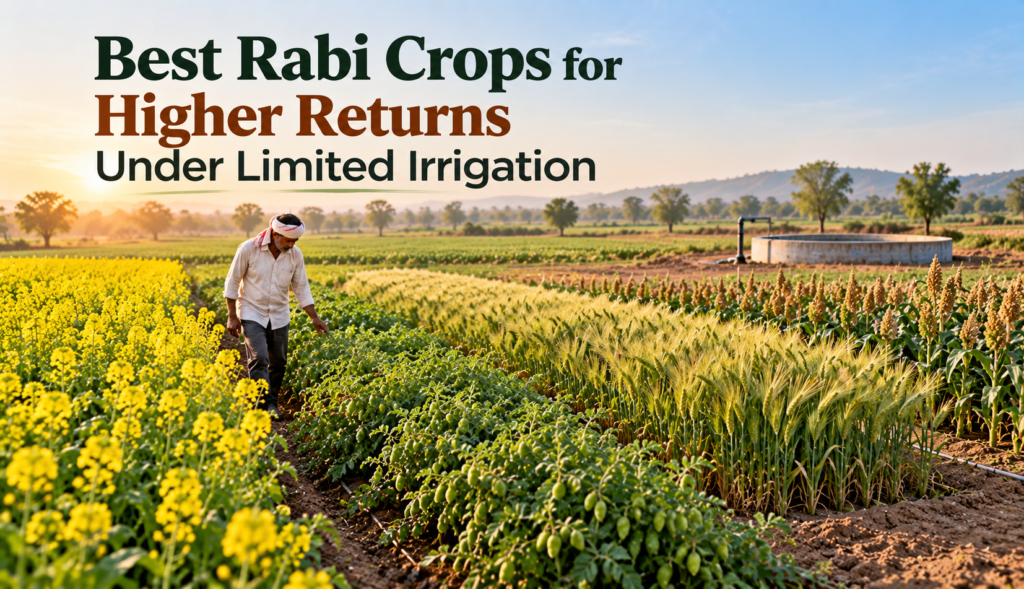
Best Rabi Crops for Higher Returns Under Limited Irrigation
Water availability is becoming an important factor in Rabi crop planning, particularly for farmers dependent on limited irrigation or residual soil moisture. Choosing the best Rabi crops according to soil type, available water, sowing window and local market demand can help farmers improve water productivity while managing cultivation costs.
For farmers with limited irrigation, crops such as mustard, chickpea, barley, Rabi jowar and selected short-duration crops can be considered depending on the region and available moisture. ICAR advisories also emphasize better resource-use efficiency, supplemental irrigation and moisture conservation for Rabi farming.
Why Crop Selection Matters Under Limited Irrigation
Limited irrigation does not necessarily mean that farmers have to leave their fields uncultivated during Rabi. The right crop can make better use of residual soil moisture and a small number of protective irrigations.
Crop selection should be based on:
- Available irrigation water
- Soil moisture at sowing
- Soil type and drainage
- Local temperature conditions
- Crop duration
- Expected market demand
- Seed and input costs
- Availability of harvesting and marketing facilities
ICAR has highlighted the importance of utilizing residual moisture, crop diversification and lifesaving irrigation for improving Rabi production in areas facing resource constraints.
- Mustard: A Strong Option for Limited Irrigation
Mustard is one of the important Rabi oilseed crops for farmers looking for comparatively efficient use of limited irrigation. It can perform under rainfed and limited-irrigation conditions when farmers select suitable varieties and maintain adequate soil moisture during critical growth stages.
Mustard is particularly important in areas where irrigation resources are restricted. ICAR advisories identify mustard among the major Rabi crops and provide separate recommendations for irrigated and rainfed conditions.
Farmers should focus on:
- Timely sowing
- Suitable variety selection
- Proper seed treatment
- Balanced nutrient management
- Weed control
- Moisture conservation
- Irrigation at critical crop stages when water is available
Efficient irrigation can make a significant difference. ICAR has documented farming systems where mustard was grown with limited irrigation and sprinkler-based water application to improve water use.
- Chickpea: A Suitable Pulse for Lower-Water Farming
Chickpea is another important Rabi crop that can fit farming systems where irrigation is limited. It is widely cultivated in semi-arid and rainfed areas and can make use of available soil moisture when planted at the appropriate time.
Chickpea is particularly relevant for crop diversification because it also contributes to pulse production and can fit into rotations with cereals and oilseeds.
For better results, farmers should consider:
- Suitable local varieties
- Timely sowing
- Seed treatment
- Good field drainage
- Weed management
- Monitoring for pod borer and other pests
- Protective irrigation where feasible
The suitability of chickpea depends strongly on soil moisture, temperature and regional conditions, so farmers should follow local agricultural university or KVK recommendations.
- Barley: An Option for Water-Constrained Areas
Barley can be considered where farmers have limited irrigation and suitable soil and climate conditions. It is a Rabi cereal crop that can be included in diversified farming systems, particularly in regions where wheat production may require greater irrigation management.
Barley can also provide opportunities for grain, feed and malt markets, depending on the variety and local demand.
Before selecting barley, farmers should check:
- Local variety recommendations
- Soil suitability
- Market demand
- Seed availability
- Expected procurement or buyer requirements
The objective should not simply be to choose the crop requiring the least water, but to select a crop that offers the best combination of water requirement, yield potential, cultivation cost and market opportunity.
- Rabi Jowar for Moisture-Conserving Farming
Rabi jowar can be useful in areas where farmers depend heavily on rainfall and stored soil moisture. Moisture-conservation practices can help reduce water stress and support more stable crop establishment.
ICAR has reported successful use of in-situ moisture conservation for Rabi jowar in rainfed areas. In its field campaign, farmers using the technology were able to obtain yields under scanty rainfall, while protected irrigation further improved yield.
Practices such as proper land preparation, moisture conservation and timely sowing can therefore be important components of low-water farming.
- Consider Short-Duration Crops Where Appropriate
Short-duration crops can be valuable where the available water window is narrow. A shorter crop duration can reduce the period during which irrigation and soil moisture must be maintained.
Crop selection should, however, be based on local recommendations rather than choosing a variety only because it matures early. For example, ICAR has documented a short-duration cumin genotype that required fewer irrigations than the existing cultivar under specific arid-region conditions.
This demonstrates an important principle for climate-smart agriculture: variety selection can influence both crop duration and water requirement.
How Farmers Can Save Water During Rabi Farming
Selecting a suitable crop is only the first step. Better irrigation and soil-management practices can further improve water productivity.
Farmers can consider:
- Use soil moisture wisely: Check field moisture before deciding on irrigation.
- Prefer efficient irrigation: Sprinkler or drip systems can improve water-use efficiency where suitable.
- Conserve residual moisture: Minimum tillage, mulching and other conservation practices can reduce moisture loss.
- Maintain proper field conditions: Avoid unnecessary runoff and waterlogging.
- Prioritize critical stages: When water is scarce, irrigation should be strategically scheduled according to crop requirements.
- Use farm ponds where feasible: Harvested rainwater can provide supplemental irrigation during dry periods.
ICAR research has documented water savings from efficient irrigation and moisture-based scheduling, reinforcing the importance of precision in irrigation management.
How to Choose the Best Rabi Crop for Your Farm
There is no single best Rabi crop for every farmer. The right choice depends on the combination of water availability, soil type, climate, crop duration, input costs and market price.
A practical decision approach is:
Farming condition | Crops to consider |
Limited irrigation | Mustard, chickpea, barley |
Mainly residual moisture | Chickpea, Rabi jowar |
Semi-arid conditions | Mustard, chickpea, suitable cereals |
Better irrigation availability | Wheat, mustard and other locally recommended crops |
Short water window | Suitable short-duration varieties |
Farmers should also consult the nearest Krishi Vigyan Kendra (KVK), agricultural university or state agriculture department before finalizing the variety and sowing schedule.
Conclusion
The best Rabi crops for higher returns under limited irrigation are those that match the farm’s available moisture, soil conditions, climate and market opportunities. Mustard, chickpea, barley and Rabi jowar can be useful options in suitable regions, while efficient irrigation and moisture-conservation practices can further improve water productivity.
Instead of maximizing irrigation, farmers should focus on better crop selection, timely sowing, moisture conservation and targeted irrigation. This approach can support more resilient Rabi farming while helping control cultivation costs and protect limited water resources.