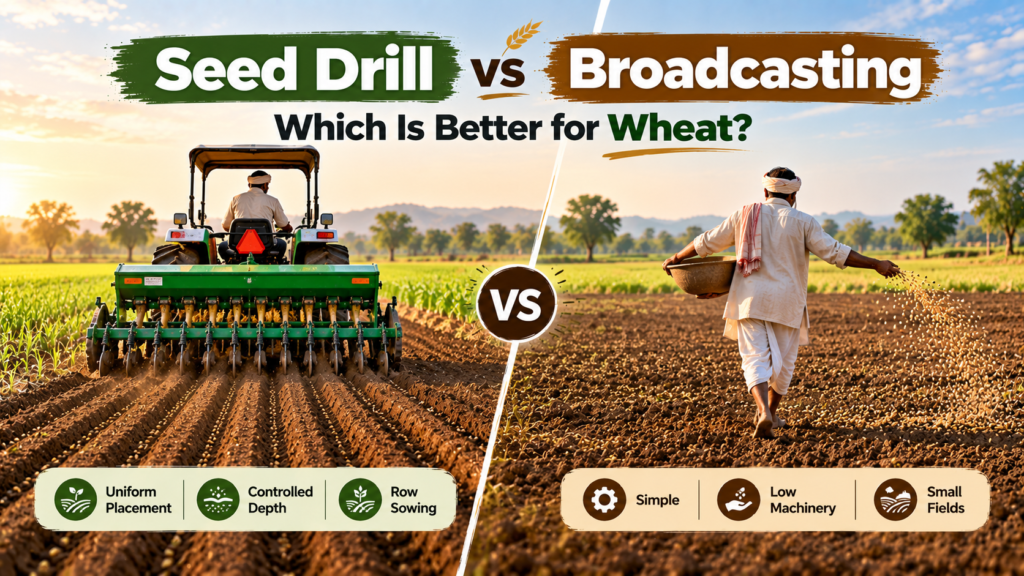
Seed Drill vs Broadcasting: Which Is Better for Wheat?
Choosing the right sowing method can directly affect wheat crop establishment, seed use, plant population and overall field performance. Between seed drill vs broadcasting, the seed drill generally provides more uniform seed placement and better control over sowing depth, while broadcasting remains a simple and economical option for farmers with limited machinery access.
For wheat farming 2026-27, farmers should consider soil condition, field size, available machinery, labour cost, seed availability and sowing time before selecting a method.
What Is Seed Drill Sowing?
A seed drill is a farm implement that places wheat seeds into the soil at a relatively uniform depth and spacing. It can help farmers achieve more systematic sowing while reducing unnecessary seed wastage.
During seed drill sowing, seeds are placed in rows rather than scattered randomly across the field. Depending on the equipment, the drill can also support more efficient fertilizer placement.
Key benefits of a seed drill
- Uniform seed placement
- Better control over sowing depth
- Reduced seed wastage
- Faster sowing over large fields
- Better row arrangement for crop management
- Suitable for timely and precision-oriented wheat sowing
- Can reduce manual labour requirements
Seed drills are particularly useful when farmers want uniform wheat crop establishment and efficient use of seed and field inputs.
What Is Broadcasting in Wheat Sowing?
Broadcasting is a traditional wheat sowing method in which seeds are scattered manually or mechanically over the prepared field. The seeds are then incorporated into the soil through planking, harrowing or another suitable field operation.
Broadcasting is relatively simple and does not necessarily require specialized sowing machinery. This makes it accessible to small and marginal farmers who may not have immediate access to a seed drill.
Advantages of broadcasting
- Simple sowing technique
- Lower machinery requirement
- Suitable where seed drills are unavailable
- Can be used for relatively small fields
- Familiar method for many farmers
- Requires less specialized equipment
However, broadcasting can result in uneven seed distribution and sowing depth if field preparation and seed incorporation are not properly managed.
Seed Drill vs Broadcasting: Key Differences
The biggest difference between seed drill vs broadcasting is how the seed is distributed and placed in the soil. A seed drill places seeds more systematically, while broadcasting scatters seeds across the field.
Factor | Seed Drill | Broadcasting |
Seed placement | More uniform | Less uniform |
Sowing depth | Better controlled | Can vary |
Seed wastage | Generally lower | Can be higher |
Row arrangement | Yes | No defined rows |
Machinery | Required | Usually minimal |
Labour | Lower after mechanization | Can require more field operations |
Field management | Easier | Can be comparatively difficult |
Precision | Higher | Lower |
Initial equipment cost | Higher | Lower |
Large fields | Highly suitable | Less efficient |
This comparison shows why seed drill sowing is increasingly preferred for efficient wheat cultivation, particularly where farmers have access to suitable machinery.
Which Method Uses Wheat Seed More Efficiently?
A seed drill can help improve wheat seed placement and seed-use efficiency because seeds are placed at controlled depths and rows. Broadcasting may require more seed to compensate for uneven distribution, poor incorporation or variable emergence.
However, the actual wheat seed rate should depend on factors such as wheat variety, sowing time, soil condition, seed quality and local agricultural recommendations.
Farmers should avoid increasing seed quantity simply to compensate for poor sowing practices.
Which Method Is Better for Wheat Yield?
A seed drill does not automatically guarantee higher yield, but uniform sowing can create better conditions for consistent crop establishment. Proper depth, adequate soil moisture, suitable plant population and timely sowing all contribute to better wheat crop performance.
Broadcasting can also produce a successful wheat crop when the seedbed is well prepared and seeds are properly incorporated into the soil. Therefore, sowing method is only one part of wheat yield management.
Other important factors include:
- Quality-certified wheat seed
- Timely sowing
- Proper seed treatment
- Balanced fertilization
- Adequate irrigation
- Weed management
- Pest and disease monitoring
- Suitable soil moisture
Seed Drill vs Broadcasting: Which Is More Cost-Effective?
For farmers who already have access to a tractor and seed drill, mechanized sowing can be more efficient, especially on larger farms. It can reduce repetitive labour and improve the uniformity of field operations.
Broadcasting generally has a lower equipment requirement, making it attractive where machinery access is limited. However, farmers should compare the complete cost, including seed requirement, labour, field preparation and subsequent crop management.
For wheat farming 2026, the better option is therefore not simply the method with the lowest initial cost. Farmers should consider the total cost per acre and expected crop establishment.
When Should Farmers Choose a Seed Drill?
A seed drill is generally a strong option when:
- The farm has access to suitable machinery.
- Timely wheat sowing is important.
- The farmer wants uniform rows.
- Seed-use efficiency is a priority.
- The field is sufficiently prepared for mechanized sowing.
- The farmer wants easier intercultural operations.
It can be especially useful for farmers focusing on precision wheat sowing and efficient farm mechanization.
When Can Broadcasting Be a Practical Choice?
Broadcasting can remain useful where farmers have limited access to agricultural machinery or operate smaller fields. It may also be practical when a seed drill is unavailable during the required sowing window.
The key is proper seedbed preparation and adequate incorporation of the seed into moist soil. Poor broadcasting practices can lead to uneven emergence and inefficient plant populations.
Conclusion
Seed drill is generally better for efficient wheat sowing, while broadcasting is a simpler and lower-equipment alternative. The right choice depends on machinery access, farm size, labour availability, soil condition and sowing time.