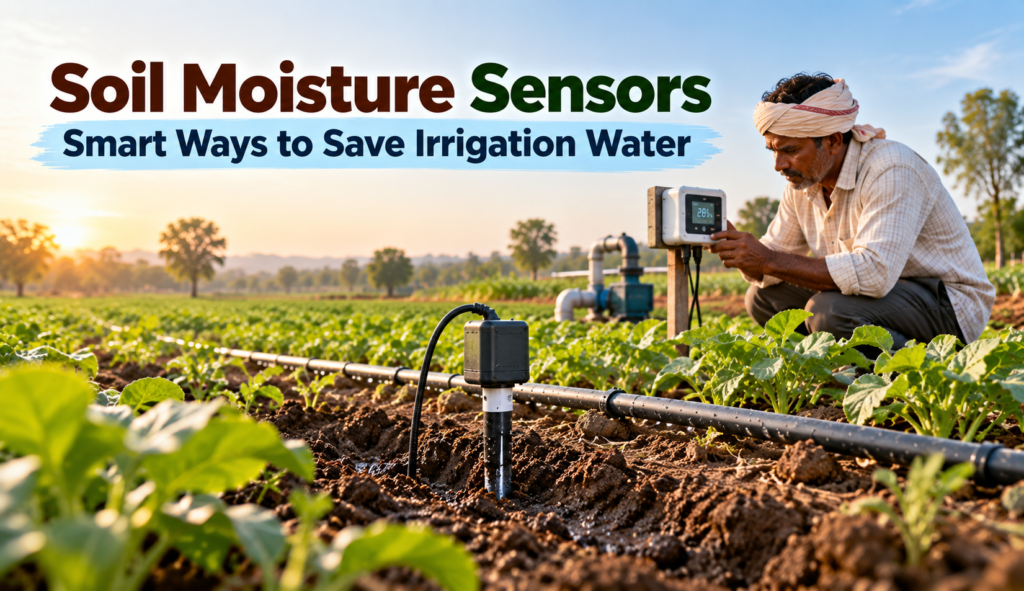
Soil Moisture Sensors: Smart Ways to Save Irrigation Water
Water management has become increasingly important as farmers face irregular rainfall, rising irrigation costs and growing pressure to use water efficiently. Soil moisture sensors help farmers measure moisture levels in the root zone and make irrigation decisions based on actual field conditions instead of fixed schedules.
Recent agricultural research and initiatives are increasingly connecting soil moisture monitoring with precision irrigation, IoT agriculture, smart farming and climate-resilient agriculture. In India, ICAR reported an IoT-enabled soil monitoring system in 2026 designed to support real-time irrigation decisions and improve water-use efficiency.
What Are Soil Moisture Sensors?
Soil moisture sensors are devices that measure the amount or availability of water in soil. The information can help farmers decide when irrigation is required and avoid watering crops when the soil already contains sufficient moisture.
Depending on the technology, sensors can measure:
- Volumetric soil water content
- Soil water tension
- Electrical properties related to moisture
- Moisture at different soil depths
- In some systems, soil temperature and electrical conductivity
This makes soil moisture sensors useful for farms using drip irrigation, sprinkler irrigation and other precision irrigation systems.
How Soil Moisture Sensors Help Save Irrigation Water
The biggest advantage of soil moisture sensors is that they replace guesswork with field-based information. Instead of irrigating simply because a certain number of days have passed, farmers can check whether the crop actually needs water.
Here are some important benefits:
- Prevents Over-Irrigation
Over-irrigation can waste water and energy while also causing nutrient leaching, poor root-zone conditions and unnecessary pumping costs.
A sensor can provide real-time information about moisture levels, helping farmers delay irrigation when sufficient moisture is already available.
- Improves Irrigation Timing
Correct irrigation timing is particularly important during crop growth stages when water demand changes. Smart irrigation systems can use sensor readings to determine when irrigation should begin.
This is especially useful when rainfall is unpredictable because farmers can make decisions using current soil conditions rather than relying only on weather expectations.
- Reduces Unnecessary Water Loss
When irrigation is applied according to actual soil moisture, farmers can reduce unnecessary applications. Research indexed by FAO AGRIS shows that soil moisture monitoring can support more efficient water management, although sensor accuracy depends on calibration, soil conditions and installation.
- Supports Precision Irrigation
Precision irrigation focuses on applying the right amount of water at the right location and time. Soil moisture data can become one of the key inputs for this approach.
When combined with drip irrigation, weather information and crop requirements, sensors can create a more data-driven irrigation strategy.
How Do Soil Moisture Sensors Work?
The working principle depends on the type of sensor. Capacitance and dielectric sensors estimate soil moisture by measuring changes in the soil’s electrical properties, while tensiometers measure soil-water tension.
A typical sensor-based irrigation setup includes:
- A soil moisture sensor installed near the crop root zone.
- A controller or data logger that receives sensor readings.
- A monitoring system or mobile application.
- An irrigation pump, valve or automation system.
- A decision threshold for starting or stopping irrigation.
More advanced IoT agriculture systems can transmit readings wirelessly and allow farmers to monitor field conditions remotely.
Research on soil moisture monitoring also highlights the growing use of IoT platforms, decision-support systems and AI-based data analysis for precision agriculture.
Where Should Soil Moisture Sensors Be Installed?
Sensor placement matters because moisture can vary considerably across a field.
For better results, farmers should consider:
- Crop root-zone depth
- Soil type and texture
- Irrigation method
- Field slope
- Areas with different drainage conditions
- Different crop growth stages
For example, installing a sensor too close to a drip emitter may provide a different reading from the wider root zone. Therefore, proper installation and calibration are essential for reliable irrigation decisions. FAO guidance also notes that soil type, calibration and the sensor’s area of influence affect soil moisture measurement.
Soil Moisture Sensors and IoT Smart Farming
The combination of soil moisture sensors and IoT technology is making irrigation management more connected.
Modern systems can send sensor readings to a smartphone or cloud dashboard. Farmers can then monitor moisture conditions without manually checking every part of the field.
Some advanced systems can also combine:
- Weather forecasts
- Soil moisture readings
- Crop growth information
- Irrigation history
- Temperature and humidity
- Automated valves
- AI-based recommendations
In May 2026, ICAR reported an IoT-enabled soil monitoring system developed for real-time soil moisture monitoring and smarter irrigation decisions in eastern India.
Benefits for Indian Farmers
For Indian agriculture, soil moisture sensors can be particularly useful where farmers face irregular rainfall, groundwater pressure or increasing irrigation expenses.
Potential benefits include:
- Better irrigation scheduling
- Reduced unnecessary water application
- Lower pumping and electricity use
- Improved water-use efficiency
- Better crop monitoring
- Support for precision farming
- Reduced dependence on fixed irrigation schedules
- Better adaptation to variable weather
However, sensors are not a replacement for agronomic knowledge. Farmers should consider crop type, soil texture, weather, irrigation method and growth stage before acting on sensor readings.
Are Soil Moisture Sensors Worth Using?
Soil moisture sensors can be worthwhile when irrigation decisions are difficult to make accurately or when water availability is limited. Their value is generally higher when they are properly calibrated and integrated with an appropriate irrigation system.
Farmers should compare the sensor’s cost with the potential benefits from reduced water use, lower energy consumption and improved irrigation management.
Low-cost sensors are also receiving attention, but cheaper equipment is not automatically better. Accuracy, durability, calibration, connectivity and after-sales support should be considered before purchase. Recent research identifies cost, technical complexity and calibration as some of the barriers to wider adoption.
The Future of Soil Moisture Monitoring
The future of soil moisture monitoring is moving toward connected and data-driven agriculture. Sensors are increasingly being combined with IoT platforms, weather data, automation and AI-based decision-support tools.
This can help move irrigation from a fixed-schedule approach toward need-based irrigation, where water application responds to actual field conditions.
For farmers looking to adopt climate-smart and resource-efficient practices, soil moisture monitoring can become an important part of a broader precision farming strategy.