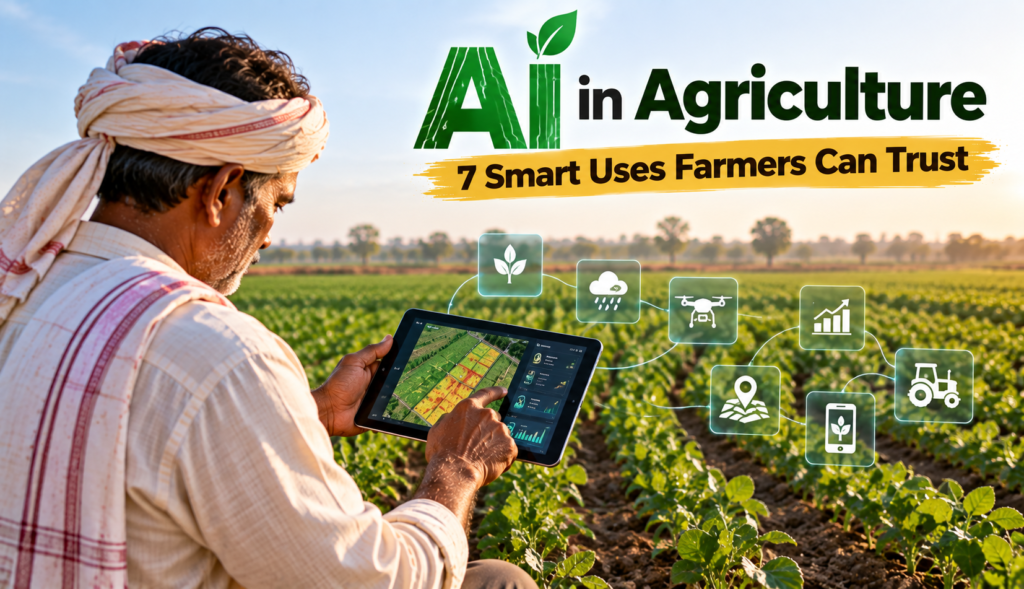
AI in Agriculture: 7 Smart Uses Farmers Can Trust
AI in agriculture is helping farmers make faster, data-based decisions about crops, water, pests, weather and farm operations. From AI-powered crop monitoring to smart irrigation and pest detection, these technologies are becoming practical tools for improving farm efficiency and resource management.
Artificial intelligence is no longer limited to large technology companies or research laboratories. Today, AI-powered systems can analyse images, weather information, soil data, satellite imagery and field observations to provide useful insights for farmers. In India, agricultural institutions are also exploring AI-enabled advisory systems, pest surveillance and crop-stress detection.
Here are seven practical AI in agriculture applications farmers should understand.
- AI-Based Crop Health Monitoring
AI can help farmers identify crop stress before the problem becomes widespread. Cameras, drones and satellite images can collect information about crop colour, growth patterns and field conditions, while AI models analyse these images to identify possible abnormalities.
For example, AI-powered crop monitoring can help detect:
- Crop stress
- Nutrient deficiencies
- Uneven crop growth
- Water-related stress
- Possible disease symptoms
This can support precision agriculture, where farmers focus attention and inputs on areas that actually need them instead of treating the entire field in the same way.
- AI for Pest and Disease Detection
Pest and disease detection is one of the most practical uses of agricultural AI. A farmer can use images of leaves, fruits or affected plants with an AI-enabled application to identify potential crop problems.
AI models can compare visible symptoms with large datasets and provide possible diagnoses or recommendations. ICAR has highlighted AI and digital technologies for pest surveillance, early warning and location-specific crop protection, while its RAISE project focuses on AI-based rice stress evaluation.
However, farmers should treat AI results as decision support, not a replacement for agricultural experts. Serious infestations or disease outbreaks should be confirmed through reliable agricultural advisory services.
- Smart Irrigation and Water Management
AI can combine soil moisture readings, weather forecasts, crop requirements and historical field data to improve irrigation decisions.
Instead of irrigating simply according to a fixed schedule, an AI-enabled system can help determine when water is needed and how much may be appropriate.
This approach works particularly well with:
- Soil moisture sensors
- Drip irrigation
- Automated irrigation systems
- Weather stations
- IoT-based farm devices
ICAR has also reported work involving IoT-enabled soil moisture monitoring and irrigation scheduling, showing how sensor-based technology is becoming part of climate-resilient agriculture.
- AI-Powered Weather and Crop Advisory
Weather can strongly influence sowing, irrigation, spraying and harvesting decisions. AI can analyse weather forecasts and agricultural data to provide more useful, location-specific information.
Farmers can use technology-driven advisories to understand potential risks related to:
- Heavy rainfall
- Drought conditions
- Heat stress
- Frost
- Strong winds
- Changing crop conditions
AI-enabled agricultural extension systems are increasingly being discussed for delivering real-time, location-specific advisories and weather-based recommendations to farmers.
- Yield Prediction and Farm Planning
AI can analyse historical yields, weather patterns, crop conditions, soil information and other datasets to estimate potential crop performance.
AI-based yield prediction can help farmers and agricultural businesses plan harvesting, storage, transportation and marketing more efficiently.
Yield estimates are not guarantees because actual production depends on many factors, including rainfall, pests, disease, soil conditions and farm management. The value of AI is that it can turn large amounts of information into a more useful planning signal.
- AI for Precision Farming
Precision farming uses data and technology to manage different parts of a field according to their specific requirements. AI strengthens this approach by analysing data from satellites, drones, sensors and farm machinery.
Farmers can potentially use AI to improve:
- Fertilizer application
- Crop monitoring
- Irrigation scheduling
- Weed management
- Field mapping
- Input planning
Recent agricultural research is combining UAVs, satellite remote sensing and machine learning for crop-health monitoring, irrigation optimization, nutrient management and yield prediction.
- AI for Better Farm Decisions
The broader benefit of AI in agriculture is decision support. Instead of relying on a single source of information, AI systems can combine multiple data points and present them in a simpler format.
For farmers, this could mean getting support for questions such as:
- When should I irrigate?
- Which part of the field needs attention?
- Is this crop showing signs of stress?
- Could weather affect spraying?
- Where should fertilizer be applied?
- What farm activity should be prioritized?
The goal is not to replace farmers’ experience. Instead, AI can help combine traditional knowledge with timely data and technology.
What Are the Benefits of AI in Agriculture?
The main benefits of agricultural AI include better decision-making, more efficient use of water and inputs, earlier detection of crop problems and improved farm monitoring. FAO describes smart farming as the combination of digital technologies, AI, IoT and precision agriculture to improve farm management and resource efficiency.
For small and medium farmers, affordability and ease of use remain important. AI tools are most useful when they provide clear recommendations, work with locally relevant data and complement existing agricultural expertise.
Challenges Farmers Should Know
AI is promising, but it is not a magic solution. Farmers may face challenges such as internet connectivity, technology costs, lack of digital skills, inaccurate data and the need for local-language support.
AI recommendations should therefore be verified against local weather conditions, crop practices and advice from qualified agricultural experts.
The Future of AI in Agriculture
AI is likely to become increasingly connected with drones, sensors, satellite imagery, IoT devices and farm machinery. This could make farming more data-driven while helping farmers respond to changing weather, rising input costs and resource constraints.
The future of smart farming will not simply be about using more technology. It will be about using the right technology at the right time to solve practical farming problems.
Conclusion
AI in agriculture can help farmers monitor crops, detect pests, manage irrigation, understand weather risks, estimate yields and make better field decisions. As AI becomes more accessible and locally relevant, it can become a useful decision-support tool alongside farmers’ experience and agricultural expertise.