Precision Farming Tools for Small Farmers in India
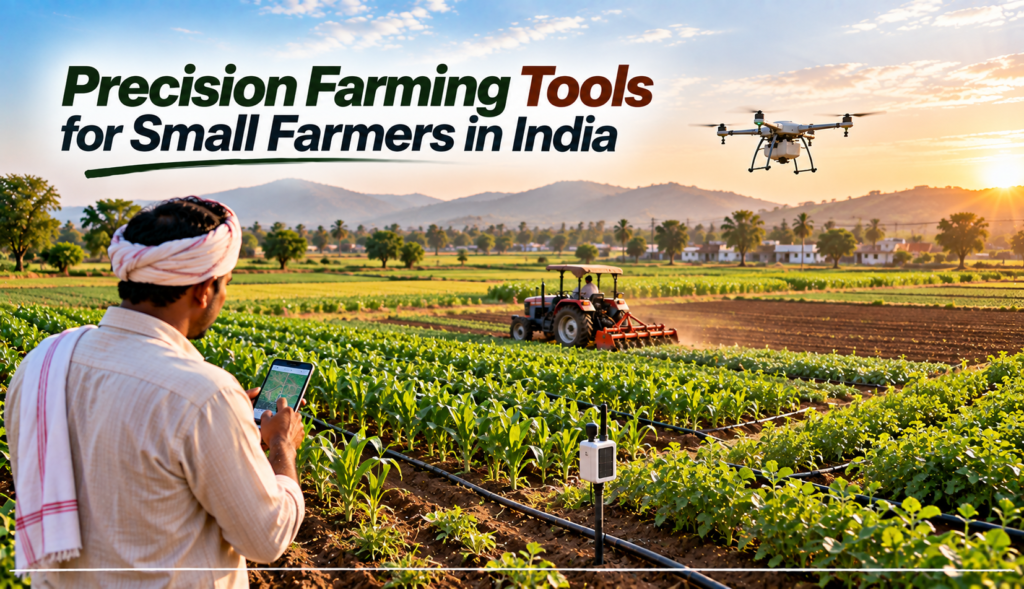
Precision farming tools help farmers make better decisions about irrigation, fertiliser, crop protection and field operations by using field-level data. For small farmers in India, affordable soil sensors, mobile apps, GPS-based equipment, drones and smart irrigation systems can make precision agriculture more practical and reduce unnecessary input use.
What Is Precision Farming?
Precision farming is a data-driven approach to agriculture in which farmers use technology to apply the right input at the right place and time. Instead of treating an entire field in exactly the same way, precision agriculture uses information about soil, crops, weather and field conditions to improve farm decisions.
The technology does not always have to be expensive. Small farmers can begin with simple tools such as:
- Soil testing and digital soil-health information
- Soil moisture sensors
- Weather-based mobile applications
- GPS-enabled farm equipment
- Drip irrigation controllers
- Crop-monitoring applications
- Drone services through trained operators or service providers
The objective is simple: use fewer resources where possible while maintaining or improving crop productivity.
- Soil Moisture Sensors
Soil moisture sensors are among the most practical precision farming tools for improving irrigation decisions. They measure moisture conditions in the soil and can help farmers decide when irrigation is actually required.
This is particularly useful in areas where water availability is limited or rainfall is unpredictable. ICAR reported in 2026 that an IoT-enabled soil monitoring system was established at ICAR-RCER, Patna to support real-time soil moisture monitoring and more efficient irrigation decisions.
Farmers can combine soil moisture information with drip or sprinkler irrigation to avoid unnecessary watering.
Key benefits
- Better irrigation scheduling
- Reduced water wastage
- Improved water-use efficiency
- Real-time field information
- Better crop stress management
ICAR has also reported IoT-enabled soil-moisture technology capable of saving 10–15% water compared with traditional irrigation scheduling in certain applications.
- Agricultural Drones
Agricultural drones can help monitor crops and apply certain agricultural inputs with greater precision and speed. They can capture aerial images, identify crop variability and, where permitted and properly operated, support spraying and other farm operations.
Drone technology is becoming increasingly visible in Indian agriculture. ICAR has documented drone-based crop monitoring and precision applications, while recent farmer demonstrations have focused on drone spraying and foliar nutrition.
For small farmers, using drone services on a hiring or community basis may be more practical than purchasing a drone individually.
Potential applications include:
- Crop monitoring
- Pest and disease surveillance
- Nutrient application
- Targeted spraying
- Field mapping
- Crop-condition assessment
ICAR research on potato management also found that drone spraying could reduce water requirements substantially compared with conventional spraying under the tested conditions.
- GPS and Smart Farm Equipment
GPS-based farming technology helps farmers improve field operations by providing accurate positioning and navigation. It can be useful for tractor operations, field mapping, row management and precision implement work.
For farmers investing in mechanisation, GPS-enabled tractors and equipment can become more useful when combined with farm-management data.
Precision equipment can help with:
- Straight-line field operations
- Accurate field measurement
- Reduced overlapping operations
- Better implement management
- Improved operational efficiency
Farmers do not necessarily need the most advanced equipment. The right technology depends on farm size, crop type, terrain and the type of machinery already available.
- Smart Irrigation Systems
Smart irrigation combines sensors, irrigation equipment and field data to supply water according to crop and soil requirements. It can be particularly valuable for farmers growing vegetables, fruits and other high-value crops.
Instead of following a fixed irrigation schedule, farmers can use soil moisture, weather and crop-stage information to make more informed decisions.
Smart irrigation can work with:
- Drip irrigation
- Sprinkler systems
- Soil moisture sensors
- Automated valves
- Weather information
- Mobile monitoring systems
This approach supports water-efficient farming and can be especially relevant in regions facing irregular rainfall or groundwater pressure.
- AI-Based Crop Monitoring
AI in agriculture can convert farm data and crop images into useful recommendations for crop monitoring and decision-making. AI-based systems can analyse images, weather information, soil data and crop conditions to identify potential problems.
ICAR’s recent work has highlighted the use of AI, machine learning, spectroscopy and vision-based technologies for applications including smart irrigation, nutrient management and crop-stress detection.
For small farmers, AI-powered mobile applications may be more accessible than sophisticated farm-management systems.
Common applications include:
- Crop disease identification
- Pest monitoring
- Weather-based advisories
- Nutrient recommendations
- Irrigation planning
- Crop-stage monitoring
- Mobile Apps and Digital Farming Platforms
A smartphone can be one of the most affordable digital farming tools available to a small farmer. Mobile applications can provide weather information, crop advisories, market information, farm records and technology-enabled agricultural services.
Digital agriculture is also being promoted through farmer advisory and capacity-building initiatives. ICAR’s 2026 collaboration with AgroStar, for example, focuses on scientific farming, AI-led advisory and digital extension services.
Farmers should prioritise apps that provide reliable information and recommendations relevant to their crop and local conditions.
- Variable-Rate and Precision Input Application
Variable-rate technology allows agricultural inputs to be applied according to differences within a field instead of applying the same quantity everywhere.
This can improve the efficiency of fertiliser and other inputs when accurate field information is available.
ICAR lists technologies including variable-rate urea application, spot fertiliser application, sensor-based spraying and precision planting systems among its agricultural engineering technologies.
For small and fragmented farms, these technologies may be more practical through custom hiring centres, farmer groups, FPOs or service providers rather than individual ownership.
Which Precision Farming Tools Should Small Farmers Choose?
Small farmers should choose precision farming tools based on the biggest problem affecting their farm rather than buying technology simply because it is advanced.
A practical approach is:
Farming problem | Suitable technology |
Water shortage | Soil moisture sensor + drip irrigation |
Irregular rainfall | Weather and crop advisory apps |
Pest monitoring | Crop-monitoring apps + drone services |
Labour shortage | Mechanisation and drone services |
Fertiliser wastage | Soil testing + precision application |
Field-operation accuracy | GPS-enabled machinery |
Crop monitoring | Smartphone or drone imaging |
Future of Precision Farming in India
The future of precision farming in India is likely to combine affordable sensors, AI, drones, digital advisory services and farm mechanisation rather than relying on one technology.
The biggest opportunity for small farmers is access rather than ownership. Shared machinery, FPOs, custom hiring centres, agricultural service providers and government-supported demonstrations can make advanced technology more accessible.
Precision farming should therefore be viewed as a step-by-step process. A farmer can start with soil testing and better irrigation management before moving towards sensors, GPS equipment, drone services or AI-based crop monitoring.