Drip Irrigation for Vegetables: 7 Benefits & Best Tips
Drip irrigation for vegetables is a water-efficient farming method that delivers water directly to the root zone through emitters and lateral pipes. It can help vegetable growers manage irrigation more precisely, reduce unnecessary water loss and combine irrigation with fertigation for more efficient nutrient application.
With increasing concerns about water availability, irregular rainfall and rising cultivation costs, micro irrigation is becoming an important part of modern vegetable farming. Crops such as tomato, chilli, cucumber, brinjal, okra and other vegetables can benefit from properly designed drip systems.
What Is Drip Irrigation for Vegetables?
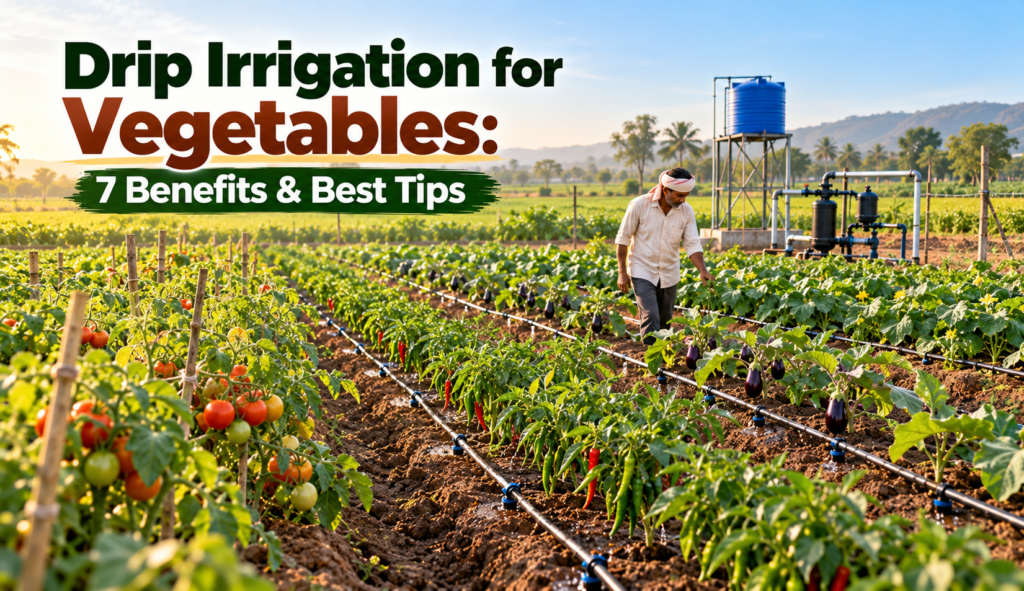
Drip irrigation supplies small quantities of water at controlled intervals near the plant roots instead of flooding the entire field. A typical system includes a water source, pump, filter, mainline, sub-main, lateral pipes, valves and emitters.
The system should be selected according to crop spacing, soil type, water quality, field size and irrigation requirement. Government micro-irrigation guidelines also highlight these factors when determining the appropriate drip system.
For vegetable growers, the major advantage is better control over when and where irrigation water is applied.
Drip Irrigation Cost for Vegetable Farming
The drip irrigation cost varies considerably depending on the crop, plant spacing, farm size, water source, filtration requirements, pipe quality and installation conditions.
The latest PMKSY micro-irrigation operational guidelines available through the government portal provide indicative system costs based on spacing and area. For example, the 2023 guidelines list indicative costs for closely spaced systems, including approximately ₹71,733 per hectare at 2.5 × 0.6 m spacing and ₹127,501 per hectare at 1.2 × 0.6 m or lower spacing for subsidy-calculation purposes. These figures are not universal market quotations and should not be treated as the final installation price.
Farmers should obtain a field-specific quotation before installation because actual expenses can differ by location and system design.
7 Major Benefits of Drip Irrigation
- Better Water Management
Drip systems apply water close to the root zone, helping farmers avoid unnecessary wetting of spaces between crop rows. This makes irrigation more targeted than conventional surface methods.
ICAR research and demonstrations have highlighted micro irrigation and drip fertigation as useful approaches for improving water and nutrient-use efficiency.
- Suitable for Water-Saving Agriculture
Water scarcity and irregular rainfall are increasingly important concerns for farmers. Drip irrigation can support water-saving agriculture by allowing irrigation to be scheduled according to crop and soil requirements.
Combining drip with mulching can further help conserve soil moisture and control weeds. ICAR has documented vegetable production systems using drip irrigation, supplemental irrigation and mulching in water-limited conditions.
- Efficient Fertigation
One of the important advantages of drip irrigation is fertigation, where soluble nutrients are delivered through the irrigation system.
Instead of applying all fertilizer across the field, nutrients can be supplied closer to the active root zone. PMKSY guidelines specifically recognize fertigation as an important component for obtaining the maximum benefits from micro irrigation.
- More Uniform Crop Growth
Properly designed emitters can provide relatively consistent water delivery across crop rows. Uniform moisture conditions can support more consistent plant development, particularly in vegetable crops where water stress can affect flowering, fruit development and quality.
However, uniformity depends on correct system design, adequate filtration and regular maintenance.
- Reduced Weed Pressure
Because drip irrigation concentrates water around the crop root zone rather than wetting the entire soil surface, some areas between rows may remain comparatively dry. This can reduce favourable conditions for weeds when combined with appropriate weed-management practices.
Drip irrigation should therefore be considered as one part of an integrated vegetable crop-management strategy rather than a standalone weed-control solution.
- Supports Precision Farming
Modern precision irrigation increasingly combines irrigation systems with soil-moisture monitoring, weather information, automated valves and fertigation management.
For larger farms, sensors and automated irrigation controllers can help farmers make more informed decisions about irrigation timing. Such approaches fit into the broader movement toward climate-smart and resource-efficient agriculture.
- Potentially Lower Input Losses
When water and nutrients are applied close to the root zone and according to crop requirements, unnecessary losses can be reduced. This can improve the efficiency of irrigation and fertilizer use.
Recent ICAR work on subsurface drip fertigation has also emphasized improved water and nutrient-use efficiency and reduced labour requirements.
Best Practices for Drip Irrigation in Vegetable Crops
Farmers should follow a few important practices to keep the system efficient:
- Filter irrigation water properly to reduce emitter clogging.
- Check emitters regularly for blockage or uneven discharge.
- Use fertigation carefully and follow crop-specific fertilizer recommendations.
- Schedule irrigation according to soil moisture and crop stage, rather than using the same schedule throughout the season.
- Inspect pipes and connections for leakage.
- Flush laterals periodically to remove accumulated particles.
- Combine drip irrigation with mulching where suitable to conserve soil moisture.
- Monitor water quality, especially where irrigation water contains high sediment or dissolved salts.
Correct maintenance is essential because clogged emitters can create uneven irrigation and reduce the expected benefits of the system.
Drip Irrigation Subsidy and Government Support
Farmers may be eligible for financial assistance under government micro-irrigation programmes, subject to the applicable state and scheme conditions.
The PMKSY micro-irrigation guidelines state that assistance can cover different types of drip systems, including online and inline systems, while the actual assistance and eligible components depend on the applicable rules.
Before investing, farmers should check with their state agriculture or horticulture department for the current subsidy rules, approved suppliers, eligible crops and application procedure.
Is Drip Irrigation Worth It for Vegetable Farming?
Drip irrigation can be a practical investment for vegetable farmers who need better control over irrigation, especially where water availability is limited or crops require frequent and targeted watering. Its benefits can increase when the system is combined with fertigation, mulching, soil-moisture monitoring and proper crop management.
The key is to choose the system according to crop spacing, soil, water quality, farm size and local conditions rather than selecting equipment only on the basis of price.
As Indian agriculture moves toward water-saving irrigation, precision farming and climate-smart agriculture, properly managed drip systems can play an important role in improving resource-use efficiency in vegetable production.